World Journal of Emergency Medicine ›› 2023, Vol. 14 ›› Issue (2): 122-127.doi: 10.5847/wjem.j.1920-8642.2023.032
• Original Articles • Previous Articles Next Articles
Jee Yen Kuck( ), Abdul Muhaimin Noor Azhar, Neena Wee, Rishya Manikam
Received:2022-06-29
Online:2023-03-03
Published:2023-03-01
Contact:
Jee Yen Kuck
E-mail:jeeyenk@yahoo.co.uk
Jee Yen Kuck, Abdul Muhaimin Noor Azhar, Neena Wee, Rishya Manikam. Diagnostic accuracy of the tongue blade test combined with clinical signs to detect maxillary and mandibular fractures in the emergency department[J]. World Journal of Emergency Medicine, 2023, 14(2): 122-127.
Add to citation manager EndNote|Ris|BibTeX
URL: http://wjem.com.cn/EN/10.5847/wjem.j.1920-8642.2023.032
Table 1.
Demographic data of enrolled patients with facial injuries
| Characteristics | Values | |
|---|---|---|
| Age, years, median (IQR) | 32 (23.00-50.25) | |
| Gender, n (%) Male Female | 74 (75.5) 24 (24.5) | |
| Occupation, n (%) Professional Non-professional Unemployed | 26 (26.5) 42 (42.9) 30 (30.6) | |
| Mechanism of injury, n (%) Road traffic accident Fall Assault Struck by object Burn/explosion | 63 (64.3) 25 (25.5) 6 (6.1) 3 (3.1) 1 (1.0) | |
| Location of facial injury, n (%) Maxillary region Mandibular region Both region | Fracture | Soft tissue injury |
| 31 (31.6) 9 (9.2) 0 (0.0) | 32 (32.7) 13 (13.3) 13 (13.3) | |
| Referral to OMFS, n (%) Maxillary fracture Mandibular fracture Soft tissue injury | 31 (100) 9 (100) 23 (39.7) | |
Table 2.
Clinical findings associated with fracture, maxillary and mandibular fracture versus soft tissue injury
| Clinical findings | Fracture (n=40) | STI (n=58) | OR | P-value |
|---|---|---|---|---|
| Total | ||||
| Swelling | 34 | 36 | 3.46 | 0.014** |
| Malocclusion | 5 | 0 | 18.13 | 0.006* |
| Facial asymmetry | 5 | 6 | 1.24 | 0.740** |
| Laceration | 8 | 16 | 0.66 | 0.391** |
| Tenderness on palpation | 38 | 43 | 6.63 | 0.007** |
| Ecchymosis and bruises | 21 | 28 | 1.18 | 0.681** |
| Abrasion | 20 | 32 | 0.81 | 0.614** |
| TBT | 17 | 4 | 9.98 | <0.001** |
| Malocclusion + tenderness on palpation + TBT | 5 | 0 | 18.13 | 0.006* |
| Maxillary region | (n=31) | (n=45) | ||
| Swelling | 26 | 31 | 2.35 | 0.138** |
| Malocclusion | 2 | 0 | 7.71 | 0.084* |
| Facial asymmetry | 2 | 6 | 0.45 | 0.337* |
| Laceration | 4 | 12 | 0.41 | 0.148* |
| Tenderness on palpation | 29 | 36 | 3.63 | 0.099** |
| Ecchymosis and bruises | 20 | 25 | 1.45 | 0.435** |
| Abrasion | 17 | 28 | 0.74 | 0.520** |
| TBT | 9 | 3 | 5.73 | 0.009* |
| Malocclusion + tenderness on palpation + TBT | 2 | 0 | 7.71 | 0.084* |
| Tenderness on palpation + swelling + TBT | 6 | 1 | 10.56 | 0.011* |
| Tenderness on palpation + TBT | 9 | 3 | 5.73 | 0.009* |
| Tenderness on palpation + swelling | 24 | 25 | 2.74 | 0.290* |
| Mandibular region | (n=9) | (n=26) | ||
| Swelling | 8 | 17 | 4.24 | 0.179** |
| Malocclusion | 3 | 0 | 28.54 | 0.002** |
| Facial asymmetry | 3 | 2 | 6.00 | 0.058* |
| Laceration | 4 | 10 | 1.28 | 0.752* |
| Tenderness on palpation | 9 | 16 | 12.09 | 0.028** |
| Ecchymosis and bruises | 1 | 10 | 0.20 | 0.128* |
| Abrasion | 3 | 14 | 0.43 | 0.289* |
| TBT | 8 | 2 | 96.00 | <0.001* |
| Malocclusion + tenderness on palpation + TBT | 3 | 0 | 28.54 | 0.002* |
| Tenderness on palpation + swelling + TBT | 7 | 1 | 87.50 | <0.001* |
| Tenderness on palpation + TBT | 8 | 2 | 96.00 | <0.001* |
| Tenderness on palpation + swelling | 8 | 13 | 8.00 | 0.040* |
Table 3.
Diagnostic accuracy of clinical examinations for fracture, maxillary fracture and mandibular fracture
| Physical examinations | Sensitivity (%) (95% CI) | Specificity (%) (95% CI) | PPV (%) (95% CI) | NPV (%) (95% CI) | +LR (95% CI) | -LR (95% CI) |
|---|---|---|---|---|---|---|
| Fracture | ||||||
| Swelling | 85.0 (70.2-94.3) | 37.9 (25.5-51.6) | 48.6 (42.6-54.6) | 78.6 (62.0-89.2) | 1.4 (1.1-1.7) | 0.4 (0.2-0.9) |
| Malocclusion | 12.5 (4.2-26.8) | 100 (93.8-100) | 100 (46.3-100) | 62.4 (59.6-65.1) | ∞ | 0.9 (0.8-0.9) |
| Facial asymmetry | 12.5 (4.2-26.8) | 89.7 (78.8-96.1) | 45.5 (21.4-71.8) | 59.8 (56.2-63.2) | 1.2 (0.4-3.7) | 1.0 (0.8-1.1) |
| Laceration | 20.0 (9.1-35.7) | 72.4 (59.1-83.3) | 33.3 (19.2-51.4) | 56.8 (51.3-62.1) | 0.7 (0.3-1.5) | 1.1 (0.9-1.3) |
| Tenderness on palpation | 95.0 (83.1-99.4) | 25.9 (15.3-39.0) | 46.9 (42.8-51.1) | 88.2 (64.5-96.9) | 1.3 (1.1-1.5) | 0.2 (0.1-0.8) |
| Ecchymosis and bruises | 52.5 (36.1-68.5) | 51.7 (38.2-65.1) | 42.9 (33.5-52.7) | 61.2 (51.2-70.4) | 1.1 (0.7-1.6) | 0.9 (0.6-1.4) |
| Abrasion | 50.0 (33.8-66.2) | 44.8 (31.7-58.5) | 38.5 (29.8-47.9) | 56.5 (46.0-66.5) | 0.9 (0.6-1.3) | 1.1 (0.7-1.7) |
| TBT | 42.5 (27.0-59.1) | 93.1 (83.3-98.1) | 81.0 (60.7-92.1) | 70.1 (64.1-75.6) | 6.2 (2.2-16.9) | 0.6 (0.5-0.8) |
| Malocclusion + tenderness on palpation + TBT | 12.5 (4.2-26.8) | 100 (93.8-100) | 100 (46.3-100) | 62.4 (59.6-65.1) | ∞ | 0.9 (0.8-1.0) |
| Maxillary fracture | ||||||
| Swelling | 83.9 (66.3-94.6) | 31.1 (18.2-46.7) | 45.6 (39.5-51.9) | 73.7 (52.9-87.5) | 1.2 (1.0-1.6) | 0.5 (0.2-1.3) |
| Malocclusion | 6.5 (0.8-21.4) | 100 (92.1-100) | 100 (19.8-100) | 60.8 (58.6-63.0) | ∞ | 0.9 (0.9-1.0) |
| Facial asymmetry | 6.5 (0.8-21.4) | 86.7 (73.2-95.0) | 25.0 (6.7-60.7) | 57.4 (53.7-60.9) | 0.5 (0.1-2.2) | 1.1 (0.9-1.3) |
| Laceration | 12.9 (3.6-29.8) | 73.3 (58.1-85.4) | 25.0 (10.6-48.4) | 55.0 (49.5-60.4) | 0.5 (0.2-1.4) | 1.2 (1.0-1.5) |
| Tenderness on palpation | 93.5 (78.6-99.2) | 20.0 (9.6-34.6) | 44.6 (40.4-48.9) | 81.8 (51.0-95.1) | 1.2 (1.0-1.4) | 0.3 (0.1-1.4) |
| Ecchymosis and bruises | 64.5 (45.4-80.8) | 44.4 (29.6-60.0) | 44.4 (35.6-53.7) | 64.5 (50.5-76.4) | 1.2 (0.8-1.7) | 0.8 (0.5-1.4) |
| Abrasion | 54.8 (36.0-72.7) | 37.8 (23.8-53.5) | 37.8 (29.1-47.3) | 54.8 (41.5-67.6) | 0.9 (0.6-1.3) | 1.2 (0.7-2.1) |
| TBT | 29.0 (14.2-48.0) | 93.3 (81.7-98.6) | 75.0 (46.9-91.1) | 65.6 (60.1-70.8) | 4.4 (1.3-14.8) | 0.8 (0.6-1.0) |
| Malocclusion + tenderness on palpation + TBT | 6.5 (0.8-21.4) | 100 (92.1-100) | 100 (19.8-100) | 60.8 (58.6-63.0) | ∞ | 0.9 (0.9-1.0) |
| Tenderness on palpation + swelling + TBT | 19.4 (7.5-37.5) | 97.8 (88.2-99.9) | 85.7 (43.2-97.9) | 63.8 (59.6-67.8) | 8.7 (1.1-68.8) | 0.8 (0.7-1.0) |
| Tenderness on palpation + TBT | 29.0 (14.2-48.0) | 93.3 (81.7-98.6) | 75.0 (46.9-91.1) | 65.6 (60.1-70.8) | 4.4 (1.3-14.8) | 0.8 (0.6-1.0) |
| Mandibular fracture | ||||||
| Swelling | 88.9 (51.8-99.7) | 34.6 (17.2-55.7) | 32.0 (24.7-40.4) | 90.0 (56.8-98.4) | 1.4 (1.0-2.0) | 0.3 (0.1-2.2) |
| Malocclusion | 33.3 (7.5-70.1) | 100 (86.8-100) | 100 (31.0-100) | 81.3 (73.2-87.3) | ∞ | 0.7 (0.4-1.1) |
| Facial asymmetry | 33.3 (7.5-70.1) | 92.3 (74.9-99.1) | 60.0 (22.9-88.4) | 80.0 (71.3-86.6) | 4.3 (0.9-21.9) | 0.7 (0.5-1.2) |
| Laceration | 44.4 (13.7-78.8) | 61.5 (40.6-79.8) | 28.6 (14.3-49.0) | 76.2 (62.4-86.1) | 1.2 (0.5-2.8) | 0.9 (0.5-1.7) |
| Tenderness on palpation | 100 (66.4-100) | 38.5 (20.2-59.4) | 36.0 (29.3-43.3) | 100 (65.5-100) | 1.6 (1.2-2.2) | 1/∞ |
| Ecchymosis and bruises | 11.1 (0.3-48.3) | 61.5 (40.6-79.8) | 9.1 (1.5-40.3) | 66.7 (57.7-74.6) | 0.3 (0.0-2.0) | 1.4 (1.0-2.1) |
| Abrasion | 33.3 (7.5-70.1) | 46.2 (26.6-66.6) | 17.6 (7.4-36.6) | 66.7 (51.8-78.8) | 0.6 (0.2-1.7) | 1.4 (0.8-2.7) |
| TBT | 88.9 (51.8-99.7) | 92.3 (74.9-99.1) | 80.0 (50.9-93.9) | 96.0 (79.0-99.4) | 11.6 (3.0-44.6) | 0.1 (0.0-0.8) |
| Malocclusion + tenderness on palpation + TBT | 33.3 (7.5-70.1) | 100 (86.8-100) | 100 (31.0-100) | 81.3 (73.2-87.3) | ∞ | 0.7 (0.4-1.1) |
| Tenderness on palpation + swelling + TBT | 77.8 (40.0-97.2) | 96.2 (80.4-99.9) | 87.5 (49.8-98.0) | 92.6 (78.6-97.7) | 20.2 (2.9-142.6) | 0.2 (0.1-0.8) |
| Tenderness on palpation + TBT | 88.9 (51.8-99.7) | 92.3 (74.9-99.1) | 80.0 (50.9-93.9) | 96.0 (92.3-99.8) | 11.6 (3.0-44.6) | 0.1 (0.0-0.8) |
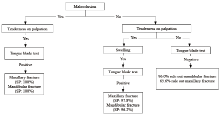
Figure 1.
Algorithm for maxillary and mandibular fractures. SP: specificity.
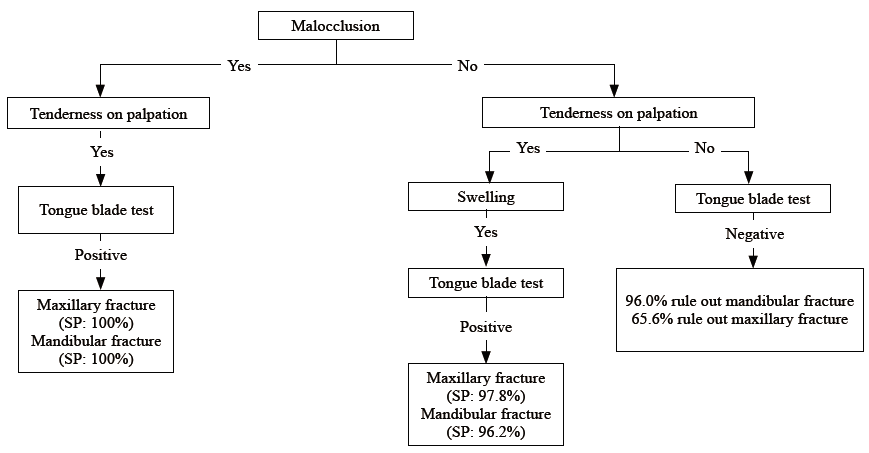
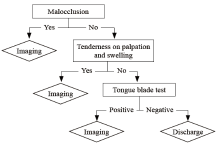
Figure 2.
Clinical decision tool for mandibular fractures.

| [1] |
Al-Hassani A, Ahmad K, El-Menyar A, Abutaka A, Mekkodathil A, Peralta R, et al. Prevalence and patterns of maxillofacial trauma: a retrospective descriptive study. Eur J Trauma Emerg Surg. 2022; 48(4):2513-9.
doi: 10.1007/s00068-019-01174-6 |
| [2] |
Rahman RA, Hussaini HM, Rahman NA, Rahman SR, Nor GM, Ai Idrus SM, et al. Facial fractures in Kajang Hospital, Malaysia: a 5-year review. Eur J Trauma Emerg Surg. 2007; 33(1):90-5.
doi: 10.1007/s00068-007-5154-5 |
| [3] | Qiu M, Barberi A, Lee K. Facial trauma: epidemiology, demographics and fracture patterns. Int J Oral Maxillofac Surg. 2017; 46:234-5. |
| [4] |
Caputo ND, Raja A, Shields C, Menke N. Re-evaluating the diagnostic accuracy of the tongue blade test: still useful as a screening tool for mandibular fractures? J Emerg Med. 2013; 45(1):8-12.
doi: 10.1016/j.jemermed.2012.11.078 pmid: 23490109 |
| [5] |
Alonso LL, Purcell TB. Accuracy of the tongue blade test in patients with suspected mandibular fracture. J Emerg Med. 1995; 13(3):297-304.
pmid: 7673618 |
| [6] |
Malhotra R, Dunning J. The utility of the tongue blade test for the diagnosis of mandibular fracture. Emerg Med J. 2003; 20(6):552-3.
pmid: 14623851 |
| [7] |
Neiner J, Free R, Caldito G, Moore-Medlin T, Nathan CA. Tongue blade bite test predicts mandible fractures. Craniomaxillofac Trauma Reconstr. 2016; 9(2):121-4.
doi: 10.1055/s-0035-1567812 pmid: 27162567 |
| [8] |
Schwab RA, Genners K, Robinson WA. Clinical predictors of mandibular fractures. Am J Emerg Med. 1998; 16(3):304-5.
pmid: 9596439 |
| [9] |
Rozema R, El Moumni M, de Vries GT, Spijkervet FKL, Verbeek R, Kleinbergen JYJ, et al. REDUCTION study group. A clinical decision aid to discern patients without and with midfacial and mandibular fractures that require treatment (the REDUCTION-II study): a prospective multicentre cohort study. Eur J Trauma Emerg Surg. 2022; 48(4):2547-58.
doi: 10.1007/s00068-022-01892-4 |
| [10] |
Hajian-Tilaki K. Sample size estimation in diagnostic test studies of biomedical informatics. J Biomed Inform. 2014; 48:193-204.
doi: 10.1016/j.jbi.2014.02.013 pmid: 24582925 |
| [1] | Ahmed Faidh Ramzee, Ayman El-Menyar, Mohammad Asim, Ahad Kanbar, Khalid Ahmed, Bahaa Daoud, Saji Mathradikkal, Ahmad Kloub, Hassan Al-Thani, Sandro Rizoli. The impact of emergency department length of stay on the outcomes of trauma patients requiring hospitalization: a retrospective observational study [J]. World Journal of Emergency Medicine, 2023, 14(2): 96-105. |
| [2] | Guang-mei Wang, Yong Li, Shuo Wu, Wen Zheng, Jing-jing Ma, Feng Xu, Jia-qi Zheng, He Zhang, Jia-li Wang, Yu-guo Chen. The combination of creatine kinase-myocardial band isoenzyme and point-of-care cardiac troponin/ contemporary cardiac troponin for the early diagnosis of acute myocardial infarction [J]. World Journal of Emergency Medicine, 2022, 13(3): 163-168. |
| [3] | Ittai Shichman, Or Shaked, Shai Factor, Ahuva Weiss-Meilik, Amal Khoury. Emergency department electric scooter injuries after the introduction of shared e-scooter services: A retrospective review of 3,331 cases [J]. World Journal of Emergency Medicine, 2022, 13(1): 5-10. |
| [4] | Ralphe Bou Chebl, Nader El Souki, Mirabelle Geha, Imad Majzoub, Rima Kaddoura, Hady Zgheib. Two-point compression ultrasonography: Enough to rule out lower extremity deep venous thrombosis? [J]. World Journal of Emergency Medicine, 2021, 12(4): 268-273. |
| [5] | Lori Stolz, Elaine Situ-LaCasse, Josie Acuña, Matthew Thompson, Nicolaus Hawbaker, Josephine Valenzuela, Uwe Stolz, Srikar Adhikari. What is the ideal approach for emergent pericardiocentesis using point-of-care ultrasound guidance? [J]. World Journal of Emergency Medicine, 2021, 12(3): 169-173. |
| [6] | Kasım Turgut, Erdal Yavuz, Mine Kayacı Yıldız, Mehmet Kaan Poyraz. Violence toward emergency physicians: A prospective-descriptive study [J]. World Journal of Emergency Medicine, 2021, 12(2): 111-116. |
| [7] | Marin Pavlov, Lucija Klobučar, Iva Klobučar, Kristina Žgela, Vesna Degoricija. Does shifting to professional emergency department staffing affect the decision for chest radiography? [J]. World Journal of Emergency Medicine, 2021, 12(2): 87-92. |
| [8] | Hady Zgheib, Aline El Zakhem, Cynthia Wakil, Mohamad Ali Cheaito, Rola Cheaito, Antoine Finianos, Ralphe Bou Chebl, Rima Kaddoura, Nader Al Souky, Imad El Majzoub. Role of urine studies in asymptomatic febrile neutropenic patients presenting to the emergency department [J]. World Journal of Emergency Medicine, 2021, 12(2): 99-104. |
| [9] | William Gilliam, Jackson F. Barr, Brandon Bruns, Brandon Cave, Jordan Mitchell, Tina Nguyen, Jamie Palmer, Mark Rose, Safura Tanveer, Chris Yum, Quincy K. Tran. Factors associated with refractory pain in emergency patients admitted to emergency general surgery [J]. World Journal of Emergency Medicine, 2021, 12(1): 12-17. |
| [10] | Rebekah Shaw, Erica Popovsky, Alyssa Abo, Marni Jacobs, Nicole Herrera, James Chamberlain, Andrea Hahn. Improving antibiotic prescribing in the emergency department for uncomplicated community-acquired pneumonia [J]. World Journal of Emergency Medicine, 2020, 11(4): 199-205. |
| [11] | Hai-jiang Zhou, Tian-fei Lan, Shu-bin Guo. Outcome prediction value of National Early Warning Score in septic patients with community-acquired pneumonia in emergency department: A single-center retrospective cohort study [J]. World Journal of Emergency Medicine, 2020, 11(4): 206-215. |
| [12] | Chuan-qi Ding, Yu-ping Zhang, Yu-wei Wang, Min-fei Yang, Sa Wang, Nian-qi Cui, Jing-fen Jin. Death and do-not-resuscitate order in the emergency department: A single-center three-year retrospective study in the Chinese mainland [J]. World Journal of Emergency Medicine, 2020, 11(4): 231-237. |
| [13] | Maybritt I. Kuypers, Adinda Klijn, Nieke E. Mullaart-Jansen, Frans B. Plötz. Availability and quality of procedural sedation and analgesia in emergency departments without emergency physicians: A national survey in the Netherlands [J]. World Journal of Emergency Medicine, 2020, 11(2): 69-73. |
| [14] | Emily Shao, Chantelle Judge, Erin McMeniman, Tina Bazianas, Rob Eley. Presenting patterns of dermatology conditions to an Australian emergency department [J]. World Journal of Emergency Medicine, 2020, 11(2): 74-78. |
| [15] | Zhenghong Liu, Mingwei Ng, Dinesh V. Gunasekeran, Huihua Li, Kishanti Ponampalam, R Ponampalam. Mobile technology: Usage and perspective of patients and caregivers presenting to a tertiary care emergency department [J]. World Journal of Emergency Medicine, 2020, 11(1): 5-11. |
| Viewed | ||||||
|
Full text |
|
|||||
|
Abstract |
|
|||||

