World Journal of Emergency Medicine ›› 2022, Vol. 13 ›› Issue (5): 367-372.doi: 10.5847/wjem.j.1920-8642.2022.072
• Original Articles • Previous Articles Next Articles
Shi-yuan Yu1, Zeng-zheng Ge1, Jun Xiang2, Yan-xia Gao3, Xin Lu1, Joseph Harold Walline4, Mu-bing Qin1, Hua-dong Zhu1, Yi Li1( )
)
Received:2021-12-19
Accepted:2022-04-20
Online:2022-08-23
Published:2022-09-01
Contact:
Yi Li
E-mail:billlyi@126.com
Shi-yuan Yu, Zeng-zheng Ge, Jun Xiang, Yan-xia Gao, Xin Lu, Joseph Harold Walline, Mu-bing Qin, Hua-dong Zhu, Yi Li. Is rosuvastatin protective against sepsis-associated encephalopathy? A secondary analysis of the SAILS trial[J]. World Journal of Emergency Medicine, 2022, 13(5): 367-372.
Add to citation manager EndNote|Ris|BibTeX
URL: http://wjem.com.cn/EN/10.5847/wjem.j.1920-8642.2022.072
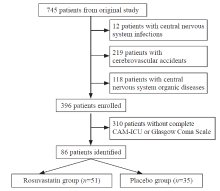
Figure 1.
Flow diagram. CAM-ICU: confusion assessment method for the intensive care unit.
Table 1.
Baseline characteristics of rosuvastatin and placebo groups
| Parameters | Rosuvastatin group (n=51) | Placebo group (n=35) | P-value |
|---|---|---|---|
| Male sex | 30 (58.8) | 13 (37.1) | 0.078 |
| Age, year | 55 (37.2-75.6) | 56 (39.5-73.4) | 0.737 |
| Heart rate, beats/min* | 112±24 | 98±19 | 0.201 |
| Mean arterial pressure, mmHg* | 75 (69.3-83.5) | 76 (71.2-92.5) | 0.312 |
| Respiratory rate, breaths/min* | 29.0±9.2 | 25.0±10.5 | 0.197 |
| Statin administration prior to enrollment | 11 (21.5) | 6 (16.1) | 0.189 |
| Sequential organ failure assessment (SOFA) score | 4.6±3.2 | 5.1±4.6 | 0.061 |
| APACHE II score | 16.2±8.1 | 18.9±8.5 | 0.243 |
| Glasgow Coma Scale | 10.1±3.4 | 9.5±3.4 | 0.515 |
| Infection site | |||
| Thorax | 44 (86.3) | 31 (88.6) | 0.754 |
| Abdomen | 6 (11.8) | 5 (14.3) | 0.317 |
| Skin or soft tissue | 2 (3.9) | 1 (2.8) | 0.792 |
| Urinary tract | 3 (5.8) | 1 (2.8) | 0.500 |
| Other | 4 (7.8) | 3 (8.4) | 0.903 |
| Underlying disease | |||
| Diabetes mellitus | 13 (25.5) | 9 (25.7) | 0.981 |
| Hypertension | 30 (58.8) | 17 (48.6) | 0.348 |
| Myocardial infarction | 3 (5.8) | 2 (5.6) | 0.974 |
| Requiring renal replacement therapy | 0 | 1 (2.8) | 0.178 |
| Hepatic failure | 1 (1.9) | 0 | 0.405 |
| Chronic pulmonary disease | 5 (9.5) | 6 (17.1) | 0.317 |
| Laboratory tests | |||
| PLT, ×105/µL* | 1.6±0.2 | 1.2±0.5 | 0.212 |
| WBC, ×103/µL* | 15.2±6.3 | 13.9±5.1 | 0.381 |
| Hb, g/dL* | 11.2±2.2 | 12.5±3.5 | 0.765 |
| Cr, µmol/L* | 133±26 | 125±19 | 0.625 |
| BUN, mmol/L* | 9.3±5.6 | 8.6±4.2 | 0.286 |
| CK, U/L | 178 (22-755) | 233 (18-1,325) | 0.701 |
| ALT, U/L | 42 (12-96) | 39 (8-102) | 0.599 |
| AST, U/L | 57 (10-122) | 37 (14-98) | 0.221 |
| Antibiotics | |||
| Daptomycin | 3 (5.8) | 1 (2.8) | 0.643 |
| Atazanavir | 1 (1.9) | 1 (2.8) | 0.659 |
| Ritonavir | 1 (1.9) | 0 | 0.593 |
| Vasoactive drugs | |||
| Dobutamine | 4 (7.8) | 3 (8.5) | 0.481 |
| Dopamine | 2 (3.9) | 3 (8.5) | 0.385 |
| Epinephrine | 0 | 0 | 1.000 |
| Norepinephrine | 2 (3.9) | 1 (2.8) | 0.640 |
| Other medications | |||
| Narcotics | 28 (54.9) | 19 (54.3) | 0.833 |
| Paralytics | 2 (3.9) | 2 (5.6) | 0.833 |
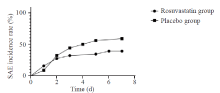
Figure 2.
Sepsis-associated encephalopathy (SAE) incidence curve.
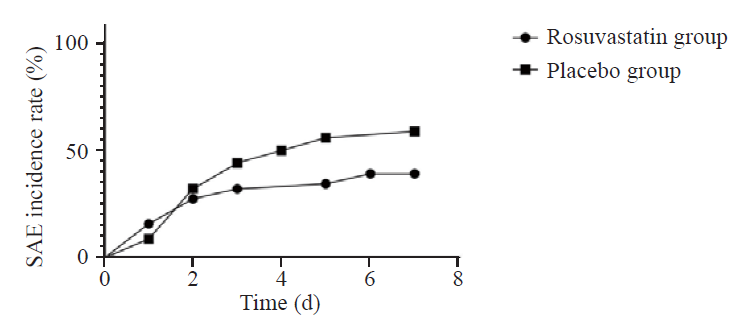
Table 2.
Outcomes in the rosuvastatin and placebo groups
| Parameters | Rosuvastatin group (n=51) | Placebo group (n=35) | P-value |
|---|---|---|---|
| SAE | 17 (33.3) | 20 (57.1) | 0.028 |
| Death | 14 (27.5) | 4 (11.4) | 0.106 |
| Hospital stay, d | 11.2±9.0 | 11.7±9.7 | 0.811 |
| ICU stay, d | 5.5±4.4 | 5.7±3.7 | 0.815 |
| Adverse events | |||
| CK, U/L | 223 (22-689) | 79 (12-206) | 0.034 |
| ALT, U/L | 39 (8-105) | 41 (11-98) | 0.747 |
| AST, U/L | 34 (13-145) | 14 (4-76) | 1.000 |
| 1 |
Singer M, Deutschman CS, Seymour CW, Shankar-Hari M, Annane D, Bauer M, et al. The third international consensus definitions for sepsis and septic shock (Sepsis-3). JAMA. 2016; 315(8): 801-10.
doi: 10.1001/jama.2016.0287 |
| 2 |
Page VJ, Ely EW, Gates S, Zhao XB, Alce T, Shintani A, et al. Effect of intravenous haloperidol on the duration of delirium and coma in critically ill patients (Hope-ICU): a randomised, double-blind, placebo-controlled trial. Lancet Respir Med. 2013; 1(7): 515-23.
doi: 10.1016/S2213-2600(13)70166-8 |
| 3 |
Molnár L, Fülesdi B, Németh N, Molnár C. Sepsis-associated encephalopathy: a review of literature. Neurol India. 2018; 66(2): 352-61.
doi: 10.4103/0028-3886.227299 |
| 4 |
Eidelman LA, Putterman D, Putterman C, Sprung CL. The spectrum of septic encephalopathy. Definitions, etiologies, and mortalities. JAMA. 1996; 275(6): 470-3.
doi: 10.1001/jama.1996.03530300054040 |
| 5 |
Pandharipande PP, Girard TD, Jackson JC, Morandi A, Thompson JL, Pun BT, et al. Long-term cognitive impairment after critical illness. N Engl J Med. 2013; 369(14): 1306-16.
doi: 10.1056/NEJMoa1301372 |
| 6 | Polito A, Eischwald F, Maho AL, Polito A, Azabou E, Annane D, et al. Pattern of brain injury in the acute setting of human septic shock. Crit Care. 2013; 17(5): R204. |
| 7 |
Sharshar T, Hopkinson NS, Orlikowski D, Annane D. Science review: the brain in sepsis—culprit and victim. Crit Care. 2005; 9(1): 37-44.
doi: 10.1186/cc2951 |
| 8 | Wintermann GB, Brunkhorst FM, Petrowski K, Strauss B, Oehmichen F, Pohl M, et al. Stress disorders following prolonged critical illness in survivors of severe sepsis. Crit Care Med. 2015; 43(6): 1213-22. |
| 9 |
Iwashyna TJ, Ely EW, Smith DM, Langa KM. Long-term cognitive impairment and functional disability among survivors of severe sepsis. JAMA. 2010; 304(16): 1787-94.
doi: 10.1001/jama.2010.1553 |
| 10 |
Ren C, Yao RQ, Zhang H, Feng YW, Yao YM. Sepsis-associated encephalopathy: a vicious cycle of immunosuppression. J Neuroinflammation. 2020; 17(1): 14.
doi: 10.1186/s12974-020-1701-3 |
| 11 |
Prinz V, Endres M. The acute (cerebro)vascular effects of statins. Anesth Analg. 2009; 109(2): 572-84.
doi: 10.1213/ane.0b013e3181a85d0e |
| 12 |
McGown CC, Brookes ZLS. Beneficial effects of statins on the microcirculation during sepsis: the role of nitric oxide. Br J Anaesth. 2007; 98(2): 163-75.
doi: 10.1093/bja/ael358 |
| 13 |
Zhang JY, Cheng X, Liao YH, Lu BJ, Yang YL, Li B, et al. Simvastatin regulates myocardial cytokine expression and improves ventricular remodeling in rats after acute myocardial infarction. Cardiovasc Drugs Ther. 2005; 19(1): 13-21.
doi: 10.1007/s10557-005-6893-3 |
| 14 |
Cortese F, Gesualdo M, Cortese A, Carbonara S, Devito F, Zito A, et al. Rosuvastatin: beyond the cholesterol-lowering effect. Pharmacol Res. 2016; 107: 1-18.
doi: 10.1016/j.phrs.2016.02.012 |
| 15 |
González N, Moreno-Villegas Z, González-Bris A, Egido J, Lorenzo Ó. Regulation of visceral and epicardial adipose tissue for preventing cardiovascular injuries associated to obesity and diabetes. Cardiovasc Diabetol. 2017; 16(1): 44.
doi: 10.1186/s12933-017-0528-4 pmid: 28376896 |
| 16 | Janda S, Young A, FitzGerald JM, Etminan M, Swiston J. The effect of statins on mortality from severe infections and sepsis: a systematic review and meta-analysis. J Crit Care. 2010; 25(4): 656.e7-656.e22. |
| 17 |
National Heart L, Truwit JD, Bernard GR, Steingrub J, Matthay MA, Liu KD, et al. Rosuvastatin for sepsis-associated acute respiratory distress syndrome. N Engl J Med. 2014; 370(23): 2191-200.
doi: 10.1056/NEJMoa1401520 |
| 18 |
Kopterides P, Falagas ME. Statins for sepsis: a critical and updated review. Clin Microbiol Infect. 2009; 15(4): 325-34.
doi: 10.1111/j.1469-0691.2009.02750.x |
| 19 |
Kruger P, Fitzsimmons K, Cook D, Jones M, Nimmo G. Statin therapy is associated with fewer deaths in patients with bacteraemia. Intensive Care Med. 2006; 32(1): 75-9.
doi: 10.1007/s00134-005-2859-y |
| 20 |
Kim N, Kim C, Ryu SH, Lee W, Bae JS. Anti-septic functions of cornuside against HMGB1-mediated severe inflammatory responses. Int J Mol Sci. 2022; 23(4): 2065.
doi: 10.3390/ijms23042065 |
| 21 |
Almog Y, Shefer A, Novack V, Maimon N, Barski L, Eizinger M, et al. Prior statin therapy is associated with a decreased rate of severe sepsis. Circulation. 2004; 110(7): 880-5.
doi: 10.1161/01.CIR.0000138932.17956.F1 |
| 22 |
Thomsen RW, Hundborg HH, Johnsen SP, Pedersen L, Sørensen HT, Schønheyder HC, et al. Statin use and mortality within 180 days after bacteremia: a population-based cohort study. Crit Care Med. 2006; 34(4): 1080-6.
pmid: 16484926 |
| 23 |
Page VJ, Davis D, Zhao XB, Norton S, Casarin A, Brown T, et al. Statin use and risk of delirium in the critically ill. Am J Respir Crit Care Med. 2014; 189(6): 666-73.
doi: 10.1164/rccm.201306-1150OC |
| 24 |
Morandi A, Hughes CG, Thompson JL, Pandharipande PP, Shintani AK, Vasilevskis EE, et al. Statins and delirium during critical illness: a multicenter, prospective cohort study. Crit Care Med. 2014; 42(8): 1899-909.
doi: 10.1097/CCM.0000000000000398 |
| 25 |
Needham DM, Colantuoni E, Dinglas VD, Hough CL, Wozniak AW, Jackson JC, et al. Rosuvastatin versus placebo for delirium in intensive care and subsequent cognitive impairment in patients with sepsis-associated acute respiratory distress syndrome: an ancillary study to a randomised controlled trial. Lancet Respir Med. 2016; 4(3): 203-12.
doi: 10.1016/S2213-2600(16)00005-9 pmid: 26832963 |
| 26 |
Felici N, Liu D, Maret J, Restrepo M, Borovskiy Y, Hajj J, et al. Long-term abnormalities of lipid profile after a single episode of sepsis. Front Cardiovasc Med. 2021; 8: 674248.
doi: 10.3389/fcvm.2021.674248 |
| 27 |
Lee CC, Lee MTG, Hsu TC, Porta L, Chang SS, Yo CH, et al. A population-based cohort study on the drug-specific effect of statins on sepsis outcome. Chest. 2018; 153(4): 805-15.
doi: 10.1016/j.chest.2017.09.024 |
| 28 |
Fernandez R, de Pedro VJ, Artigas A. Statin therapy prior to ICU admission: protection against infection or a severity marker? Intensive Care Med. 2006; 32(1): 160-4.
doi: 10.1007/s00134-005-2743-9 |
| 29 |
Kor DJ, Iscimen R, Yilmaz M, Brown MJ, Brown DR, Gajic O. Statin administration did not influence the progression of lung injury or associated organ failures in a cohort of patients with acute lung injury. Intensive Care Med. 2009; 35(6): 1039-46.
doi: 10.1007/s00134-009-1421-8 |
| 30 |
Wang HF, Blumberg JB, Chen CY, Choi SW, Corcoran MP, Harris SS, et al. Dietary modulators of statin efficacy in cardiovascular disease and cognition. Mol Aspects Med. 2014; 38: 1-53.
doi: 10.1016/j.mam.2014.04.001 |
| 31 |
Strandberg TE. Role of statin therapy in primary prevention of cardiovascular disease in elderly patients. Curr Atheroscler Rep. 2019; 21(8): 28.
doi: 10.1007/s11883-019-0793-7 pmid: 31111235 |
| 32 |
Iovino F, Molema G, Bijlsma JJE. Platelet endothelial cell adhesion molecule-1, a putative receptor for the adhesion of Streptococcus pneumoniae to the vascular endothelium of the blood-brain barrier. Infect Immun. 2014; 82(9): 3555-66.
doi: 10.1128/IAI.00046-14 |
| 33 |
Kuperberg SJ, Wadgaonkar R. Sepsis-associated encephalopathy: the blood-brain barrier and the sphingolipid rheostat. Front Immunol. 2017; 8: 597.
doi: 10.3389/fimmu.2017.00597 pmid: 28670310 |
| 34 |
Bonsu KO, Reidpath DD, Kadirvelu A. Effects of statin treatment on inflammation and cardiac function in heart failure: an adjusted indirect comparison meta-analysis of randomized trials. Cardiovasc Ther. 2015; 33(6): 338-46.
doi: 10.1111/1755-5922.12150 |
| 35 |
Greenwood J, Steinman L, Zamvil SS. Statin therapy and autoimmune disease: from protein prenylation to immunomodulation. Nat Rev Immunol. 2006; 6(5): 358-70.
doi: 10.1038/nri1839 pmid: 16639429 |
| 36 |
Shahbaz SK, Sadeghi M, Koushki K, Penson PE, Sahebkar A. Regulatory T cells: possible mediators for the anti-inflammatory action of statins. Pharmacol Res. 2019; 149: 104469.
doi: 10.1016/j.phrs.2019.104469 |
| 37 |
Li JL, Li G, Jing XZ, Li YF, Ye QY, Jia HH, et al. Assessment of clinical sepsis-associated biomarkers in a septic mouse model. J Int Med Res. 2018; 46(6): 2410-22.
doi: 10.1177/0300060518764717 pmid: 29644918 |
| 38 |
Accardo Palumbo A, Forte GI, Pileri D, Vaccarino L, Conte F, D’Amelio L, et al. Analysis of IL-6, IL-10 and IL-17 genetic polymorphisms as risk factors for sepsis development in burned patients. Burns. 2012; 38(2): 208-13.
doi: 10.1016/j.burns.2011.07.022 pmid: 22079540 |
| 39 |
Gupta SC, Hevia D, Patchva S, Park B, Koh W, Aggarwal BB. Upsides and downsides of reactive oxygen species for cancer: the roles of reactive oxygen species in tumorigenesis, prevention, and therapy. Antioxid Redox Signal. 2012; 16(11): 1295-322.
doi: 10.1089/ars.2011.4414 |
| 40 |
Kim J, Lee H, An J, Song Y, Lee CK, Kim K, et al. Alterations in gut microbiota by statin therapy and possible intermediate effects on hyperglycemia and hyperlipidemia. Front Microbiol. 2019; 10: 1947.
doi: 10.3389/fmicb.2019.01947 |
| 41 |
Wang PF, Hu YY, Yao DH, Li YS. Omi/HtrA2 regulates a mitochondria-dependent apoptotic pathway in a murine model of septic encephalopathy. Cell Physiol Biochem. 2018; 49(6): 2163-73.
doi: 10.1159/000493819 |
| 42 |
Armitage J. The safety of statins in clinical practice. Lancet. 2007; 370(9601): 1781-90.
pmid: 17559928 |
| 43 |
Shitara Y, Sugiyama Y. Pharmacokinetic and pharmacodynamic alterations of 3-hydroxy-3-methylglutaryl coenzyme A (HMG-CoA) reductase inhibitors: drug-drug interactions and interindividual differences in transporter and metabolic enzyme functions. Pharmacol Ther. 2006; 112(1): 71-105.
doi: 10.1016/j.pharmthera.2006.03.003 |
| [1] | A-ling Tang, Mei-jia Shen, Guo-qiang Zhang. Intestinal microcirculation dysfunction in sepsis: pathophysiology, clinical monitoring, and therapeutic interventions [J]. World Journal of Emergency Medicine, 2022, 13(5): 343-348. |
| [2] | Xiao-kang Dai, Zhen-xing Ding, Yuan-yuan Tan, Hua-rui Bao, Dong-yao Wang, Hong Zhang. Neutrophils inhibit CD8+ T cells immune response by arginase-1 signaling in patients with sepsis [J]. World Journal of Emergency Medicine, 2022, 13(4): 266-273. |
| [3] | Xuan Fu, Xue Lin, Samuel Seery, Li-na Zhao, Hua-dong Zhu, Jun Xu, Xue-zhong Yu. Speckle-tracking echocardiography for detecting myocardial dysfunction in sepsis and septic shock patients: A single emergency department study [J]. World Journal of Emergency Medicine, 2022, 13(3): 175-181. |
| [4] | Mei-jia Shen, Li-chao Sun, Xiao-yu Liu, Meng-chen Xiong, Shan Li, A-ling Tang, Guo-qiang Zhang. Trichostatin A improves the inflammatory response and liver injury in septic mice through the FoxO3a/autophagy signaling pathway [J]. World Journal of Emergency Medicine, 2022, 13(3): 182-188. |
| [5] | Hai Hu, Jing-yuan Jiang, Ni Yao. Comparison of different versions of the quick sequential organ failure assessment for predicting in-hospital mortality of sepsis patients: A retrospective observational study [J]. World Journal of Emergency Medicine, 2022, 13(2): 114-119. |
| [6] | Li-wei Duan, Jin-long Qu, Jian Wan, Yong-hua Xu, Yi Shan, Li-xue Wu, Jin-hao Zheng, Wei-wei Jiang, Qi-tong Chen, Yan Zhu, Jian Zhou, Wen-bo Yu, Lei Pei, Xi Song, Wen-fang Li, Zhao-fen Lin. Effects of viral infection and microbial diversity on patients with sepsis: A retrospective study based on metagenomic next-generation sequencing [J]. World Journal of Emergency Medicine, 2021, 12(1): 29-35. |
| [7] | Hai-jiang Zhou, Tian-fei Lan, Shu-bin Guo. Outcome prediction value of National Early Warning Score in septic patients with community-acquired pneumonia in emergency department: A single-center retrospective cohort study [J]. World Journal of Emergency Medicine, 2020, 11(4): 206-215. |
| [8] | Yu-ming Wang, Yan-jun Zheng, Ying Chen, Yun-chuan Huang, Wei-wei Chen, Ran Ji, Li-li Xu, Zhi-tao Yang, Hui-qiu Sheng, Hong-ping Qu, En-qiang Mao, Er-zhen Chen. Effects of fluid balance on prognosis of acute respiratory distress syndrome patients secondary to sepsis [J]. World Journal of Emergency Medicine, 2020, 11(4): 216-222. |
| [9] | Miao Yuan, Ding-yi Yan, Fang-shi Xu, Yi-di Zhao, Yang Zhou, Long-fei Pan. Effects of sepsis on hippocampal volume and memory function [J]. World Journal of Emergency Medicine, 2020, 11(4): 223-230. |
| [10] | Wen-peng Yin, Jia-bao Li, Xiao-fang Zheng, Le An, Huan Shao, Chun-sheng Li. Effect of neutrophil CD64 for diagnosing sepsis in emergency department [J]. World Journal of Emergency Medicine, 2020, 11(2): 79-86. |
| [11] | Shao-hua Liu, Huo-yan Liang, Hong-yi Li, Xian-fei Ding, Tong-wen Sun, Jing Wang. Effect of low high-density lipoprotein levels on mortality of septic patients: A systematic review and meta-analysis of cohort studies [J]. World Journal of Emergency Medicine, 2020, 11(2): 109-116. |
| [12] | Yi-wen Fan, Shao-wei Jiang, Jia-meng Chen, Hui-qi Wang, Dan Liu, Shu-ming Pan, Cheng-jin Gao. A pulmonary source of infection in patients with sepsis-associated acute kidney injury leads to a worse outcome and poor recovery of kidney function [J]. World Journal of Emergency Medicine, 2020, 11(1): 18-26. |
| [13] | Kimberly A. Chambers, Adam Y. Park, Rosa C. Banuelos, Bryan F. Darger, Bindu H. Akkanti, Annamaria Macaluso, Manoj Thangam, Pratik B. Doshi. Outcomes of severe sepsis and septic shock patients after stratification by initial lactate value [J]. World Journal of Emergency Medicine, 2018, 9(2): 113-117. |
| [14] | Muhammad Akbar Baig, Hira Shahzad, Erfan Hussain, Asad Mian. Validating a point of care lactate meter in adult patients with sepsis presenting to the emergency department of a tertiary care hospital of a low- to middle-income country [J]. World Journal of Emergency Medicine, 2017, 8(3): 184-189. |
| [15] | Chao Cao, Tao Ma, Yan-fen Chai, Song-tao Shou. The role of regulatory T cells in immune dysfunction during sepsis [J]. World Journal of Emergency Medicine, 2015, 6(1): 5-9. |
| Viewed | ||||||
|
Full text |
|
|||||
|
Abstract |
|
|||||

