World Journal of Emergency Medicine ›› 2021, Vol. 12 ›› Issue (3): 179-184.doi: 10.5847/wjem.j.1920-8642.2021.03.003
• Original Articles • Previous Articles Next Articles
Gui-long Feng1, Miao-miao Zheng2, Shi-hong Yao3, Yin-qi Li3, Shao-jun Zhang4( ), Wei-jing Wen1, Kai Fan1, Jia-li Zhang1, Xiao Zhang1
Received:2020-05-20
Accepted:2021-03-15
Online:2021-06-01
Published:2021-05-31
Contact:
Shao-jun Zhang
E-mail:8020221@zju.edu.cn
Gui-long Feng, Miao-miao Zheng, Shi-hong Yao, Yin-qi Li, Shao-jun Zhang, Wei-jing Wen, Kai Fan, Jia-li Zhang, Xiao Zhang. Risk factors and predictive model of adrenocortical insufficiency in patients with traumatic brain injury[J]. World Journal of Emergency Medicine, 2021, 12(3): 179-184.
Add to citation manager EndNote|Ris|BibTeX
URL: http://wjem.com.cn/EN/10.5847/wjem.j.1920-8642.2021.03.003
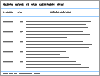
Table 1
Clinical data in the AI group and non-AI group (n, %) and results of Chi-square test (t/χ2) or Wilcoxon rank-sum test (Z) on preset related factors of AI after TBI
| Variables | AI group (n=34) | Non-AI group (n=74) | t/χ2 or Z value | P-value |
|---|---|---|---|---|
| Gender | 0.390 (t/χ2) | 0.532 | ||
| Male (n=75) | 25 (33.3) | 50 (66.7) | ||
| Female (n=33) | 9 (27.3) | 24 (72.7) | ||
| Age | 4.301 (t/χ2) | 0.038 | ||
| ≥60 years (n=33) | 15 (45.5) | 18 (54.5) | ||
| <60 years (n=75) | 19 (25.3) | 56 (74.7) | ||
| Body temperature | 2.363 (t/χ2) | 0.124 | ||
| Normal (n=83) | 23 (27.7) | 60 (72.3) | ||
| Abnormal (n=25) | 11(44.0) | 14 (56.0) | ||
| MAP | 11.540 (t/χ2) | 0.001 | ||
| Normal (n=80) | 18 (22.5) | 62 (77.5) | ||
| Abnormal (n=28) | 16 (57.1) | 12 (42.9) | ||
| Pulse | 0.764 (t/χ2) | 0.382 | ||
| Normal (n=76) | 22 (28.9) | 54 (71.1) | ||
| Abnormal (n=32) | 12 (37.5) | 20 (62.5) | ||
| Respiratory | 1.801 (t/χ2) | 0.180 | ||
| Normal (n=79) | 22 (27.8) | 57 (72.2) | ||
| Abnormal (n=29) | 12 (41.4) | 17 (58.6) | ||
| Urinary volume | 19.649 (t/χ2) | 0.000 | ||
| Normal (n=85) | 18 (21.2) | 67 (78.8) | ||
| Abnormal (n=23) | 16 (69.6) | 7 (30.4) | ||
| Serum sodium level | 19.423 (t/χ2) | 0.000 | ||
| Normal (n=62) | 9 (14.5) | 53 (85.5) | ||
| Abnormal (n=46) | 25 (54.3) | 21 (45.7) | ||
| Cerebral hernia | 7.940 (t/χ2) | 0.005 | ||
| No (n=82) | 20 (24.4) | 62 (75.6) | ||
| Yes (n=26) | 14 (53.8) | 12 (46.2) | ||
| Frontal lobe contusion | 4.541 (t/χ2) | 0.033 | ||
| No (n=48) | 10 (20.8) | 38 (79.2) | ||
| Yes (n=60) | 24 (40.0) | 36 (60.0) | ||
| Cisterna ambiens hemorrhage | 0.518 (t/χ2) | 0.472 | ||
| No (n=37) | 10 (27.0) | 27 (73.0) | ||
| Yes (n=71) | 24 (33.8) | 47 (66.2) | ||
| DAI | 11.540 (t/χ2) | 0.001 | ||
| No (n=80) | 18 (22.5) | 62 (77.5) | ||
| Yes (n=28) | 16 (57.1) | 12 (42.9) | ||
| Skull base fracture | 7.889 (t/χ2) | 0.005 | ||
| No (n=74) | 17 (23.0) | 57 (77.0) | ||
| Yes (n=34) | 17 (50.0) | 17 (50.0) | ||
| GCS score | -3.838 (Z) | 0.000 | ||
| 13-15 (n=57) | 9 (15.8) | 48 (84.2) | ||
| 9-12 (n=26) | 11 (42.3) | 15 (57.7) | ||
| 3-8 (n=25) | 14 (56.0) | 11 (44.0) | ||
Table 2
The factors entered into multiple logistic regression and the assignment
| Variables | Assignment description |
|---|---|
| Age (X1) | (≥60 years)=0, (<60 years)=1 |
| GCS (X2) | (13-15)=0, (9-12)=1, (3-8)=2 |
| Mean arterial pressure (X3) | (80-110 mmHg)=0, (<80 mmHg or >110 mmHg)=1 |
| Urinary volume (X4) | (400-2,500 mL/d)=0, (<400 mL/d or >2,500 mL/d)=1 |
| Serum sodium level (X5) | (135-145 mmol/L)=0, (<135 mmol/L or >145 mmol/L)=1 |
| Cerebral hernia (X6) | No=0, Yes=1 |
| Frontal lobe contusion (X7) | No=0, Yes=1 |
| DAI (X8) | No=0, Yes=1 |
| Skull base fracture (X9) | No=0, Yes=1 |
| AI (dependent variable) | No=0, Yes=1 |
Table 3
Logistic regression parameter estimation and testing
| Variables | β | S.E. | Wald | df | P | Exp (B) |
|---|---|---|---|---|---|---|
| Age | -1.172 | 0.640 | 3.356 | 1 | 0.067 | 0.310 |
| Glasgow Coma Scale score | 0.618 | 0.469 | 1.736 | 1 | 0.188 | 1.855 |
| Mean arterial pressure | 1.214 | 0.830 | 2.137 | 1 | 0.144 | 3.367 |
| Urinary volume | 2.583 | 0.807 | 10.241 | 1 | 0.001 | 13.243 |
| Serum sodium level | 2.235 | 0.730 | 9.376 | 1 | 0.002 | 9.349 |
| Cerebral hernia | -0.893 | 0.836 | 1.141 | 1 | 0.285 | 0.409 |
| Frontal lobe contusion | -0.411 | 0.699 | 0.345 | 1 | 0.557 | 0.663 |
| Diffuse axonal injury | 2.269 | 1.076 | 4.442 | 1 | 0.035 | 9.665 |
| Skull base fracture | 1.210 | 0.651 | 3.451 | 1 | 0.063 | 3.353 |
| Constant | -3.552 | 0.950 | 13.970 | 1 | 0.000 | 0.029 |
| 1 | Cheng PX, Yin P, Ning PS, Wang LJ, Cheng XJ, Liu YN, et al. Trends in traumatic brain injury mortality in China, 2006-2013: a population-based longitudinal study. PLoS Med. 2017; 14(7):e1002332. |
| 2 |
Vella MA, Crandall ML, Patel MB. Acute management of traumatic brain injury. Surg Clin N Am. 2017; 97(5):1015-30.
doi: 10.1016/j.suc.2017.06.003 |
| 3 |
Tanriverdi F, Kelestimur F. Neuroendocrine disturbances after brain damage: an important and often undiagnosed disorder. J Clin Med. 2015; 4(5):847-57.
doi: 10.3390/jcm4050847 pmid: 26239451 |
| 4 |
Dusick JR, Wang C, Cohan P, Swerdloff R, Kelly DF. Pathophysiology of hypopituitarism in the setting of brain injury. Pituitary. 2012; 15(1):2-9.
doi: 10.1007/s11102-008-0130-6 |
| 5 |
Olivecrona Z, Dahlqvist P, Koskinen LO. Acute neuro-endocrine profile and prediction of outcome after severe brain injury. Scand J Trauma Resusc Emerg Med. 2013; 21:33.
doi: 10.1186/1757-7241-21-33 |
| 6 |
Tapp ZM, Godbout JP, Kokiko-Cochran ON. A tilted axis: maladaptive inflammation and HPA axis dysfunction contribute to consequences of TBI. Front Neurol. 2019; 10:345.
doi: 10.3389/fneur.2019.00345 pmid: 31068886 |
| 7 |
Powner DJ, Boccalandro C. Adrenal insufficiency following traumatic brain injury in adults. Curr Opin Crit Care. 2008; 14(2):163-6.
doi: 10.1097/MCC.0b013e3282f57528 pmid: 18388678 |
| 8 |
Cohan P, Wang C, McArthur DL, Cook SW, Dusick JR, Armin B, et al. Acute secondary adrenal insufficiency after traumatic brain injury: a prospective study. Crit Care Med. 2005; 33(10):2358-66.
doi: 10.1097/01.CCM.0000181735.51183.A7 |
| 9 | Pazderska A, Pearce SH. Adrenal insufficiency - recognition and management. Clin Med (Lond). 2017; 17(3):258-62. |
| 10 |
Ntali G, Tsagarakis S. Traumatic brain injury induced neuroendocrine changes: acute hormonal changes of anterior pituitary function. Pituitary. 2019; 22(3):283-95.
doi: 10.1007/s11102-019-00944-0 |
| 11 |
Herman JP, McKlveen JM, Solomon MB, Carvalho-Netto E, Myers B. Neural regulation of the stress response: glucocorticoid feedback mechanisms. Braz J Med Biol Res. 2012; 45(4):292-8.
doi: 10.1590/S0100-879X2012007500041 |
| 12 |
Liyanarachchi K, Ross R, Debono M. Human studies on hypothalamo-pituitary-adrenal (HPA) axis. Best Pract Res Clin Endocrinol Metab. 2017; 31(5):459-73.
doi: 10.1016/j.beem.2017.10.011 |
| 13 |
Shwe S, Witchey L, Lahham S, Kunstadt E, Shniter I, Fox JC. Retrospective analysis of eFAST ultrasounds performed on trauma activations at an academic level-1 trauma center. World J Emerg Med. 2020; 11(1):12-7.
doi: 10.5847/wjem.j.1920-8642.2020.01.002 |
| 14 |
Bernard F, Outtrim J, Lynch AG, Menon DK, Matta BF. Hemodynamic steroid responsiveness is predictive of neurological outcome after traumatic brain injury. Neurocrit Care. 2006; 5(3):176-9.
doi: 10.1385/NCC:5:3 |
| 15 |
Kgosidialwa O, Agha A. Hypopituitarism post traumatic brain injury (TBI): review. Ir J Med Sci. 2019; 188(4):1201-6.
doi: 10.1007/s11845-019-02007-6 pmid: 30931510 |
| 16 | Gray S, Bilski T, Dieudonne B, Saeed S. Hypopituitarism after traumatic brain injury. Cureus. 2019; 11(3):e4163. |
| 17 |
Tsagarakis S, Tzanela M, Dimopoulou I. Diabetes insipidus, secondary hypoadrenalism and hypothyroidism after traumatic brain injury: clinical implications. Pituitary. 2005; 8(3-4):251-4.
pmid: 16508710 |
| 18 |
Capatina C, Paluzzi A, Mitchell R, Karavitaki N. Diabetes insipidus after traumatic brain injury. J Clin Med. 2015; 4(7):1448-62.
doi: 10.3390/jcm4071448 |
| 19 |
Rajagopal R, Swaminathan G, Nair S, Joseph M. Hyponatremia in traumatic brain injury: A practical management protocol. World Neurosurg. 2017; 108:529-33.
doi: S1878-8750(17)31517-6 pmid: 28899834 |
| 20 |
Hannon MJ, Thompson CJ. Neurosurgical hyponatremia. J Clin Med. 2014; 3(4):1084-104.
doi: 10.3390/jcm3041084 pmid: 26237593 |
| 21 |
Kolmodin L, Sekhon MS, Henderson WR, Turgeon AF, Griesdale DE. Hypernatremia in patients with severe traumatic brain injury: a systematic review. Ann Intensive Care. 2013; 3(1):35.
doi: 10.1186/2110-5820-3-35 pmid: 24196399 |
| 22 |
Jenkins R, Morris NA, Haac B, Besien RV, Stein DM, Badjatia N, et al. Outcome predictors for severely brain-injured patients directly admitted or transferred from emergency departments to a trauma center. World J Emerg Med. 2020; 11(2):120-1.
doi: 10.5847/wjem.j.1920-8642.2020.02.010 pmid: 32076479 |
| 23 |
Jeong JH, Kim YZ, Cho YW, Kim JS. Negative effect of hypopituitarism following brain trauma in patients with diffuse axonal injury. J Neurosurg. 2010; 113(3):532-8.
doi: 10.3171/2009.10.JNS091152 |
| [1] | Hong-yan Wei, Wen-jie Liang, Bin Li, Ling-yu Wei, An-qi Jiang, Wei-dong Chen, Peng-hao Guo, Jia Xu. Clinical characteristics and risk factors of Talaromyces marneffei infection in human immunodeficiency virus-negative patients: A retrospective observational study [J]. World Journal of Emergency Medicine, 2021, 12(4): 281-286. |
| [2] | Wei Guo, Lin-yu Ran, Ji-hong Zhu, Qing-gang Ge, Zhe Du, Fei-long Wang, Wei-bo Gao, Tian-bing Wang. Identifying critically ill patients at risk of death from coronavirus disease [J]. World Journal of Emergency Medicine, 2021, 12(1): 18-23. |
| [3] | Tian Xu, Ya Li, Li-ding Zhao, Guo-sheng Fu, Wen-bin Zhang. Predictors of recurrent angina in patients with no need for secondary revascularization [J]. World Journal of Emergency Medicine, 2021, 12(1): 42-47. |
| [4] | Kou Kou, Xiang-yu Hou, Jian-dong Sun, Kevin Chu. Current pre-hospital traumatic brain injury management in China [J]. World Journal of Emergency Medicine, 2014, 5(4): 245-254. |
| [5] | Liza Victoria S Escobedo, Joseph Habboushe, Haytham Kaafarani, George Velmahos, Kaushal Shah, Jarone Lee. Traumatic brain injury: A case-based review [J]. World Journal of Emergency Medicine, 2013, 4(4): 252-259. |
| [6] | Xue-zhong Xing, Yong Gao, Hai-jun Wang, Quan-hui Yang, Chu-lin Huang, Shi-ning Qu, Hao Zhang, Hao Wang, Qing-ling Xiao, Ke-lin Sun. Risk factors and prognosis of critically ill cancer patients with postoperative acute respiratory insufficiency [J]. World Journal of Emergency Medicine, 2013, 4(1): 43-47. |
| [7] | Gan-nan Wang, Jin-song Zhang, Wei-juan Cao, Hao Sun, Jing Zhang, Yao Wang, Hang Xiao. Association of ALOX5, LTA4H and LTC4S gene polymorphisms with ischemic stroke risk in a cohort of Chinese in east China [J]. World Journal of Emergency Medicine, 2013, 4(1): 32-37. |
| [8] | Xue-zhong Xing, Hai-jun Wang, Chu-lin Huang, Quan-hui Yang, Shi-ning Qu, Hao Zhang, Hao Wang, Yong Gao, Qing-ling Xiao, Ke-lin Sun. Two acute kidney injury risk scores for critically ill cancer patients undergoing non-cardiac surgery [J]. World Journal of Emergency Medicine, 2012, 3(4): 278-281. |
| [9] | Rong Hua, Shan-shan Mao, Yong-mei Zhang, Fu-xing Chen, Zhong-hai Zhou, Jun-quan Liu. Effects of pituitary adenylate cyclase activating polypeptide on CD4+/CD8+ T cell levels after traumatic brain injury in a rat model [J]. World Journal of Emergency Medicine, 2012, 3(4): 294-298. |
| [10] | Fei He, Jun Zhang, Zhong-qiu Lu, Qing-ling Gao, Du-juan Sha, Li-gang Pei, Guo-feng Fan. Risk factors and outcomes of acute kidney injury after intracoronary stent implantation [J]. World Journal of Emergency Medicine, 2012, 3(3): 197-201. |
| [11] | Xiao-fang Cai, Ji-min Sun, Lian-sheng Bao, Wen-bin Li. Risk factors and antibiotic resistance of pneumonia caused by multidrug resistant Acinetobacter baumannii in pediatric intensive care unit [J]. World Journal of Emergency Medicine, 2012, 3(3): 202-207. |
| [12] | Ye-cheng Liu, Ji-hai Liu, Zhe Amy Fang, Guang-liang Shan, Jun Xu, Zhi-wei Qi, Hua-dong Zhu, Zhong Wang, Xue-zhong Yu. Modified shock index and mortality rate of emergency patients [J]. World Journal of Emergency Medicine, 2012, 3(2): 114-117. |
| [13] | Jun He, Xiang-yu Hou, Sam Toloo, Jennifer R Patrick, Gerry Fitz Gerald. Demand for hospital emergency departments: a conceptual understanding [J]. World Journal of Emergency Medicine, 2011, 2(4): 253-261. |
| [14] | Jing Zhang, Yao Wang, Gan-nan Wang, Hao Sun, Tao Sun, Jian-quan Shi, Hang Xiao, Jin-song Zhang. Clinical factors in patients with ischemic versus hemorrhagic stroke in East China [J]. World Journal of Emergency Medicine, 2011, 2(1): 18-23. |
| [15] | Xiao-yan Li, Xiao-bo Wang, Xiu-feng Liu, Shu-gui Li. Prevalence and risk factors of organ failure in patients with severe acute pancreatitis [J]. World Journal of Emergency Medicine, 2010, 1(3): 201-204. |
| Viewed | ||||||
|
Full text |
|
|||||
|
Abstract |
|
|||||

