World Journal of Emergency Medicine ›› 2012, Vol. 3 ›› Issue (4): 294-298.doi: 10.5847/wjem.j.issn.1920-8642.2012.04.010
• Original Articles • Previous Articles Next Articles
Rong Hua( ), Shan-shan Mao, Yong-mei Zhang, Fu-xing Chen, Zhong-hai Zhou, Jun-quan Liu
Received:2012-05-16
Accepted:2012-11-03
Online:2012-12-15
Published:2012-12-15
Contact:
Rong Hua
E-mail:ilovezq@sohu.com
Rong Hua, Shan-shan Mao, Yong-mei Zhang, Fu-xing Chen, Zhong-hai Zhou, Jun-quan Liu. Effects of pituitary adenylate cyclase activating polypeptide on CD4+/CD8+ T cell levels after traumatic brain injury in a rat model[J]. World Journal of Emergency Medicine, 2012, 3(4): 294-298.
Add to citation manager EndNote|Ris|BibTeX
URL: http://wjem.com.cn//EN/10.5847/wjem.j.issn.1920-8642.2012.04.010
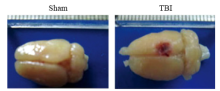
Figure 1.
Schematic representation of the cortical contusion area induced by weight-dropping trauma.
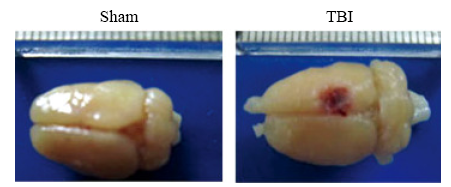
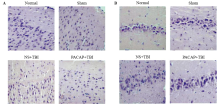
Figure 2.
Photomicrographs showing the effects of microinjection of PACAP into the ventricle on cerebral cortex neurons adjacent to the contused area and hippocampal neurons following TBI in rats. A: cortical tissues adjacent to the injury site; B: the hippocampus of the injury side. HE staining (original magnification×200).

Table 1
The effects of microinjection of PACAP into the brain lateral ventricle on CD4+ and CD8+ T cell numbers in the blood of TBI rats (n =6, mean±SD)
| Group | CD4+ T cells | CD8+ T cells |
|---|---|---|
| Sham | 59.57±4.97 | 13.54±4.51 |
| NS+TBI | 39.20±2.44* | 24.62±6.27* |
| PACAP+TBI | 48.26±6.29# | 18.34±5.09 |
Figure 3.
Effects of microinjection of PACAP into the lateral ventricle on CD4+ and CD8+ T cell numbers in the blood of TBI rats.

Table 2
The effects of microinjection of PACAP into the ventricle on CD4+ and CD8+ T cell numbers in the spleens of TBI rats (n=6, mean±SD).
| Groups | CD4+ T cells | CD8+ T cells |
|---|---|---|
| Sham | 43.14±3.73 | 17.43±3.76 |
| NS+ TBI | 25.74±4.46# | 23.26±4.13# |
| PACAP+ TBI | 28.37±11.93* | 19.49±2.11 |

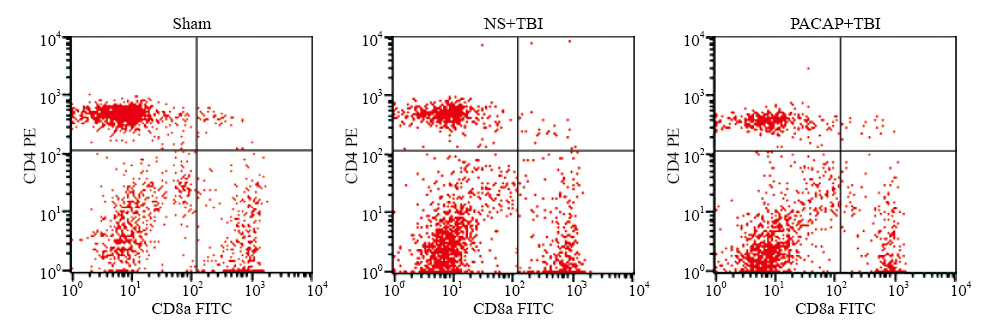
Figure 4.
Effects of microinjection of PACAP into the ventricle on CD4+ and CD8+ T cell numbers in the spleen of TBI rats.
| 1 |
Yong VW, Rivest S. Taking advantage of the systemic immune system to cure brain diseases. Neuron 2009; 64:55-60.
doi: 10.1016/j.neuron.2009.09.035 |
| 2 |
Bourgault S, Vaudry D, Dejda A, Doan ND, Vaudry H, Fournier A. Pituitary adenylate cyclase-activating polypeptide: focus on structure-activity relationships of a neuroprotective Peptide. Curr Med Chem 2009; 16:4462-4480.
doi: 10.2174/092986709789712899 pmid: 19835562 |
| 3 |
Sanchez A, Chiriva-Internati M, Grammas P. Transduction of PACAP38 protects primary cortical neurons from neurotoxic injury. Neurosci Lett 2008; 448:52-55.
doi: 10.1016/j.neulet.2008.10.021 pmid: 18938212 |
| 4 |
Kato H, Ito A, Kawanokuchi J, Jin S, Mizuno T, Ojika K. et al. Pituitary adenylate cyclase-activating polypeptide (PACAP) ameliorates experimental autoimmune encephalomyelitis by suppressing the functions of antigen presenting cells. Mult Scler 2004; 10:651-659.
doi: 10.1191/1352458504ms1096oa pmid: 15584490 |
| 5 | Paxinos G, Watson C. The rat brain in sterotaxic coordinates. 2nd ed. Sydney: Academic Press, 1986: F23-26. |
| 6 |
Feeney DM, Boyeson MG, Linn RT, Murray HM, Dail WG. Responses to cortical injury: I. Methodology and local effects of contusions in the rat. Brain Res 1981; 211:67-77.
doi: 10.1016/0006-8993(81)90067-6 pmid: 7225844 |
| 7 |
Werner C, Engelhard K. Pathophysiology of traumatic brain injury. Br J Anaesth 2007; 99:4-9.
doi: 10.1093/bja/aem131 pmid: 17573392 |
| 8 |
Liu SL, Wang ZP, Zeng YM, Jiang S, Wang SQ. Relation between GLu-R and the protective effect of hypothermia on oxygen and glucose deprivation injury in hippocampal slice or rat. Zhongguo Ying Yong Sheng Li Xue Za Zhi 2005; 21:127-132.
pmid: 21171321 |
| 9 | Schibler A, Humphreys S. Increased brain tissue oxygen tension in children with traumatic brain injury using temperature-corrected guided ventilation during prophylactic hypothermia. Crit Care Resusc 2012; 14:20-24. |
| 10 |
Miyata A, Arimura A, Dahl RR, Minamino N, Uehara A, Jiang L. et al. Isolation of a novel 38 residue-hypothalamic polypeptide which stimulates adenylate cyclase in pituitary cells. Biochem Biophys Res Commun 1989; 164:567-574.
doi: 10.1016/0006-291x(89)91757-9 pmid: 2803320 |
| 11 |
Vaudry D, Falluel-Morel A, Bourgault S, Basille M, Burel D, Wurtz O. et al. Pituitary adenylate cyclase- activating polypeptide and its receptors: 20 years after the discovery. Pharmacol Rev 2009; 61:283-357.
doi: 10.1124/pr.109.001370 pmid: 19805477 |
| 12 |
Sanchez A, Chiriva-Internati M, Grammas P. Transduction of PACAP38 protects primary cortical neurons from neurotoxic injury. Neurosci Lett 2008; 448:52-55.
doi: 10.1016/j.neulet.2008.10.021 pmid: 18938212 |
| 13 |
Kovesdi E, Tamas A, Reglodi D, Farkas O, Pál J, Tóth G. et al. Posttraumatic administration of pituitary adenylate cyclase activating polypeptide in central fluid percussion injury in rats. Neurotox Res 2008; 13:71-78.
doi: 10.1007/BF03033558 |
| 14 |
Kato H, Ito A, Kawanokuchi J, Jin S, Mizuno T, Ojika K. et al. Pituitary adenylate cyclase-activating polypeptide (PACAP) ameliorates experimental autoimmune encephalomyelitis by suppressing the functions of antigen presenting cells. Mult Scler 2004; 10:651-659.
doi: 10.1191/1352458504ms1096oa pmid: 15584490 |
| 15 |
Lv B, Tang Y, Chen F, Xiao X. Vasoactive intestinal Peptide and pituary adenylate cyclase-activating polypeptide inhibit tissue factor expression in monocyte in vitro and in vivo. Shock 2009; 31:185-191.
doi: 10.1097/SHK.0b013e31817d423a pmid: 18650785 |
| 16 |
Mrakovcic-Sutic I, Tokmadzic VS, Laskarin G, Mahmutefendic H, Lucin P, Zupan Z. et al. Early changes in frequency of peripheral blood lymphocyte subpopulations in severe traumatic brain-injured patients. Scand J Immunol 2010; 72:57-65.
doi: 10.1111/j.1365-3083.2010.02407.x pmid: 20591077 |
| 17 |
Delgado M, Ganea D. VIP and PACAP inhibit Fas ligand-mediated bystander lysis by CD4(+) T cells. J Neuroimmunol 2001; 112:78-88.
doi: 10.1016/s0165-5728(00)00414-8 pmid: 11108936 |
| 18 |
Hobbs TR, O'Malley JP, Khouangsathiene S, Dubay CJ. Comparison of lactate, base excess, bicarbonate, and pH as predictors of mortality after severe trauma in rhesus macaques (Macaca mulatta). Comp Med 2010; 60:233-229.
pmid: 20579439 |
| 19 |
Siveen KS, Kuttan G. Effect of Aerva lanata on cell-mediated immune responses and cytotoxic T-lymphocyte generation in normal and tumor-bearing mice. J Immunotoxicol 2012; 9:25-33.Epub 2011 Nov 30.
doi: 10.3109/1547691X.2011.609191 |
| 20 | Ganea D, Rodriguez R, Delgado M. Vasoactive intestinal peptide and pituitary adenylate cyclase-activating polypeptide: players in innate and adaptive immunity. Cell Mol Biol (Noisy-le-grand) 2003; 49:127-142. |
| 21 |
Ganea D, Delgado M. The neuropeptides VIP/PACAP and T cells: inhibitors oractivators? Curr Pharm Des 2003; 9:997-1004.
doi: 10.2174/1381612033455116 pmid: 12678866 |
| 22 |
Delgado M, Ganea D. Anti-inflammatory neuropeptides: a new class of endogenous immunoregulatory agents. Brain Behav Immun 2008; 22:1146-1151.
doi: 10.1016/j.bbi.2008.06.001 |
| [1] | Gui-long Feng, Miao-miao Zheng, Shi-hong Yao, Yin-qi Li, Shao-jun Zhang, Wei-jing Wen, Kai Fan, Jia-li Zhang, Xiao Zhang. Risk factors and predictive model of adrenocortical insufficiency in patients with traumatic brain injury [J]. World Journal of Emergency Medicine, 2021, 12(3): 179-184. |
| [2] | Yu-peng Wang, Lei Ding, Rui-tao Zhang, Xiao-zeng Wang, Dan-qing Yu, Shou-yan Hao, Jin-wei Tian, Zhen-yu Liu, Xiang-qian Qi, Hu Tan, Hong-yi Wu, Feng-hua Ding, Li-jun Guo, Ya-ling Han. Analysis of risk factors for early stent thrombosis in the Chinese population: A multicenter restrospective study [J]. World Journal of Emergency Medicine, 2021, 12(3): 192-197. |
| [3] | Zi-wei Ke, Yue Jiang, Ya-ping Bao, Ye-qin Yang, Xiao-mei Zong, Min Liu, Xiang-yun Guan, Zhong-qiu Lu. Intensivists’ response to hyperoxemia in mechanical ventilation patients: The status quo and related factors [J]. World Journal of Emergency Medicine, 2021, 12(3): 202-206. |
| [4] | Yu-qing Cui, Xian-fei Ding, Huo-yan Liang, Dong Wang, Xiao-juan Zhang, Li-feng Li, Quan-cheng Kan, Le-xin Wang, Tong-wen Sun. Efficacy and safety of low-dose corticosteroids for acute respiratory distress syndrome: A systematic review and meta-analysis [J]. World Journal of Emergency Medicine, 2021, 12(3): 207-213. |
| [5] | Jian-hua Yi, Zhao-cai Zhang, Mei-bian Zhang, Xin He, Hao-ran Lin, Hai-wen Huang, Hai-bin Dai, Yu-wen Huang. Role of epithelial-to-mesenchymal transition in the pulmonary fibrosis induced by paraquat in rats [J]. World Journal of Emergency Medicine, 2021, 12(3): 214-220. |
| [6] | Yan-yan Liu, Yu-peng Wang, Ling-yun Zu, Kang Zheng, Qing-bian Ma, Ya-an Zheng, Wei Gao. Comparison of intraosseous access and central venous catheterization in Chinese adult emergency patients: A prospective, multicenter, and randomized study [J]. World Journal of Emergency Medicine, 2021, 12(2): 105-110. |
| [7] | Hao-tian Chen, Jian-feng Xu, Xiao-xia Huang, Ni-ya Zhou, Yong-kui Wang, Yue Mao. Blood eosinophils and mortality in patients with acute respiratory distress syndrome: A propensity score matching analysis [J]. World Journal of Emergency Medicine, 2021, 12(2): 131-136. |
| [8] | Wei Guo, Lin-yu Ran, Ji-hong Zhu, Qing-gang Ge, Zhe Du, Fei-long Wang, Wei-bo Gao, Tian-bing Wang. Identifying critically ill patients at risk of death from coronavirus disease [J]. World Journal of Emergency Medicine, 2021, 12(1): 18-23. |
| [9] | Li-wei Duan, Jin-long Qu, Jian Wan, Yong-hua Xu, Yi Shan, Li-xue Wu, Jin-hao Zheng, Wei-wei Jiang, Qi-tong Chen, Yan Zhu, Jian Zhou, Wen-bo Yu, Lei Pei, Xi Song, Wen-fang Li, Zhao-fen Lin. Effects of viral infection and microbial diversity on patients with sepsis: A retrospective study based on metagenomic next-generation sequencing [J]. World Journal of Emergency Medicine, 2021, 12(1): 29-35. |
| [10] | Yi Han, Su-cheng Mu, Jian-li Wang, Wei Wei, Ming Zhu, Shi-lin Du, Min Min, Yun-jie Xu, Zhen-ju Song, Chao-yang Tong. MicroRNA-145 plays a role in mitochondrial dysfunction in alveolar epithelial cells in lipopolysaccharide-induced acute respiratory distress syndrome [J]. World Journal of Emergency Medicine, 2021, 12(1): 54-60. |
| [11] | Yu-ming Wang, Yan-jun Zheng, Ying Chen, Yun-chuan Huang, Wei-wei Chen, Ran Ji, Li-li Xu, Zhi-tao Yang, Hui-qiu Sheng, Hong-ping Qu, En-qiang Mao, Er-zhen Chen. Effects of fluid balance on prognosis of acute respiratory distress syndrome patients secondary to sepsis [J]. World Journal of Emergency Medicine, 2020, 11(4): 216-222. |
| [12] | Wei Bi, Yan Sun, Lin-qin Ma, Cai-jun Wu. Predictive role of interleukin-6 and CAT score in mechanical ventilation in patients with chronic obstructive pulmonary disease at the acute exacerbation stage in the emergency department [J]. World Journal of Emergency Medicine, 2020, 11(2): 93-96. |
| [13] | Jung Wan Kim, Jin Woong Lee, Seung Ryu, Jung Soo Park, InSool Yoo, Yong Chul Cho, Hong Joon Ahn. Changes in peak inspiratory flow rate and peak airway pressure with endotracheal tube size during chest compression [J]. World Journal of Emergency Medicine, 2020, 11(2): 97-101. |
| [14] | Rui-ning Liu, Xiao-jun Wei, Shao-ping Li, Cheng Jiang, Yan Zhao. Comparison of invasive dynamic blood pressure between superior mesenteric artery and common carotid artery in rats [J]. World Journal of Emergency Medicine, 2020, 11(2): 102-108. |
| [15] | Ye-cheng Liu, Yan-meng Qi, Hui Zhang, Joseph Walline, Hua-dong Zhu. A survey of ventilation strategies during cardiopulmonary resuscitation [J]. World Journal of Emergency Medicine, 2019, 10(4): 222-227. |
| Viewed | ||||||
|
Full text |
|
|||||
|
Abstract |
|
|||||

