World Journal of Emergency Medicine ›› 2018, Vol. 9 ›› Issue (1): 20-25.doi: 10.5847/wjem.j.1920-8642.2018.01.003
• Original Articles • Previous Articles Next Articles
Yuzeng Shen1( ), Yee Chien Tay2, Edward Wee Kwan Teo3, Nan Liu4, Shao Wei Lam4, Marcus Eng Hock Ong1
Received:2017-04-22
Accepted:2017-09-20
Online:2018-03-15
Published:2018-03-15
Contact:
Yuzeng Shen
E-mail:shen.yuzeng@singhealth.com.sg
Yuzeng Shen, Yee Chien Tay, Edward Wee Kwan Teo, Nan Liu, Shao Wei Lam, Marcus Eng Hock Ong. Association between the elderly frequent attender to the emergency department and 30-day mortality: A retrospective study over 10 years[J]. World Journal of Emergency Medicine, 2018, 9(1): 20-25.
Add to citation manager EndNote|Ris|BibTeX
URL: http://wjem.com.cn//EN/10.5847/wjem.j.1920-8642.2018.01.003
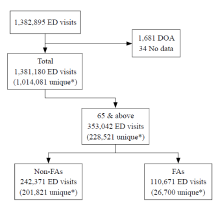
Figure 1.
65 & above, data selection of non-frequent attenders (FAs) and FAs.
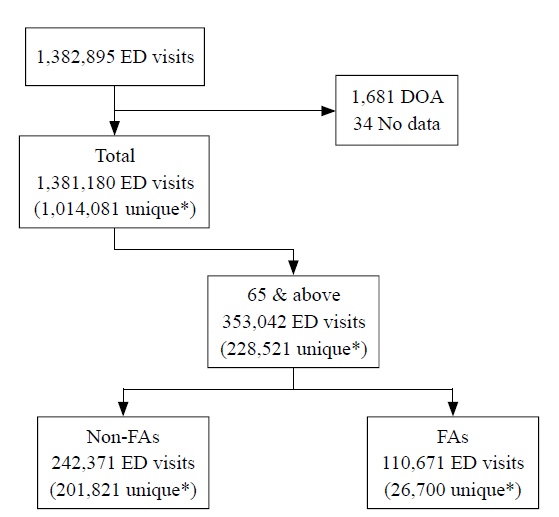
Table 1
Average per year FA3 attendance by period, 2005-2014
| Parameters | All attendance (n=1,381,180) | 65 & above attendance (n=353,042) |
|---|---|---|
| Average per year | ||
| Total attendance | 138,118 | 35,304 |
| FA attendance | 30,523 | 11,067 |
| FA share of attendance | 22.1 | 31.3 |
| Average per year | ||
| Unique attendance | 101,408 | 6,982 |
| Unique FA attendance | 7,121 | 816 |
| FA share of unique attendance | 7.0 | 11.7 |
Table 2
Patient and visit characteristics of 65 & above non-frequent attenders (FAs) vs. FAs, 2005-2014
| Parameters | 65 & above non-FA (n=242,371) | 65 & above FA (n=110,671) | P values |
|---|---|---|---|
| Gender | < 0.001 | ||
| Female | 54.0 | 51.5 | |
| Male | 46.0 | 48.5 | |
| Age | - | ||
| 65 & above | 100.0 | 100.0 | |
| 85 & above | 11.8 | 15.4 | |
| Ethnicity | < 0.001 | ||
| Chinese | 81.8 | 80.2 | |
| Malay | 7.3 | 8.6 | |
| Indian | 7.1 | 8.7 | |
| Others | 3.7 | 2.5 | |
| Distance to SGH-ED | |||
| 0 to <5 km | 29.0 | 32.8 | |
| 5 to <10 km | 29.1 | 26.1 | |
| 10 to <15 km | 27.2 | 26.8 | |
| 15 km or more | 14.7 | 14.4 | |
| Transport | < 0.001 | ||
| Ambulance | 19.6 | 23.9 | |
| Day of attendance | < 0.001 | ||
| Monday | 16.6 | 15.8 | |
| Tuesday | 14.7 | 14.6 | |
| Wednesday | 14.1 | 14.1 | |
| Thursday | 14.1 | 14.1 | |
| Friday | 14.3 | 14.2 | |
| Saturday | 14.0 | 14.1 | |
| Sunday | 12.3 | 13.2 | |
| Time of attendance | < 0.001 | ||
| 00:00-05:59 hours | 6.5 | 8.8 | |
| 06:00-11:59 hours | 29.9 | 29.0 | |
| 12:00-17:59 hours | 39.5 | 36.0 | |
| 18:00-23:59 hours | 24.1 | 26.2 | |
| Triage priority | < 0.001 | ||
| P1 | 13.9 | 17.3 | |
| P2 | 53.3 | 59.6 | |
| P3/P4 | 32.8 | 23.1 | |
| Attended previous year | 27.9 | 60.7 | < 0.001 |
| FA with 3-6 visits | - | 81.2 | - |
| FA with 7 or more visits | - | 18.8 | - |
Table 3
Outcome characteristics of 65 & above non-frequent attenders (FAs) vs. FAs, 2005-2014
| Parameters | 65 & above non-FA (n=242,371) | 65 & above FA (n=110,671) | P-values |
|---|---|---|---|
| Median time to consultation | 36 | 32 | <0.001 |
| Median time to disposition | 189 | 198 | <0.001 |
| Admission | |||
| Admitted | 57.4 | 70.8 | <0.001 |
| Length of stay (median) | 6 | 6 | 0.803 |
| Admission diagnosis | <0.001 | ||
| Infectious diseases | 6.7 | 7.5 | |
| Neoplasms | 2.5 | 3.3 | |
| Immunity disorders | 5.3 | 7.9 | |
| Blood diseases | 1.3 | 1.5 | |
| Mental disorders | 0.3 | 0.4 | |
| Nervous diseases | 4.3 | 1.9 | |
| Circulatory diseases | 13.2 | 13.4 | |
| Respiratory diseases | 8.6 | 12.0 | |
| Digestive diseases | 8.3 | 9.0 | |
| Genitourinary diseases | 3.7 | 5.6 | |
| Skin diseases | 3.9 | 3.6 | |
| Musculoskeletal | 4.9 | 3.7 | |
| General symptoms | 23.5 | 24.5 | |
| Injury and poisoning | 13.2 | 5.7 | |
| ED observation ward | 4.0 | 2.5 | <0.001 |
| 30-day mortality rate | 5.4 | 5.4 | 0.764 |
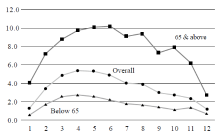
Figure 2.
30-day mortality rates by the numbered visit.
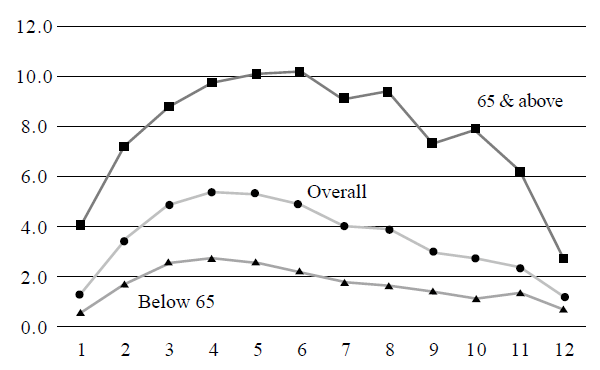
Table 4
Univariate and multivariate analysis of factors associated with 30-day mortality
| Parameters | Univariate odds ratio | Multivariate adjusted odds ratio | ||
|---|---|---|---|---|
| Gender | ||||
| Female | 1 | |||
| Male | 1.36 | (1.33, 1.4) | 1.21 | (1.17, 1.25) |
| Age | ||||
| 65 & above | - | - | ||
| Ethnicity | ||||
| Chinese | 1 | |||
| Malay | 0.98 | (0.93, 1.04) | 0.93 | (0.88, 0.99) |
| Indian | 0.65 | (0.61, 0.70) | 0.69 | (0.64, 0.74) |
| Others | 0.67 | (0.61, 0.73) | 0.64 | (0.58, 0.71) |
| Distance to SGH-ED | ||||
| 0 to <5 km | 1 | |||
| 5 to <10 km | 0.91 | (0.88, 0.95) | 1.16 | (1.12, 1.21) |
| 10 to <15 km | 0.91 | (0.87, 0.94) | 1.15 | (1.11, 1.20) |
| 15 km or more | 0.96 | (0.92, 1.01) | 1.19 | (1.13, 1.25) |
| Transport | ||||
| Ambulance | 4.27 | (4.15, 4.4) | 2.72 | (2.63, 2.81) |
| Day of attendance | ||||
| Monday | 1.01 | (0.96, 1.06) | 1.03 | (0.97, 1.09) |
| Tuesday | 0.99 | (0.94, 1.04) | 1.00 | (0.94, 1.06) |
| Wednesday | 1.01 | (0.96, 1.07) | 1.01 | (0.95, 1.07) |
| Thursday | 0.99 | (0.93, 1.04) | 0.98 | (0.92, 1.04) |
| Friday | 1 | |||
| Saturday | 0.98 | (0.92, 1.03) | 0.97 | (0.91, 1.03) |
| Sunday | 1.14 | (1.08, 1.20) | 1.04 | (0.98, 1.11) |
| Time of attendance | ||||
| 00:00-05:59 hours | 1 | |||
| 06:00-11:59 hours | 0.76 | (0.72, 0.80) | 1.10 | (1.04, 1.18) |
| 12:00-17:59 hours | 0.81 | (0.77, 0.86) | 1.19 | (1.12, 1.27) |
| 18:00-23:59 hours | 0.94 | (0.89, 0.99) | 1.17 | (1.10, 1.24) |
| Triage priority | ||||
| P1 | 1 | |||
| P2 | 0.34 | (0.33, 0.35) | 0.45 | (0.43, 0.46) |
| P3/P4 | 0.06 | (0.06, 0.07) | 0.14 | (0.13, 0.15) |
| Attend previous year | 1.34 | (1.30, 1.38) | 1.31 | (1.26, 1.35) |
| FA | 1.00 | (0.97, 1.04) | - | |
| 3-6 visits | 1.15 | (1.12, 1.19) | 0.77 | (0.75, 0.80) |
| 7 or more visits | 0.54 | (0.50, 0.59) | 0.36 | (0.33, 0.40) |
| Time to consultation | 0.99 | (0.98, 0.99) | 1.00 | (1.00, 1.00) |
| Time to disposition | 1.00 | (1.00, 1.00) | 1.00 | (1.00, 1.00) |
| ED diagnosis | ||||
| Infectious diseases | 1 | |||
| Neoplasms | 4.32 | (4.06, 4.59) | 5.32 | (4.97, 5.69) |
| Immunity disorders | 0.68 | (0.64, 0.73) | 0.75 | (0.69, 0.80) |
| Blood diseases | 0.74 | (0.66, 0.83) | 1.03 | (0.91, 1.16) |
| Mental disorders | 0.23 | (0.16, 0.34) | 0.33 | (0.22, 0.48) |
| Nervous diseases | 0.12 | (0.10, 0.14) | 0.25 | (0.21, 0.29) |
| Circulatory diseases | 0.55 | (0.52, 0.59) | 0.53 | (0.49, 0.56) |
| Respiratory diseases | 1.06 | (1.00, 1.12) | 0.96 | (0.90, 1.02) |
| Digestive diseases | 0.47 | (0.44, 0.50) | 0.73 | (0.68, 0.79) |
| Genitourinary diseases | 0.56 | (0.51, 0.61) | 0.90 | (0.83, 0.98) |
| Skin diseases | 0.25 | (0.23, 0.28) | 0.70 | (0.62, 0.79) |
| Musculoskeletal diseases | 0.12 | (0.10, 0.13) | 0.31 | (0.27, 0.36) |
| Symptoms | 0.36 | (0.34, 0.39) | 0.60 | (0.56, 0.64) |
| Injury and poisoning | 0.17 | (0.16, 0.19) | 0.32 | (0.29, 0.35) |
| ED observation ward | 0.09 | (0.07, 0.12) | 0.14 | (0.11, 0.17) |
| 1 | Department of Statistics, Ministry of Trade & Industry R of S. Population Trends, 2016; 2016. |
| 2 |
Aminzadeh F, Dalziel WB. Older adults in the emergency department: a systematic review of patterns of use, adverse outcomes, and effectiveness of interventions. Ann Emerg Med. 2002;39(3):238-47.
doi: 10.1067/mem.2002.121523 |
| 3 |
Roberts DC, Mckay MP, Shaffer A. Increasing rates of emergency department visits for elderly patients in the United States, 1993 to 2003. Ann Emerg Med. 2008;51(6):769-74.
doi: 10.1016/j.annemergmed.2007.09.011 |
| 4 |
Hunt KA, Weber EJ, Showstack JA, Colby DC, Callaham ML. Characteristics of frequent users of emergency departments. Ann Emerg Med. 2006;48(1):1-8.
doi: 10.1016/j.annemergmed.2006.03.033 pmid: 16781914 |
| 5 |
LaCalle E, Rabin E. Frequent users of emergency departments: the myths, the data, and the policy implications. Ann Emerg Med. 2010;56(1):42-8.
doi: 10.1016/j.annemergmed.2010.01.032 |
| 6 |
Derlet RW. Overcrowding in emergency departments: increased demand and decreased capacity. Ann Emerg Med. 2002;39(4):430-2.
doi: 10.1067/mem.2002.122707 pmid: 11919530 |
| 7 |
Hoot NR, Aronsky D. Systematic review of emergency department crowding: causes, effects,solutions. Ann Emerg Med. 2008;52(2):126-136.e1.
doi: 10.1016/j.annemergmed.2010.05.012 pmid: 20646787 |
| 8 |
Clark EG, Watson J, Leemann A, Breaud AH, Feeley FG, Wolff J, et al. Acute care needs in an Indian emergency department:A retrospective analysis. World J Emerg Med. 2016;7(3):191-5.
doi: 10.5847/wjem.j.1920-8642.2016.03.005 pmid: 27547278 |
| 9 |
Lim KH, Yap KB. The presentation of elderly people at an emergency department in Singapore. Singapore Med J. 1999;40(12):742-4.
pmid: 10709424 |
| 10 |
Singal BM, Hedges JR, Rousseau EW, Sanders AB, Berstein E, McNamara RM, et al. Geriatric patient emergency visits. Part I: Comparison of visits by geriatric and younger patients. Ann Emerg Med. 1992;21(7):802-7.
doi: 10.1016/s0196-0644(05)81025-x pmid: 1610036 |
| 11 |
Rosenfeld T, Fahey P, Price M, Leeder S. The fate of elderly patients discharged from the accident and emergency department of a general teaching hospital. Community Health Stud. 1990;14(4):365-72.
doi: 10.1111/j.1753-6405.1990.tb00047.x pmid: 2073775 |
| 12 |
Richardson DB. Elderly patients in the emergency department: a prospective study of characteristics and outcome. Med J Aust. 1992;157(4):234-9.
pmid: 1435437 |
| 13 | Shen Y, Teo EWK, Liu N, Lam SW, Ong MEH. Data-driven approach to defining the emergency department frequent attender using a cohort of 10 years - Paper presented at SGH 22nd Annual Scientific Meeting, 2017 April 7-8; Singapore. |
| 14 |
Yip WL, Fan KL, Lui CT, Leung LP, Ng F, Tsui KL. Utilization of the Accident & Emergency Departments by Chinese elderly in Hong Kong. World J Emerg Med. 2015;6(4):283-8.
doi: 10.5847/wjem.j.1920-8642.2015.04.006 pmid: 26693263 |
| 15 |
McCusker J, Healey E, Bellavance F, Connolly B. Predictors of repeat emergency department visits by elders. Acad Emerg Med. 1997;4(6):581-8.
doi: 10.1111/j.1553-2712.1997.tb03582.x pmid: 9189191 |
| 16 |
Lamantia MA, Platts-mills TF, Biese K, Khandelwal C, Forbach C, Cairns CB, et al. Predicting hospital admission and returns to the emergency department for elderly patients. Acad Emerg Med. 2010;17(3):252-9.
doi: 10.1111/j.1553-2712.2009.00675.x pmid: 20370757 |
| 17 |
McCusker J, Cardin S, Bellavance F, Belzile E. Return to the emergency department among elders: patterns and predictors. Acad Emerg Med. 2000;7(3):249-59.
doi: 10.1111/j.1553-2712.2000.tb01070.x pmid: 10730832 |
| 18 |
Philips GA, Brophy DS, Wieland TJ, Chenhall AJ, Dent AW. The effect of multidisciplinary case management on selected outcomes for frequent attenders at an emergency department. Med J Aust. 2006;184(12):602-6.
pmid: 16803437 |
| [1] | Lori Stolz, Elaine Situ-LaCasse, Josie Acuña, Matthew Thompson, Nicolaus Hawbaker, Josephine Valenzuela, Uwe Stolz, Srikar Adhikari. What is the ideal approach for emergent pericardiocentesis using point-of-care ultrasound guidance? [J]. World Journal of Emergency Medicine, 2021, 12(3): 169-173. |
| [2] | Yu-qing Cui, Xian-fei Ding, Huo-yan Liang, Dong Wang, Xiao-juan Zhang, Li-feng Li, Quan-cheng Kan, Le-xin Wang, Tong-wen Sun. Efficacy and safety of low-dose corticosteroids for acute respiratory distress syndrome: A systematic review and meta-analysis [J]. World Journal of Emergency Medicine, 2021, 12(3): 207-213. |
| [3] | Kasım Turgut, Erdal Yavuz, Mine Kayacı Yıldız, Mehmet Kaan Poyraz. Violence toward emergency physicians: A prospective-descriptive study [J]. World Journal of Emergency Medicine, 2021, 12(2): 111-116. |
| [4] | Wen Gao, Yu-ping Zhang, Jing-fen Jin. Poor outcomes of delirium in the intensive care units are amplified by increasing age: A retrospective cohort study [J]. World Journal of Emergency Medicine, 2021, 12(2): 117-123. |
| [5] | Hao-tian Chen, Jian-feng Xu, Xiao-xia Huang, Ni-ya Zhou, Yong-kui Wang, Yue Mao. Blood eosinophils and mortality in patients with acute respiratory distress syndrome: A propensity score matching analysis [J]. World Journal of Emergency Medicine, 2021, 12(2): 131-136. |
| [6] | Yong Liang, Hong Zeng, Yu-geng Liu, Ai-min Xu, Wen-hong Liu. Prevalence of post-traumatic stress disorder after earthquakes among the elderly in China: A meta-analysis [J]. World Journal of Emergency Medicine, 2021, 12(2): 137-142. |
| [7] | Marin Pavlov, Lucija Klobučar, Iva Klobučar, Kristina Žgela, Vesna Degoricija. Does shifting to professional emergency department staffing affect the decision for chest radiography? [J]. World Journal of Emergency Medicine, 2021, 12(2): 87-92. |
| [8] | Hady Zgheib, Aline El Zakhem, Cynthia Wakil, Mohamad Ali Cheaito, Rola Cheaito, Antoine Finianos, Ralphe Bou Chebl, Rima Kaddoura, Nader Al Souky, Imad El Majzoub. Role of urine studies in asymptomatic febrile neutropenic patients presenting to the emergency department [J]. World Journal of Emergency Medicine, 2021, 12(2): 99-104. |
| [9] | William Gilliam, Jackson F. Barr, Brandon Bruns, Brandon Cave, Jordan Mitchell, Tina Nguyen, Jamie Palmer, Mark Rose, Safura Tanveer, Chris Yum, Quincy K. Tran. Factors associated with refractory pain in emergency patients admitted to emergency general surgery [J]. World Journal of Emergency Medicine, 2021, 12(1): 12-17. |
| [10] | Wei Guo, Lin-yu Ran, Ji-hong Zhu, Qing-gang Ge, Zhe Du, Fei-long Wang, Wei-bo Gao, Tian-bing Wang. Identifying critically ill patients at risk of death from coronavirus disease [J]. World Journal of Emergency Medicine, 2021, 12(1): 18-23. |
| [11] | Rebekah Shaw, Erica Popovsky, Alyssa Abo, Marni Jacobs, Nicole Herrera, James Chamberlain, Andrea Hahn. Improving antibiotic prescribing in the emergency department for uncomplicated community-acquired pneumonia [J]. World Journal of Emergency Medicine, 2020, 11(4): 199-205. |
| [12] | Hai-jiang Zhou, Tian-fei Lan, Shu-bin Guo. Outcome prediction value of National Early Warning Score in septic patients with community-acquired pneumonia in emergency department: A single-center retrospective cohort study [J]. World Journal of Emergency Medicine, 2020, 11(4): 206-215. |
| [13] | Chuan-qi Ding, Yu-ping Zhang, Yu-wei Wang, Min-fei Yang, Sa Wang, Nian-qi Cui, Jing-fen Jin. Death and do-not-resuscitate order in the emergency department: A single-center three-year retrospective study in the Chinese mainland [J]. World Journal of Emergency Medicine, 2020, 11(4): 231-237. |
| [14] | Guo-xiong Chen, Hong-na Wang, Jin-lin Zou, Xiao-xu Yuan. Effects of intracoronary injection of nicorandil and tirofiban on myocardial perfusion and short-term prognosis in elderly patients with acute ST-segment elevation myocardial infarction after emergency PCI [J]. World Journal of Emergency Medicine, 2020, 11(3): 157-163. |
| [15] | Rui-xue Sun, Priscilla Song, Joseph Walline, He Wang, Ying-chun Xu, Hua-dong Zhu, Xue-zhong Yu, Jun Xu. Morbidity and mortality risk factors in emergency department patients with Acinetobacter baumannii bacteremia [J]. World Journal of Emergency Medicine, 2020, 11(3): 164-168. |
| Viewed | ||||||
|
Full text |
|
|||||
|
Abstract |
|
|||||

