World Journal of Emergency Medicine ›› 2020, Vol. 11 ›› Issue (1): 27-32.doi: 10.5847/wjem.j.1920-8642.2020.01.004
• Original Articles • Previous Articles Next Articles
Wei He1, Yue-yang You1, Kai Sun1, Chen Xie2, Yue Ming1, Li-na Yu1, Feng-jiang Zhang1, Min Yan1,2( )
)
Received:2019-06-06
Accepted:2019-10-10
Online:2020-01-01
Published:2020-01-01
Contact:
Min Yan
E-mail:zryanmin@zju.edu.cn
Wei He, Yue-yang You, Kai Sun, Chen Xie, Yue Ming, Li-na Yu, Feng-jiang Zhang, Min Yan. Admission delay is associated with worse surgical outcomes for elderly hip fracture patients: A retrospective observational study[J]. World Journal of Emergency Medicine, 2020, 11(1): 27-32.
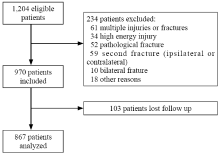
Figure 1.
Flow chart.
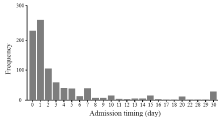
Figure 2.
Bar chart of admission timing.
Table 1
Univariate logistic regression for 1-year mortality with admission timing dichotomized according to different cut point
| Admission timing | OR (95% CI) | P value |
|---|---|---|
| Day 0 later vs. within day 0 | 1.006 (0.610-1.658) | 0.981 |
| Day 1 later vs. within day 1 | 1.090 (0.706-1.685) | 0.697 |
| Day 2 later vs. within day 2 | 1.400 (0.898-2.183) | 0.138 |
| Day 3 later vs. within day 3 | 1.222 (0.761-1.960) | 0.406 |
| Day 4 later vs. within day 4 | 1.258 (0.766-2.066) | 0.365 |
| Day 5 later vs. within day 5 | 1.387 (0.824-2.336) | 0.219 |
| Day 6 later vs. within day 6 | 1.453 (0.854-2.473) | 0.168 |
| Day 7 later vs. within day 7 | 1.897 (1.073-3.292) | 0.027 |
| Day 8 later vs. within day 8 | 1.893 (1.066-3.359) | 0.029 |
| Day 9 later vs. within day 9 | 1.741 (0.955-3.175) | 0.070 |
Table 2
Multivariate logistic regression analysis for 1-year mortality
| Variables | β value | Standard error | Wald Chi-square | OR (95% CI) | P value |
|---|---|---|---|---|---|
| Age | 0.069 | 0.017 | 17.191 | 1.072 (1.037-1.107) | 0.000 |
| Sex (female vs. male) | -0.509 | 0.247 | 4.236 | 0.601 (0.370-0.976) | 0.040 |
| Pneumonia | 0.562 | 0.243 | 5.353 | 1.754 (1.090-2.822) | 0.021 |
| Admission timing (>7 days vs. ≤7 days) | 0.621 | 0.304 | 4.175 | 1.762 (1.026-3.379) | 0.041 |
| Admission-to-surgery time (>2 days vs. ≤2 days) | 1.315 | 0.736 | 3.189 | 3.724 (0.880-15.769) | 0.074 |
| Renal insufficiency | 0.839 | 0.456 | 3.379 | 2.314 (0.946-5.662) | 0.066 |
| Fracture type (trochanteric vs. femoral neck) | 0.338 | 0.242 | 1.946 | 1.402 (0.872-2.254) | 0.163 |
Table 3
Characteristics of patients by admission timing
| Variables | Total (n=867) | ≤7 days (n=758) | >7 days (n=109) | P value |
|---|---|---|---|---|
| Age, mean (SD), years | 81.2 (8.0) | 81.2 (8.0) | 81.0 (7.6) | 0.869 |
| Female, n (%) | 648 (74.7) | 572 (75.7) | 76 (69.7) | 0.197 |
| ASA classification, n (%) | 0.098 | |||
| 1 | 4 (0.5) | 3 (0.4) | 1 (0.9) | |
| 2 | 375 (43.3) | 338 (44.6) | 37 (33.9) | |
| 3 | 470 (54.2) | 402 (53.0) | 68 (62.4) | |
| 4 | 18 (2.1) | 15 (2.0) | 3 (2.8) | |
| Fracture type, n (%) | 0.000 | |||
| Femoral neck fracture | 582 (67.1) | 489 (64.5) | 93 (85.3) | |
| Trochanteric fracture | 285 (32.9) | 269 (35.5) | 16 (14.7) | |
| Operative method, n (%) | 0.000 | |||
| Replacement | 486 (56.1) | 405 (53.4) | 81 (74.3) | |
| Fixation | 381 (44.0) | 353 (46.6) | 28 (25.7) | |
| Anesthetic method, n (%) | 0.936 | |||
| General anesthesia | 653 (75.3) | 571 (75.3) | 82 (75.2) | |
| Neuraxial anesthesia | 104 (12.0) | 90 (11.9) | 14 (12.8) | |
| General anesthesia + Neuraxial anesthesia | 110 (12.7) | 97 (12.8) | 13 (11.9) | |
| Intraoperative blood loss, mean (SD), mL | 136.3 (127.4) | 136.9(131.4) | 132.4 (96.0) | 0.668 |
| Preoperative comorbidity, n (%) | ||||
| Pneumonia | 208 (24.0) | 174 (23.0) | 34 (31.2) | 0.060 |
| Hypertension | 466 (53.7) | 402 (53.0) | 64 (58.7) | 0.266 |
| Coronary heart disease | 75 (8.7) | 60 (7.9) | 15 (13.8) | 0.042 |
| Heart failure | 13 (1.5) | 10 (1.3) | 3 (2.8) | 0.250 |
| Stroke | 120 (13.8) | 103 (13.6) | 17 (15.6) | 0.570 |
| Diabetes mellitus | 163 (18.8) | 133 (17.5) | 30 (27.5) | 0.013 |
| Renal insufficiency | 35 (4.0) | 31 (4.1) | 4 (3.7) | 0.367 |
| Preoperative laboratory examinations | ||||
| Hemoglobin, mean (SD), g/L | 109.0 (20.4) | 108.8 (20.8) | 110.2 (17.6) | 0.612 |
| White blood cell, mean (SD), 109/L | 7.8 (3.7) | 8.0 (3.8) | 6.8 (2.7) | 0.001 |
| Platelet, mean (SD), 109/L | 183.9 (74.8) | 176.2 (67.7) | 237.0 (97.4) | 0.000 |
| Albumin, mean (SD), g/L | 34.4 (4.0) | 34.5 (4.0) | 33.4 (4.2) | 0.008 |
| Creatinine, median (IQR), μmol/L | 58.0 (26.0) | 58.0 (26.3) | 57.0 (22.0) | 0.299 |
| C-reactive protein, median (IQR), mg/L | 48.4 (50.3) | 50.0 (47.9) | 14.8(32.1) | 0.000 |
| Admission-to-surgery time, mean (SD), days | 5.2 (2.8) | 5.2 (2.9) | 5.5 (2.5) | 0.225 |
| Duration of surgery, mean (SD), hours | 2.1(0.6) | 2.1 (0.6) | 1.8 (0.6) | 0.001 |
| Surgery-to-discharge time, mean (SD), days | 6.2 (6.2) | 6.0 (3.9) | 6.2 (3.2) | 0.559 |
| Surgery within two days after admission, n (%) | 68 (7.8) | 66 (8.7) | 2 (1.8) | 0.013 |
| Year, n (%) | 0.177 | |||
| 2014 | 89 (10.3) | 73 (6.9) | 16 (14.7) | |
| 2015 | 166 (19.1) | 147 (19.4) | 19 (17.4) | |
| 2016 | 295 (34.0) | 252 (33.2) | 43 (39.4) | |
| 2017 | 317 (36.6) | 286 (37.7) | 31 (28.4) |
Table 4
Primary and secondary outcomes of patients by admission timing, n (%)
| Variables | ≤7 days (n=758) | >7 days (n=109) | P value |
|---|---|---|---|
| Primary outcome | |||
| 1-year mortality | 73 (9.6) | 18 (16.5) | 0.028 |
| Secondary outcomes | |||
| 1-month mortality | 22 (2.9) | 7 (6.4) | 0.056 |
| 3-month mortality | 39 (5.1) | 8 (7.3) | 0.344 |
| Postoperative ICU admission | 51 (6.7) | 13 (11.9) | 0.052 |
| Postoperative pneumonia | 39 (5.1) | 7 (6.4) | 0.578 |
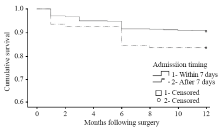
Figure 3.
Survival analysis of patients by admission timing (Log Rank P=0.027).

| 1 | Kannus P, Parkkari J, Sievänen H, Heinonen A, Vuori I, Järvinen M. Epidemiology of hip fractures. Bone. 1996; 18(1):S57-63. |
| 2 |
Hansson S, Rolfson O, Akesson K, Nemes S, Leonardsson O, Rogmark C. Complications and patient-reported outcome after hip fracture. A consecutive annual cohort study of 664 patients. Injury. 2015; 46(11):2206-11.
doi: 10.1016/j.injury.2015.07.024 pmid: 26298023 |
| 3 |
Muntasar AE, Toner E, Alkhazaaleh OA, Arumugam D, Shah N, Hajibandeh S, et al. Effect of angioembolisation versus surgical packing on mortality in traumatic pelvic haemorrhage: A systematic review and meta-analysis. World J Emerg Med. 2018; 9(2):85-92.
pmid: 29576819 |
| 4 |
Pincus D, Ravi B, Wasserstein D, Huang A, Paterson JM, Nathens AB, et al. Association between wait time and 30-day mortality in adults undergoing hip fracture surgery. JAMA. 2017; 318(20):1994-2003.
doi: 10.1001/jama.2017.17606 pmid: 29183076 |
| 5 |
Palma LD, Torcianti M, Meco L, Catalani A, Marinelli M. Operative delay and mortality in elderly patients with hip fracture: an observational study. Eur J Orthop Surg Traumatol. 2014; 24(5):783-8.
doi: 10.1007/s00590-013-1241-y pmid: 23712671 |
| 6 |
Uzoigwe CE, Burnand HG, Cheesman CL, Aghedo DO, Faizi M, Middleton RG. Early and ultra-early surgery in hip fracture patients improves survival. Injury. 2013; 44(6):726-9.
doi: 10.1016/j.injury.2012.08.025 pmid: 23010072 |
| 7 |
Paul P, Issac RT. Delay in time from fracture to surgery: A potential risk factor for in-hospital mortality in elderly patients with hip fractures. J Orthop. 2018; 15(2):375-8.
doi: 10.1016/j.jor.2018.03.001 pmid: 29881157 |
| 8 |
Roberts KC, Brox WT, Jevsevar DS, Sevarino K. Management of hip fractures in the elderly. J Am Acad Orthop Surg. 2015; 23(2):131-7.
doi: 10.5435/JAAOS-D-14-00432 pmid: 25624365 |
| 9 |
Mak JCS, Cameron ID, March LM. Evidence-based guidelines for the management of hip fractures in older persons: an update. Med J Aust. 2010; 192(1):37-41.
pmid: 20047547 |
| 10 | Orosz GM, Magaziner J, Hannan EL, Morrison RS, Koval K, Gilbert M, et al. Association of timing of surgery for hip fracture and patient outcomes. JAMA. 2004(291):1738-43. |
| 11 |
Tian M, Gong X, Rath S, Wei J, Yan LL, Lamb SE, et al. Management of hip fractures in older people in Beijing: a retrospective audit and comparison with evidence-based guidelines and practice in the UK. Osteoporos Int. 2016; 27(2):677-81.
pmid: 26267012 |
| 12 |
Russotto V, Sabaté S, Canet J. Development of a prediction model for postoperative pneumonia: a multicentre prospective observational study. Eur J Anaesthesiol. 2019; 36(2):93-104.
pmid: 30431500 |
| 13 | Anthon CA, Duchman KR, Bedard NA, Gholson JJ, Gao YB, Pugely AJ, et al. Hip fractures: appropriate timing to operative intervention. J Arthroplast. 2017; 32(11):3314-8. |
| 14 |
Khan SK, Kalra S, Khanna A, Thiruvengada MM, Parker MJ. Timing of surgery for hip fractures: a systematic review of 52 published studies involving 291413 patients. Injury. 2009; 40(7):692-7.
doi: 10.1016/j.injury.2009.01.010 pmid: 19450802 |
| 15 | Bohl DD, Shen MR, Hannon CP, Fillingham YA, Darrith B, Della Valle CJ. Serum Albumin predicts survival and postoperative course following surgery for geriatric hip fracture. J Bone Jo Surg. 2017; 99(24):2110-8. |
| 16 | Malafarina V, Reginster JY, Cabrerizo S, Bruyère O, Kanis J, Martinez J, et al. Nutritional status and nutritional treatment are related to outcomes and mortality in older adults with hip fracture. Nutrients. 2018; 10(5):555. |
| 17 |
Haugan K, Johnsen LG, Basso T, Foss OA. Mortality and readmission following hip fracture surgery: a retrospective study comparing conventional and fast-track care. BMJ Open. 2017; 7(8):e015574.
doi: 10.1136/bmjopen-2016-015574 pmid: 28851773 |
| 18 |
Tsuda Y, Yasunaga H, Horiguchi H, Ogawa S, Kawano H, Tanaka S. Association between dementia and postoperative complications after hip fracture surgery in the elderly: analysis of 87654 patients using a national administrative database. Arch Orthop Trauma Surg. 2015; 135(11):1511-7.
pmid: 26487632 |
| [1] | Yu-qing Cui, Xian-fei Ding, Huo-yan Liang, Dong Wang, Xiao-juan Zhang, Li-feng Li, Quan-cheng Kan, Le-xin Wang, Tong-wen Sun. Efficacy and safety of low-dose corticosteroids for acute respiratory distress syndrome: A systematic review and meta-analysis [J]. World Journal of Emergency Medicine, 2021, 12(3): 207-213. |
| [2] | Wen Gao, Yu-ping Zhang, Jing-fen Jin. Poor outcomes of delirium in the intensive care units are amplified by increasing age: A retrospective cohort study [J]. World Journal of Emergency Medicine, 2021, 12(2): 117-123. |
| [3] | Hao-tian Chen, Jian-feng Xu, Xiao-xia Huang, Ni-ya Zhou, Yong-kui Wang, Yue Mao. Blood eosinophils and mortality in patients with acute respiratory distress syndrome: A propensity score matching analysis [J]. World Journal of Emergency Medicine, 2021, 12(2): 131-136. |
| [4] | Wei Guo, Lin-yu Ran, Ji-hong Zhu, Qing-gang Ge, Zhe Du, Fei-long Wang, Wei-bo Gao, Tian-bing Wang. Identifying critically ill patients at risk of death from coronavirus disease [J]. World Journal of Emergency Medicine, 2021, 12(1): 18-23. |
| [5] | Rui-xue Sun, Priscilla Song, Joseph Walline, He Wang, Ying-chun Xu, Hua-dong Zhu, Xue-zhong Yu, Jun Xu. Morbidity and mortality risk factors in emergency department patients with Acinetobacter baumannii bacteremia [J]. World Journal of Emergency Medicine, 2020, 11(3): 164-168. |
| [6] | Shao-hua Liu, Huo-yan Liang, Hong-yi Li, Xian-fei Ding, Tong-wen Sun, Jing Wang. Effect of low high-density lipoprotein levels on mortality of septic patients: A systematic review and meta-analysis of cohort studies [J]. World Journal of Emergency Medicine, 2020, 11(2): 109-116. |
| [7] | Chang Pan, Xiao-ran Huang, Jiao-jiao Pang, Kai Cheng, Feng Xu, Yu-guo Chen. Trends in mortality of emergency departments patients in China [J]. World Journal of Emergency Medicine, 2019, 10(3): 152-155. |
| [8] | Yuzeng Shen, Yee Chien Tay, Edward Wee Kwan Teo, Nan Liu, Shao Wei Lam, Marcus Eng Hock Ong. Association between the elderly frequent attender to the emergency department and 30-day mortality: A retrospective study over 10 years [J]. World Journal of Emergency Medicine, 2018, 9(1): 20-25. |
| [9] | Kasim Turgut, Mehmet Ediz Sarihan, Cemil Colak, Taner Güven, Ali Gür, Sükrü Gürbüz. Falls from height: A retrospective analysis [J]. World Journal of Emergency Medicine, 2018, 9(1): 46-50. |
| [10] | Youichi Yanagawa, Kouhei Ishikawa, Kei Jitsuiki, Toshihiko Yoshizawa, Yasumasa Oode, Kazuhiko Omori, Hiromichi Ohsaka. Fibrinogen degradation product levels on arrival for trauma patients requiring a transfusion even without head injury [J]. World Journal of Emergency Medicine, 2017, 8(2): 106-109. |
| [11] | Wai Lam Yip, Kit Ling Fan, Chun Tat Lui, Ling Pong Leung, Fu Ng, Kwok Leung Tsui. Utilization of the Accident & Emergency Departments by Chinese elderly in Hong Kong [J]. World Journal of Emergency Medicine, 2015, 6(4): 283-288. |
| [12] | Cui-ping Zhu, Xiao-hui Wu, Yu-ting Liang, Wen-cheng Ma, Lu Ren. The mortality of patients in a pediatric emergency department at a tertiary medical center in China: An observational study [J]. World Journal of Emergency Medicine, 2015, 6(3): 212-216. |
| [13] | Ruo Wu, Shi-yun Lin, Hui-min Zhao. Albuterol in the treatment of acute respiratory distress syndrome: A meta-analysis of randomized controlled trials [J]. World Journal of Emergency Medicine, 2015, 6(3): 165-171. |
| [14] | Bedia Gülen, Ertan Sonmez, Serpil Yaylaci, Mustafa Serinken, Cenker Eken, Ali Dur, Figen Tunali Turkdogan, Özgür Söğüt. Effect of harmless acute pancreatitis score, red cell distribution width and neutrophil/lymphocyte ratio on the mortality of patients with nontraumatic acute pancreatitis at the emergency department [J]. World Journal of Emergency Medicine, 2015, 6(1): 29-33. |
| [15] | Quan-yue Li, Dong-hai Zhao, Hai-yan Qu, Chuan-nong Zhou. Life-threatening complications of ascariasis in trauma patients: a review of the literature [J]. World Journal of Emergency Medicine, 2014, 5(3): 165-170. |
| Viewed | ||||||||||||||||||||||||||||||||||||||||||||||||||
|
Full text 1660
|
|
|||||||||||||||||||||||||||||||||||||||||||||||||
|
Abstract 389
|
|
|||||||||||||||||||||||||||||||||||||||||||||||||

