World Journal of Emergency Medicine ›› 2017, Vol. 8 ›› Issue (3): 214-222.doi: 10.5847/wjem.j.1920-8642.2017.03.009
• Original Articles • Previous Articles Next Articles
Salima Kerai1( ), Omrana Pasha2, Uzma Khan1, Muhammad Islam2, Nargis Asad3, Junaid Razzak4
Received:2016-10-28
Accepted:2017-04-15
Online:2017-09-15
Published:2017-09-15
Contact:
Salima Kerai
E-mail:salima.kerai@aku.edu
Salima Kerai, Omrana Pasha, Uzma Khan, Muhammad Islam, Nargis Asad, Junaid Razzak. Association of post-traumatic stress disorder and work performance: A survey from an emergency medical service, Karachi, Pakistan[J]. World Journal of Emergency Medicine, 2017, 8(3): 214-222.
Add to citation manager EndNote|Ris|BibTeX
URL: http://wjem.com.cn//EN/10.5847/wjem.j.1920-8642.2017.03.009
Table 1
Work performance variables
| Variables | Staff | Operational definition | Analysis |
|---|---|---|---|
| Number of late comings | All staff | Late is marked when a staff reports 40 minutes after the actual reporting time | Numerator: number of late arrivals Denominator: total working days (72 days) |
| Number of days absent | All staff | Absent is not coming to work for whole day OR 3 lates are marked as one absent | Numerator: number of days absent Denominator: total working days (72 days) |
| Number of sick days | All staff | Those who do not come to work due to being ill or sick | Numerator: number of sick calls Denominator: total working days (72 days) |
| Adherence to protocol | Doctors and nurses | Performed according to pre-defined algorithms/protocol | Numerator: number of times adhered to protocol Denominator: total emergencies in 72 days |
| Drivers | Number of vehicle crashes | ||
| Patient satisfaction | All staff | Patient satisfaction refers to contentment with the treatment provided and with the skills and attitude of paramedics. Score ranges from 0-24, 0 being lowest, 24 being highest | Numerator: score obtained Denominator: total score |
Table 2
Sub-variables for adherence to protoco
| S. NO | Indicators for adherence to protocol for doctor and nurse |
|---|---|
| 1 | With complaint of chest pain |
| a) Aspirin was received | |
| 2 | With complaint of shortness of breath/respiratory distress |
| a) Oxygen saturation was checked | |
| b) Oxygen was given | |
| 3 | With complaint of one sided weakness/stroke |
| a) Blood pressure was checked | |
| b) Blood sugar was checked | |
| 4 | With complaint of road traffic crash |
| a) Analgesia given | |
| 5 | With complaint of cardiac arrest |
| a) CPR was initiated | |
| 6 | With complaint of altered or loss of consciousness or in case of seizures |
| a) Blood sugar was checked |
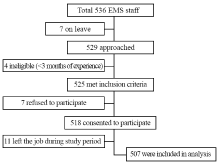
Figure 1.
Study flow diagram.
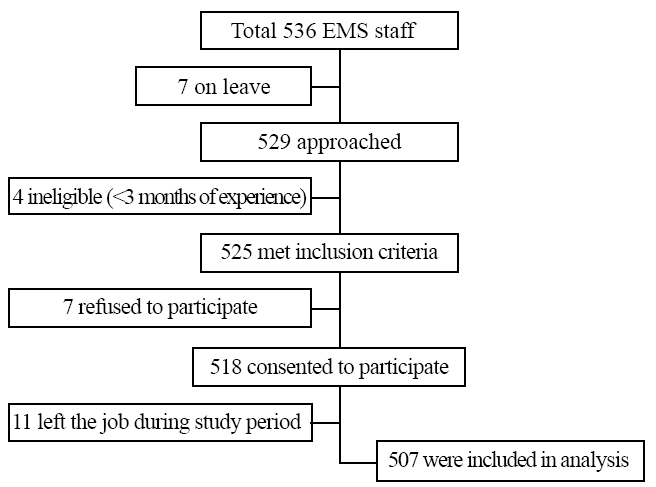
Table 3
Characteristics of study participants, n (%)
| Variables | Results (n=507) |
|---|---|
| Job type | |
| Doctors | 37 (7.3) |
| Nurses | 202 (39.8) |
| Drivers | 211 (42.6) |
| Paramedics | 57 (11.2) |
| Age groups in years | 32.4±5.8 |
| ≤25 | 52 (10.3) |
| 26-35 | 336 (66.2) |
| 36-45 | 105 (20.7) |
| ≥55 | 14 (2.8) |
| Marital status | |
| Single | 139 (27.4) |
| Married | 368 (72.6) |
| Living status | |
| Family | 426 (84.0) |
| Alone | 81 (15.8) |
| Years of experience* | 4±1.0 |
| Working hours in a week* | 47.2±6.5 |
| Years of formal schooling* | 13.8±2.9 |
| Household monthly income in PKR per month | |
| 10 000-25 000 | 195 (38.5) |
| 25 000-50 000 | 208 (41.0) |
| 50 000-100 000 | 88 (17.4) |
| 100 000-300 000 | 16 (3.2) |
| Substance abuse (addiction) | 174 (34.3) |
| Coping* | |
| Dysfunctional | 17.5±3.3 |
| Emotion focused | 24.5±3.9 |
| Problem focused | 25.3±3.2 |
| Social support* | |
| Family | 22.6±4.8 |
| Friends | 19.9±5.1 |
| Significant others | 19.7±7.3 |
| Family history of psychiatric illness | 82 (16.1) |
| Use of medicine to relive stress | 27 (5.3) |
| Anxiety and depression* (AKUADS) | 15.6±8.2 |
| Above cut-off? | 146 (28.8) |
| Post-traumatic stress disorder* (IES-R) | 24.0±12.2 |
| Above cut-off? | 111 (22.0) |
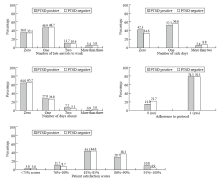
Figure 2.
Bar graph for work performance variables.
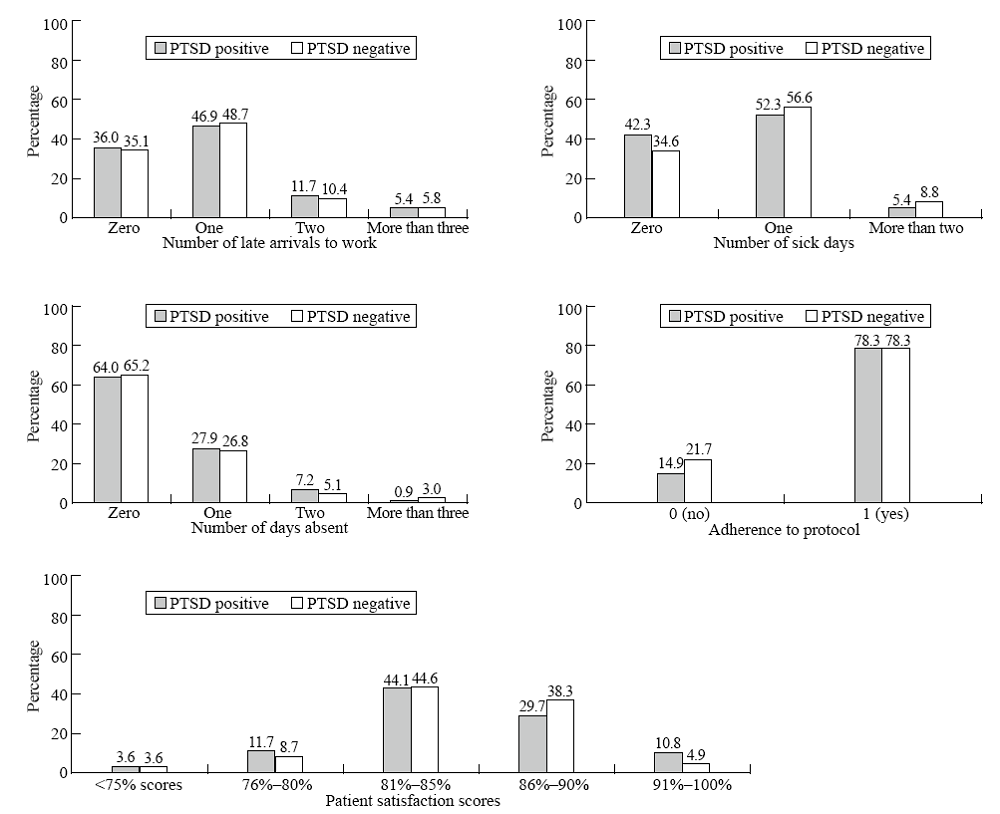
Table 4
Negative Binomial Regression for late arrivals to work (n=507)
| Variables | Unadjusted rate ratios | 95%CI | Adjusted rate ratios | 95%CI |
|---|---|---|---|---|
| PTSD | 1.00 | 0.99-1.01 | 0.99 | 0.98-1.00 |
| Years of formal schooling | 1.03 | 0.99-1.07 | 1.04 | 1.00-1.08 |
| Years of experience | 1.17 | 1.04-1.33 | 1.17 | 1.04-1.32 |
| Working hours per week | 1.02 | 1.01-1.04 | 1.02 | 1.01-1.04 |
| Social support of family | 0.97 | 0.94-0.99 | 0.97 | 0.94-0.99 |
Table 5
Negative Binomial Regression for days absent from work (n=507)
| Variables | Unadjusted rate ratios | 95%CI | Adjusted rate ratios | 95%CI |
|---|---|---|---|---|
| PTSD | 0.99 | 0.97 to 1.00 | 0.98 | 0.96-0.99 |
| Living status (Alone) | 1.70 | 1.02 to 2.81 | 1.78 | 1.09-2.93 |
| Dysfunctional coping | 1.06 | 0.99 to 1.13 | 1.08 | 0.99-1.05 |
Table 6
Negative Binomial Regression for sick days ( n=507)
| Variables | Unadjusted rate ratios | 95%CI | Adjusted rate ratios | 95%CI |
|---|---|---|---|---|
| PTSD | 0.99 | 0.98-0.99 | 0.99 | 0.98-1.00 |
| Age in years | 1.01 | 1.00-1.03 | 1.02 | 1.00-1.03 |
| Living status (Alone) | 1.33 | 1.01-1.74 | 1.38 | 1.05-1.82 |
Table 7
Logistic regression for adherence to protocol (n=332)
| Variables | Unadjusted OR | 95%CI | Adjusted OR | 95%CI |
|---|---|---|---|---|
| PTSD | 1.02 | 1.00-1.04 | 1.01 | 0.99-1.04 |
| Age in years | 0.86 | 0.82-0.91 | 0.89 | 0.84-0.95 |
| Years of formal schooling | 1.55 | 1.36-1.78 | 1.48 | 1.29-1.70 |
| Years of experience | 1.16 | 0.93-0.45 | 1.39 | 1.07-1.80 |
Table 8
Linear regression for patient satisfaction (n=502)
| Variables | Unadjusted β | 95%CI | Adjusted β | 95%CI |
|---|---|---|---|---|
| PTSD | 0.0001 | -0.0001 to 0.0003 | 0.00001 | -0.0003 to 0.0003 |
| Problem focused coping | 0.002 | 0.001 to 0.003 | 0.002 | 0.001 to 0 003 |
| 1 |
Donnelly E, Siebert D. Occupational risk factors in the emergency medical services. Prehosp Disaster Med. 2009; 24(5):422-9.
doi: 10.1017/s1049023x00007251 pmid: 20066645 |
| 2 |
Donnelly E. Work-related stress and posttraumatic stress in emergency medical services. Prehosp Emerg Care. 2012; 16(1):76-85.
doi: 10.3109/10903127.2011.621044 pmid: 22128908 |
| 3 |
Jonsson A, Segesten K, Mattsson B. Post-traumatic stress among Swedish ambulance personnel. Emerg Med J. 2003; 20(1):79-84.
doi: 10.1136/emj.20.1.79 |
| 4 | Misra M, Greenberg N, Hutchinson C, Brain A, Glozier N. Psychological impact upon London Ambulance Service of the 2005 bombings. Occup Med (Lond). 2009; 59(6):428-33. |
| 5 |
Mishra S, Goebert D, Char E, Dukes P, Ahmed I. Trauma exposure and symptoms of post-traumatic stress disorder in emergency medical services personnel in Hawaii. Emerg Med J. 2010; 27(9):708-11.
doi: 10.1136/emj.2009.080622 pmid: 20466825 |
| 6 |
Sterud T, Ekeberg O, Hem E. Health status in the ambulance services: a systematic review. BMC Health Serv Res. 2006; 6:82.
doi: 10.1186/1472-6963-6-82 pmid: 16817949 |
| 7 |
Bennett P, Williams Y, Page N, Hood K, Woollard M, Vetter N. Associations between organizational and incident factors and emotional distress in emergency ambulance personnel. Br J Clin Psychol. 2005; 44(Pt 2):215-26.
doi: 10.1348/014466505X29639 pmid: 16004656 |
| 8 |
Boscarino JA. Posttraumatic stress disorder and physical illness: results from clinical and epidemiologic studies. Ann N Y Acad Sci. 2004; 1032:141-53.
pmid: 15677401 |
| 9 | Breslau N. Outcomes of posttraumatic stress disorder. J Clin Psychiatry. 2001; 62 Suppl 17: 55-9. |
| 10 |
Breslau N, Lucia VC, Davis GC. Partial PTSD versus full PTSD: an empirical examination of associated impairment. Psychol Med. 2004; 34(7):1205-14.
doi: 10.1017/s0033291704002594 pmid: 15697047 |
| 11 |
Alonso J, Angermeyer M, Bernert S, Bruffaerts R, Brugha T, Bryson H, et al. Disability and quality of life impact of mental disorders in Europe: results from the European Study of the Epidemiology of Mental Disorders (ESEMeD) project. Acta Psychiatr Scand Suppl. 2004;(420):38-46.
doi: 10.1111/j.1600-0047.2004.00329.x pmid: 15128386 |
| 12 | Sasser S VM, Kellermann A, Lormand JD. Prehospital trauma care systems. Geneva: World Health Organization, 2005. |
| 13 | Diagnostic and statistical manual of mental disorders: DSM-IV-TR: American Psychiatric Association; 2000. |
| 14 | Weiss DS. The Impact of Event Scale: Revised. In: John P. Wilson CCS-KT, editor. Cross-Cultural Assessment of Psychological Trauma and PTSD: Springer Science & Business Media; 2007. |
| 15 |
Creamer M, Bell R, Failla S. Psychometric properties of the Impact of Event Scale - Revised. Behav Res Ther. 2003; 41(12):1489-96.
doi: 10.1016/j.brat.2003.07.010 pmid: 14705607 |
| 16 | Tareen MS, McDowell C, Naqvi K, Bashir A, Keenan P, Rehman Au, et al. The evaluation of an Urdu version of Impact of events scale - revised (UIES-R). International Psychiatry. 2012; 9(1). |
| 17 | Razik S, Ehring T, Emmelkamp PM. Psychological consequences of terrorist attacks: Prevalence and predictors of mental health problems in Pakistani emergency responders. Psychiatry Res. 2013; 207(1-2):80-5. |
| 18 | Ehring T, Razik S, Emmelkamp PM. Prevalence and predictors of posttraumatic stress disorder, anxiety, depression, and burnout in Pakistani earthquake recovery workers. Psychiatry Res. 2011; 185(1-2):161-6. |
| 19 | Bernard A, Lindsell C, Handel D, Collett L, Gallo P, Kaiser K, et al. Postal survey methodology to assess patient satisfaction in a suburban emergency medical services system: an observational study. BMC Emerg Med. 2007; 7:5. |
| 20 | Myers JB, Slovis CM, Eckstein M, Goodloe JM, Isaacs SM, Loflin JR, et al. Evidence-Based Performance Measures for Emergency Medical Services Systems: A Model for Expanded EMS Benchmarking: A Statement Developed by the 2007 Consortium US Metropolitan Municipalities' EMS Medical Directors. Prehospital Emergency Care. 2008; 12(2):141-51. |
| 21 | Deborah Shaw ANS. Report on National Ambulance Service Clinical Performance Indicators. UK: National Health Service NHS, 2012. |
| 22 |
Carver CS. You want to measure coping but your protocol's too long: consider the brief COPE. Int J Behav Med 1997; 4(1):92-100.
doi: 10.1207/s15327558ijbm0401_6 pmid: 16250744 |
| 23 |
Dahlem NW, Zimet GD, Walker RR. The Multidimensional Scale of Perceived Social Support: a confirmation study. J Clin Psychol. 1991; 47(6):756-61.
doi: 10.1002/1097-4679(199111)47:6<756::aid-jclp2270470605>3.0.co;2-l pmid: 1757578 |
| 24 | Brown RL, Rounds LA. Conjoint screening questionnaires for alcohol and other drug abuse: criterion validity in a primary care practice. Wis Med J. 1995; 94(3):135-40. |
| 25 | Karmaliani R, Bann CM, Pirani F, Akhtar S, Bender RH, Goldenberg RL, et al. Diagnostic validity of two instruments for assessing anxiety and depression among pregnant women in Hyderabad, Pakistan. Health Care Women Int. 2007; 28(6):556-72. |
| 26 | Boscarino JA, Adams RE, Figley CR. Worker productivity and outpatient service use after the September 11th attacks: Results from the New York City terrorism outcome study. Am J Ind Med. 2006 Aug; 49(8):670-82. |
| 27 |
Lim D, Sanderson K, Andrews G. Lost productivity among full time workers with mental disorders. J Ment Health Policy Econ. 2000; 3(3):139-46.
pmid: 11967449 |
| 28 | Sendhil Mullainathan aES. Scarcity: Why having too little means so much. New York: Macmillan; 2013. |
| 29 | Sheehy-Skeffington J. Decision-making up against the wall: A framework for understanding the behavioural dimension of low socioeconomic status. In: S. Oishi & A. Uskul (Eds), The Socioeconomic Environment and Human Psychology. Oxford: Oxford University Press. |
| 30 | Mohammed F. Protecting Pakistani Laborers Post-Eighteenth Amendment: Recognizing Rights after the Devolution of Power. Loyola University Chicago International Law Review. 2012; 9(2):265. |
| 31 | Sayeed A, editor Social Protection in Pakistan: Concept, Situation Analysis and the Way Forward. Proceedings of a Joint Seminar Organized by the Planning Commission, ILO and UNDP on Employment-based Poverty Reduction Strategy for Decent Work in Pakistan Pakistan Institute of Development Economics Islamabad; 2004. |
| 32 | Viswesvaran C. Assessment of individual job performance: A review of the past century and a look ahead. Handbook of Industrial, Work and Organizational Psychology. 2001; 1:110-26. |
| [1] | Yu-qing Cui, Xian-fei Ding, Huo-yan Liang, Dong Wang, Xiao-juan Zhang, Li-feng Li, Quan-cheng Kan, Le-xin Wang, Tong-wen Sun. Efficacy and safety of low-dose corticosteroids for acute respiratory distress syndrome: A systematic review and meta-analysis [J]. World Journal of Emergency Medicine, 2021, 12(3): 207-213. |
| [2] | Hao-tian Chen, Jian-feng Xu, Xiao-xia Huang, Ni-ya Zhou, Yong-kui Wang, Yue Mao. Blood eosinophils and mortality in patients with acute respiratory distress syndrome: A propensity score matching analysis [J]. World Journal of Emergency Medicine, 2021, 12(2): 131-136. |
| [3] | Yong Liang, Hong Zeng, Yu-geng Liu, Ai-min Xu, Wen-hong Liu. Prevalence of post-traumatic stress disorder after earthquakes among the elderly in China: A meta-analysis [J]. World Journal of Emergency Medicine, 2021, 12(2): 137-142. |
| [4] | Chang Pan, Jiao-jiao Pang, Kai Cheng, Feng Xu, Yu-guo Chen. Trends and challenges of emergency and acute care in Chinese mainland: 2005-2017 [J]. World Journal of Emergency Medicine, 2021, 12(1): 5-11. |
| [5] | Yi Han, Su-cheng Mu, Jian-li Wang, Wei Wei, Ming Zhu, Shi-lin Du, Min Min, Yun-jie Xu, Zhen-ju Song, Chao-yang Tong. MicroRNA-145 plays a role in mitochondrial dysfunction in alveolar epithelial cells in lipopolysaccharide-induced acute respiratory distress syndrome [J]. World Journal of Emergency Medicine, 2021, 12(1): 54-60. |
| [6] | Shuang-shuang Gu, Xiu-wen Kang, Jun Wang, Xiao-fang Guo, Hao Sun, Lei Jiang, Jin-song Zhang. Effects of extracellular vesicles from mesenchymal stem cells on oxygen-glucose deprivation/reperfusion-induced neuronal injury [J]. World Journal of Emergency Medicine, 2021, 12(1): 61-67. |
| [7] | Yu-ming Wang, Yan-jun Zheng, Ying Chen, Yun-chuan Huang, Wei-wei Chen, Ran Ji, Li-li Xu, Zhi-tao Yang, Hui-qiu Sheng, Hong-ping Qu, En-qiang Mao, Er-zhen Chen. Effects of fluid balance on prognosis of acute respiratory distress syndrome patients secondary to sepsis [J]. World Journal of Emergency Medicine, 2020, 11(4): 216-222. |
| [8] | Colin A. Meghoo, Stanislav Gaievskyi, Oleksandr Linchevskyy, Bindhu Oommen, Kateryna Stetsenko. Prehospital response to respiratory distress by the public ambulance system in a Ukrainian city [J]. World Journal of Emergency Medicine, 2019, 10(1): 42-45. |
| [9] | Siti Nasrina Yahaya, Shaik Farid Abdull Wahab, Muhammad Saiful Bahribin Yusoff, Mohd Azhar Mohd Yasin, Mohammed Alwi Abdul Rahman. Prevalence and associated factors of stress, anxiety and depression among emergency medical officers in Malaysian hospitals [J]. World Journal of Emergency Medicine, 2018, 9(3): 178-186. |
| [10] | Hui Xie, Zhi-gang Zhou, Wei Jin, Cheng-bin Yuan, Jiang Du, Jian Lu, Rui-lan Wang. Ventilator management for acute respiratory distress syndrome associated with avian influenza A (H7N9) virus infection: A case series [J]. World Journal of Emergency Medicine, 2018, 9(2): 118-124. |
| [11] | Emad Siddiqui, Badar Afzal, Ghazala Kazi, Asher Feroz, Rubaba Naeem, Tarab Mansoor, Ahreen Allana, Saif Siddiqui, Zain Siddiqui. Factors behind not using child restrain(t) among hospital employees and general population: A case control study [J]. World Journal of Emergency Medicine, 2017, 8(4): 269-275. |
| [12] | Muhammad Akbar Baig, Hira Shahzad, Erfan Hussain, Asad Mian. Validating a point of care lactate meter in adult patients with sepsis presenting to the emergency department of a tertiary care hospital of a low- to middle-income country [J]. World Journal of Emergency Medicine, 2017, 8(3): 184-189. |
| [13] | Linda Chokotho, Wakisa Mulwafu, Isaac Singini, Yasin Njalale, Kathryn H. Jacobsen. Improving hospital-based trauma care for road traffic injuries in Malawi [J]. World Journal of Emergency Medicine, 2017, 8(2): 85-90. |
| [14] | Andrew Fu Wah Ho, Pin Pin Pek, Stephanie Fook-Chong, Ting Hway Wong, Yih Yng Ng, Aaron Sung Lung Wong, Marcus Eng Hock Ong. Prehospital system delay in patients with ST-segment elevation myocardial infarction in Singapore [J]. World Journal of Emergency Medicine, 2015, 6(4): 277-282. |
| [15] | Ruo Wu, Shi-yun Lin, Hui-min Zhao. Albuterol in the treatment of acute respiratory distress syndrome: A meta-analysis of randomized controlled trials [J]. World Journal of Emergency Medicine, 2015, 6(3): 165-171. |
| Viewed | ||||||
|
Full text |
|
|||||
|
Abstract |
|
|||||

