World Journal of Emergency Medicine ›› 2015, Vol. 6 ›› Issue (1): 48-53.doi: 10.5847/wjem.j.1920-8642.2015.01.009
• Original Articles • Previous Articles Next Articles
Emad Hokkam1,2( ), Abdelaziz Gonna3, Ossama Zakaria4, Amany El-shemally4
Received:2014-05-07
Accepted:2015-01-06
Online:2015-03-15
Published:2015-03-15
Contact:
Emad Hokkam
E-mail:ehokkam@gmail.com
Emad Hokkam, Abdelaziz Gonna, Ossama Zakaria, Amany El-shemally. Trauma patterns in patients attending the Emergency Department of Jazan General Hospital, Saudi Arabia[J]. World Journal of Emergency Medicine, 2015, 6(1): 48-53.
Add to citation manager EndNote|Ris|BibTeX
URL: http://wjem.com.cn//EN/10.5847/wjem.j.1920-8642.2015.01.009
Table 1
Demographic characteristics of the patients (n=1 050)
| Variables | Number | % | |
|---|---|---|---|
| Age (years) | |||
| < 18 | 290 | 27.6 | |
| 18- | 473 | 45.1 | |
| 30- | 179 | 17.1 | |
| 50- | 69 | 6.5 | |
| ≥ 60 | 39 | 3.7 | |
| Mean±SD | 25.3±16.8 | ||
| Range | 1-80 | ||
| Sex | |||
| Male | 675 | 64.3 | |
| Female | 375 | 35.7 | |
| Residence | |||
| Rural | 414 | 39.4 | |
| Urban | 636 | 60.6 | |
Table 2
Trauma characteristics of the patients (n=1 050)
| Variables | Number | % | |||
|---|---|---|---|---|---|
| Types of trauma | |||||
| Blunt | 324 | 30.9 | |||
| Penetrating | 96 | 9.1 | |||
| Minor injury | 630 | 60 | |||
| Causes of trauma | |||||
| Blunt | |||||
| Motor car accident | 207 | 19.7 | |||
| Falling down | 48 | 4.6 | |||
| Violence | 69 | 6.6 | |||
| Penetrating | |||||
| Stabbing 62 | 5.9 | ||||
| Firearm 34 | 3.2 | ||||
| Minor injury | |||||
| Cut wound 420 | 40 | ||||
| Contused wound 210 | 20 | ||||
| Interval between trauma and hospitalization | |||||
| < 30 minutes | 323 | 30.8 | |||
| 30-60 minutes | 548 | 52.2 | |||
| 1-2 hours | 126 | 12 | |||
| ≥ 2 hours | 53 | 5 | |||
| Mean±SD | 41.3±79.8 | ||||
Table 3
Results of clinical evaluation of the patients (n=1 050)
| Variables | Results | |
|---|---|---|
| Heart rate (beats/minute) | ||
| Mean±SD | 88.4±10.2 | |
| Range | 40-140 | |
| Systolic BP (mmHg) | ||
| Mean±SD | 120.7±15.1 | |
| Range | 50-210 | |
| Diastolic BP (mmHg) | ||
| Mean±SD | 76.7±10.9 | |
| Range | 20-120 | |
| Respiratory rate (cycle/minute) | ||
| Mean±SD | 14.5±1.9 | |
| Range | 10-33 | |
| Consciousness level shown by AVPU scale (n, %) | ||
| Alert | 972 (92.6) | |
| Response to verbal stimuli | 30 (2.9) | |
| Response to painful stimuli | 3 (0.3) | |
| Unresponsive | 45 (4.3) | |
| Consciousness level by GCS (n, %) | ||
| 13-15 | 975 (92.9) | |
| 9-12 | 30 (2.9) | |
| 6-8 | 0 (0) | |
| 4-5 | 21 (2) | |
| 3 | 24 (2.2) | |
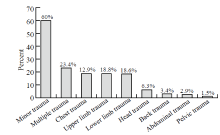
Figure 1.
The final diagnosis of the patients (n=1 050).
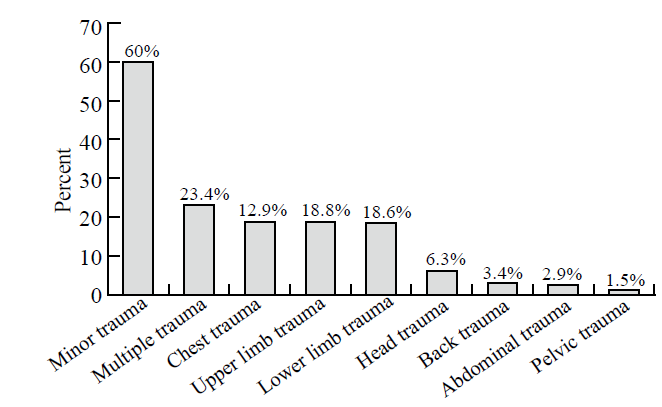
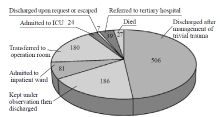
Figure 2.
Fate of the patients.
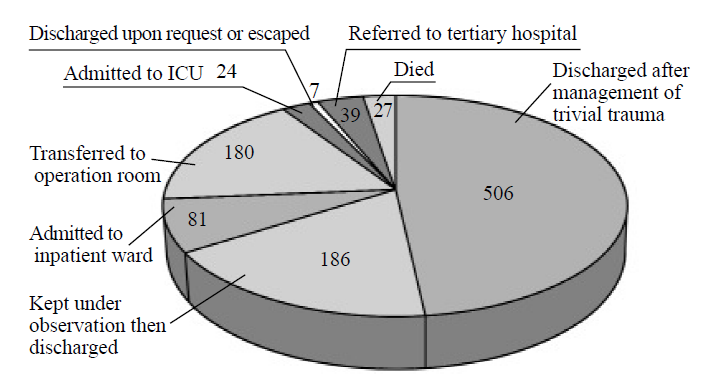
Table 4
Comparison between patients with blunt trauma and those with penetrating trauma (n, %)
| Characteristics | Blunt trauma | Penetrating trauma | Pvalue | |
|---|---|---|---|---|
| Age (years) | ||||
| < 18 | 58 (17.9) | 11 (11.5) | 0.003* | |
| 18- | 156 (48.1) | 43 (44.7) | ||
| 30- | 56 (17.3) | 28 (29.2) | ||
| 50- | 31 (9.6) | 14 (14.6) | ||
| ≥ 60 | 23 (7.1) | 0 (0) | ||
| Sex | ||||
| Male | 178 (54.9) | 86 (89.6) | 0.001* | |
| Female | 146 (45.1) | 10 (10.4) | ||
| Total | 324 | 96 | ||
| Residence | ||||
| Rural | 115 (35.5) | 39 (40.6) | 0.4 (NS) | |
| Urban | 209 (64.5) | 57 (59.4) | ||
| Interval between trauma and hospitalization | ||||
| ≤ 30 minutes | 81 (25) | 35 (36.5) | 0.001* | |
| 30-60 minutes | 153 (47.2) | 50 (52.1) | ||
| 1-2 hours | 71 (21.9) | 7 (7.3) | ||
| ≥ 2 hours | 19 (5.9) | 4 (4.2) | ||
| Duration of stay in emergency room | ||||
| ≤ 30 minutes | 59 (18.2) | 24 (25) | 0.003* | |
| > 30-60 minutes | 83 (25.6) | 37 (38.5) | ||
| 60-180 minutes | 135 (41.7) | 17 (17.7) | ||
| > 3 hours | 47 (14.5) | 18 (18.8) | ||
| Fate | ||||
| Discharged after treatment of trivial trauma | 69 (21.3) | 14 (14.6) | 0.001* | |
| Kept under observation then discharged | 43 (13.3) | 6 (6.3) | 0.001* | |
| Admitted to inpatient wards | 14 (4.3) | 1 (1) | 0.04* | |
| Transferred to operation room | 124 (38.3) | 56 (58.3) | 0.003* | |
| Admitted to ICU | 18 (5.6) | 6 (6.3) | 0.9 (NS) | |
| Discharged upon request or escaped | 0 (0) | 3 (3.1) | 0.6 (NS) | |
| Referred to tertiary hospital | 36 (11.1) | 3 (3.1) | 0.002* | |
| Died | 20 (6.2) | 7 (7.3) | 0.3 (NS) | |
Table 5
The relationship between the time from trauma to hospitalization and the fate of the patients with same type of trauma (n)
| Variables | Minor injury (n=630) | Blunt injury (n=324) | Penetrating injury (n=96) | ||||||||||||
|---|---|---|---|---|---|---|---|---|---|---|---|---|---|---|---|
| < 30minutes | 30-60 minutes | 1-2 hours | ≥ 2 hours | Total | < 30minutes | 30-60 minutes | 1-2 hours | ≥ 2 hours | Total | < 30minutes | 30-60 minutes | 1-2 hours | ≥ 2 hours | Total | |
| Discharged after management of trivial trauma | 140 | 231 | 32 | 20 | 423 | 17 | 33 | 15 | 4 | 69 | 5 | 7 | 1 | 1 | 14 |
| Kept under observation then discharged | 45 | 75 | 10 | 7 | 137 | 11 | 20 | 9 | 3 | 43 | 2 | 3 | 0 | 1 | 6 |
| Admitted to inpatient ward | 22 | 36 | 5 | 3 | 66 | 4 | 6 | 3 | 1 | 14 | 0 | 1 | 0 | 0 | 1 |
| Transferred to operation room | 0 | 0 | 0 | 0 | 0 | 31 | 59 | 27 | 7 | 124 | 21 | 28 | 5 | 2 | 56 |
| Admitted to ICU | 0 | 0 | 0 | 0 | 0 | 4 | 9 | 4 | 1 | 18 | 2 | 3 | 1 | 0 | 6 |
| Discharged upon request or escaped | 0 | 3 | 1 | 0 | 4 | 0 | 0 | 0 | 0 | 0 | 1 | 2 | 0 | 0 | 3 |
| Referred to tertiary hospital | 0 | 0 | 0 | 0 | 0 | 9 | 16 | 9 | 2 | 36 | 1 | 2 | 0 | 0 | 3 |
| Died | 0 | 0 | 0 | 0 | 0 | 5 | 10 | 4 | 1 | 20 | 3 | 4 | 0 | 0 | 7 |
| Total | 207 | 345 | 48 | 30 | 630 | 81 | 153 | 71 | 19 | 324 | 35 | 50 | 7 | 4 | 96 |
| 1 | Baker SP. Where have you been and where are you going with injury control? In: Mohan D, Tiwari G. eds. Injury prevention and control. New York: Taylor and Francis Publishers; 2000: 22. |
| 2 | Ali K, Arain GM, Masood AS, Aslam M. Pattern of injuries in trauma patients presenting in Accident and Emergency Department of Jinnah Hospital, Lahore. Ann King Edward Med Coll 2006; 12:26. |
| 3 | Tabish SA, Shah S, Bhat AS, Bhat FA, Shoukat H, Mir My. Clinical profile and mortality pattern in patients of ballistic trauma. JIMSA 2004; 13:247-250. |
| 4 | World Health Organization. World report on violence and health: Summary. Geneva, Switzerland: World Health Organization, 2002; 1-34. |
| 5 | Soroush AR, Ghahri-Saremi SH, Rambod M, Malek-Hosseini SA, Nick-Eghbal S, Khaji A. Pattern of injuries in Shiraz. Chinese J Trauma 2008; 11:2-8. |
| 6 |
Ansari S, Akhdar F, Mandoorah M, Moutaery K. Causes and effects of road traffic accidents in Saudi Arabia. Public Health 2000; 114:37-39.
doi: 10.1016/S0033-3506(00)00306-1 |
| 7 | Al-Turki S. Trauma and ATLS training in Saudi Arabia. Middle East J Emerg Med 2001; 1:50-55 |
| 8 |
Murray CJ, Lopez AD. Alternative projections of mortality and disability by cause 1990-2020: Global Burden of Disease Study. Lancet 1997; 349:1498-1504.
doi: 10.1016/S0140-6736(96)07492-2 |
| 9 | Celso B, Tepas J, Langland-Orban B, Pracht E, Papa L, Lottenberg L, et al. A systematic review and meta-analysis comparing outcome of severely injured patients treated in trauma centers following the establishment of trauma systems. J Trauma 2006; 60:371-378. |
| 10 | Al-Naami MY, Arafah MA, Al-Ibrahim FS. Trauma care systems in Saudi Arabia: an agenda for action. Ann Saudi Med 2010; 30:50-58. |
| 11 |
Bhanderi DJ, Choudhary S. A study of occurrence of domestic accidents in semi-urban community. Indian J Community Med 2008; 33:104-106.
pmid: 19967034 |
| 12 | Drever F. Occupational Health Decennial Supplement. 1st edition, London: HMSO, 1995. |
| 13 |
Al-Dawood K. Non-fatal occupational injuries requiring admission to hospitals in Al-Khobar City, Saudi Arabia: prospective cohort study. Croat Med J 2000; 41:323-326.
pmid: 10962054 |
| 14 | Smith K. Enviromental Hazards. 2nd edition, London, New York: Routledge, 1996. |
| 15 | UNISDR: preventionweb Saudi Arabia - Disaster Statistics. Available at: http://www.preventionweb.net/english/countries/statistics/?cid=150. |
| 16 | Summerfield D. The social, cultural and political dimensions of contemporary war. Med Confl Surviv 1997; 13:3-25. |
| 17 | World Report on Road Traffic Injury Prevention-Summary. Geneva: World Health Organization; 2004. |
| 18 | Mizelle HL, Rothrock SG, Silvestri S, Pagane J. Preventable morbidity and mortality from peripheral paralytic assisted intubation. Prehospital Emerg Care 2002; 6:472. |
| 19 | Morris SC. The Team Approach to Management of the Polytrauma Patient. Virtual Mentor 2009; 11:516-520. |
| 20 | Akoğlu H, Denizbaşı A, Ünlüer E, Güneysel O, Onur O. Demographic characteristics of trauma patients of the emergency department of Marmara University Hospital. Marmara Med J 2005; 18:113-122. |
| 21 | Norris FH. Epidemiology of trauma: frequency and impact of different potentially traumatic events on different demographic groups. J Consult Clin Psychol 1992; 60:409-418. |
| 22 | Liberman M, Mulder D, Lavoie A, Denis R, Sampalis JS. Multicenter Canadian study of prehospital trauma care. Ann Surg 2003; 237:153-160. |
| 23 |
Shafi S, Gentilello L. Pre-hospital endotracheal intubation and positive pressure ventilation is associated with hypotension and decreased survival in hypovolemic trauma patients: an analysis of the National Trauma Data Bank. J Trauma 2005; 59:1140-1145.
pmid: 16385292 |
| 24 | Vajda P. Prehospital care of the adult trauma patient. Bratisl Lek Listy 2007; 108:371-374. |
| 25 |
Kazmi TH, Omair A, Inam SB, Shaikh I, Jamali S. Spectrum of injuries at the Emergency Department of a Tertiary Care Hospital. J Coll Physicians Surg Pak 2004; 14:61.
pmid: 14764269 |
| [1] | Lori Stolz, Elaine Situ-LaCasse, Josie Acuña, Matthew Thompson, Nicolaus Hawbaker, Josephine Valenzuela, Uwe Stolz, Srikar Adhikari. What is the ideal approach for emergent pericardiocentesis using point-of-care ultrasound guidance? [J]. World Journal of Emergency Medicine, 2021, 12(3): 169-173. |
| [2] | Janett Kreutziger, Philip Puchner, Stefan Schmid, Wolfgang Mayer, Harald Prossliner, Wolfgang Lederer. Accuracy of training blood volume quantification using a visual estimation tool [J]. World Journal of Emergency Medicine, 2021, 12(3): 174-178. |
| [3] | Gui-long Feng, Miao-miao Zheng, Shi-hong Yao, Yin-qi Li, Shao-jun Zhang, Wei-jing Wen, Kai Fan, Jia-li Zhang, Xiao Zhang. Risk factors and predictive model of adrenocortical insufficiency in patients with traumatic brain injury [J]. World Journal of Emergency Medicine, 2021, 12(3): 179-184. |
| [4] | Kasım Turgut, Erdal Yavuz, Mine Kayacı Yıldız, Mehmet Kaan Poyraz. Violence toward emergency physicians: A prospective-descriptive study [J]. World Journal of Emergency Medicine, 2021, 12(2): 111-116. |
| [5] | Yong Liang, Hong Zeng, Yu-geng Liu, Ai-min Xu, Wen-hong Liu. Prevalence of post-traumatic stress disorder after earthquakes among the elderly in China: A meta-analysis [J]. World Journal of Emergency Medicine, 2021, 12(2): 137-142. |
| [6] | Marin Pavlov, Lucija Klobučar, Iva Klobučar, Kristina Žgela, Vesna Degoricija. Does shifting to professional emergency department staffing affect the decision for chest radiography? [J]. World Journal of Emergency Medicine, 2021, 12(2): 87-92. |
| [7] | Hady Zgheib, Aline El Zakhem, Cynthia Wakil, Mohamad Ali Cheaito, Rola Cheaito, Antoine Finianos, Ralphe Bou Chebl, Rima Kaddoura, Nader Al Souky, Imad El Majzoub. Role of urine studies in asymptomatic febrile neutropenic patients presenting to the emergency department [J]. World Journal of Emergency Medicine, 2021, 12(2): 99-104. |
| [8] | William Gilliam, Jackson F. Barr, Brandon Bruns, Brandon Cave, Jordan Mitchell, Tina Nguyen, Jamie Palmer, Mark Rose, Safura Tanveer, Chris Yum, Quincy K. Tran. Factors associated with refractory pain in emergency patients admitted to emergency general surgery [J]. World Journal of Emergency Medicine, 2021, 12(1): 12-17. |
| [9] | Chang Pan, Jiao-jiao Pang, Kai Cheng, Feng Xu, Yu-guo Chen. Trends and challenges of emergency and acute care in Chinese mainland: 2005-2017 [J]. World Journal of Emergency Medicine, 2021, 12(1): 5-11. |
| [10] | Rebekah Shaw, Erica Popovsky, Alyssa Abo, Marni Jacobs, Nicole Herrera, James Chamberlain, Andrea Hahn. Improving antibiotic prescribing in the emergency department for uncomplicated community-acquired pneumonia [J]. World Journal of Emergency Medicine, 2020, 11(4): 199-205. |
| [11] | Hai-jiang Zhou, Tian-fei Lan, Shu-bin Guo. Outcome prediction value of National Early Warning Score in septic patients with community-acquired pneumonia in emergency department: A single-center retrospective cohort study [J]. World Journal of Emergency Medicine, 2020, 11(4): 206-215. |
| [12] | Chuan-qi Ding, Yu-ping Zhang, Yu-wei Wang, Min-fei Yang, Sa Wang, Nian-qi Cui, Jing-fen Jin. Death and do-not-resuscitate order in the emergency department: A single-center three-year retrospective study in the Chinese mainland [J]. World Journal of Emergency Medicine, 2020, 11(4): 231-237. |
| [13] | Rui Zhang, Meng-yang Xue, Bao-shan Liu, Wen-jun Wang, Xin-hui Fan, Bo-yuan Zheng, Qiu-huan Yuan, Feng Xu, Jia-li Wang, Yu-guo Chen. Aldehyde dehydrogenase 2 preserves mitochondrial morphology and attenuates hypoxia/reoxygenation-induced cardiomyocyte injury [J]. World Journal of Emergency Medicine, 2020, 11(4): 246-254. |
| [14] | Wei-shuyi Ruan, Yuan-qiang Lu. The life-saving emergency thoracic endovascular aorta repair management on suspected aortoesophageal foreign body injury [J]. World Journal of Emergency Medicine, 2020, 11(3): 152-156. |
| [15] | Guo-xiong Chen, Hong-na Wang, Jin-lin Zou, Xiao-xu Yuan. Effects of intracoronary injection of nicorandil and tirofiban on myocardial perfusion and short-term prognosis in elderly patients with acute ST-segment elevation myocardial infarction after emergency PCI [J]. World Journal of Emergency Medicine, 2020, 11(3): 157-163. |
| Viewed | ||||||
|
Full text |
|
|||||
|
Abstract |
|
|||||

