World Journal of Emergency Medicine ›› 2014, Vol. 5 ›› Issue (1): 24-28.doi: 10.5847/wjem.j.issn.1920-8642.2014.01.004
• Original Articles • Previous Articles Next Articles
HY Chan( ), SM Lo, LLY Lee, WYL Lo, WC Yu, YF Wu, ST Ho, RSD Yeung, JTS Chan
Received:2013-05-16
Accepted:2013-11-17
Online:2014-03-15
Published:2014-03-15
Contact:
HY Chan
E-mail:chy387@ha.org.hk
HY Chan, SM Lo, LLY Lee, WYL Lo, WC Yu, YF Wu, ST Ho, RSD Yeung, JTS Chan. Lean techniques for the improvement of patients' flow in emergency department[J]. World Journal of Emergency Medicine, 2014, 5(1): 24-28.
Add to citation manager EndNote|Ris|BibTeX
URL: http://wjem.com.cn//EN/10.5847/wjem.j.issn.1920-8642.2014.01.004
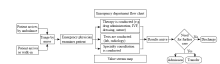
Figure 1.
Emergency department logistics flow chart.
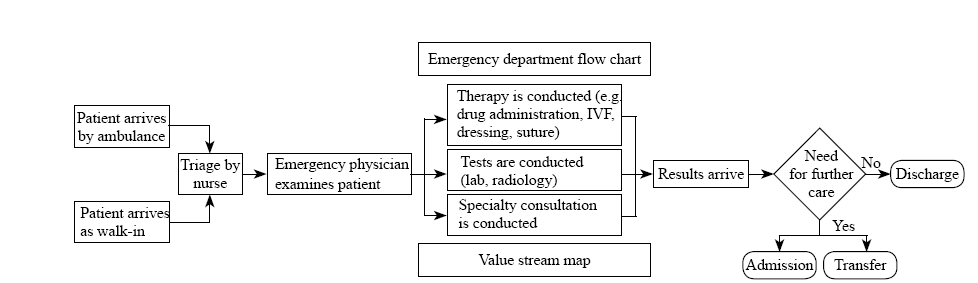
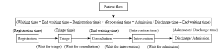
Figure 2.
Value stream map.
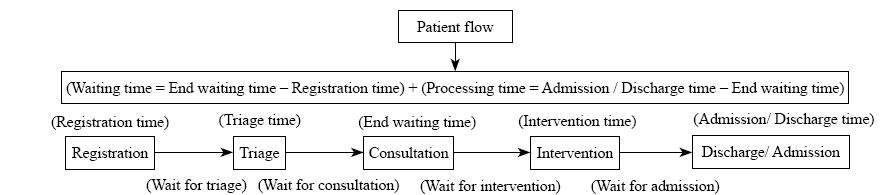

Figure 3.
Time determinants of patient flow in ED.
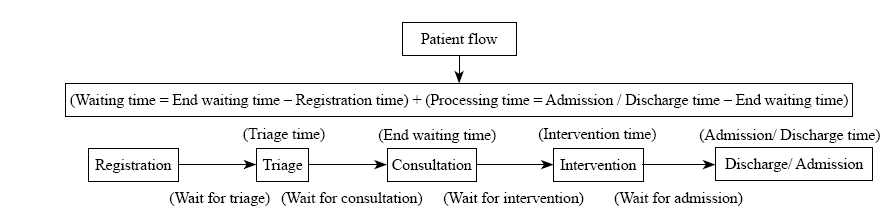
Table 1
Lean management work in ED
| Process change | Specific example | Expected outcome |
|---|---|---|
| Structured re-design process | Re-engineering the layout of each consultation room | Reduce end waiting consultation time |
| Inventory control and easy access in each consultation room | Reduce total processing time | |
| Relocate the drug cupboard | Reduce triage waiting time | |
| Relocate the treatment area | Reduce intervention time | |
| Increase the number of consultation rooms | ||
| Re-design the signage | ||
| Re-construct nursing station | ||
| Priority Admission Triage Program | Admission screening and prioritization by emergency specialist | Reduce EMW admission waiting time |
| Diverse the sub-acute medical patient to EMW | Reduce avoidable medical admission | |
| Communication with medical department | Centralized bed co-ordination system | Reduce admission waiting time |
| Report medical bed vacancy every three hours | ||
| Update medical bed vacancy in a timely manner | Reduce ED overcrowding | |
| Consult medical bed coordinator in urgent situation | ||
| Activate overflow system when necessary | ||
| Cardiac Troponin-T blood test | Perform for patient complained of chest pain | Reduce blood result time |
| Distinguish unstable angina patient from one with myocardial infarction without ST-segment elevation | ||
| High sensitivity and specificity | Reduce total processing time |
Table 2
Comparison of time interval changes between the pre- and post-lean periods
| Variables | Pre-lean mean (min) | Post-lean mean (min) | P< |
|---|---|---|---|
| Triage waiting time | 3.18 (4.235) | 2.63 (3.591) | 0.05 |
| Consultation waiting time | 13.68 (9.731) | 11.65 (7.213) | 0.05 |
| Final waiting time | 16.86 (10.92) | 14.28 (7.876) | 0.05 |
| Blood result time | 60.01 (30.31) | 76.42 (33.69) | NS |
| Admission waiting time | 28.99 (55.60) | 38.24 (66.34) | 0.05 |
| EMW admission waiting time | 54.76 (80.89) | 24.45 (41.63) | 0.05 |
| Processing time | 100.86 (81.40) | 143.41 (114.26) | 0.05 |
| Length of stay in ED | 117.71 (82.28) | 157.70 (113.51) | 0.05 |
| 1 |
Holden RJ. Lean thinking in emergency departments: a critical review. Ann Emerg Med 2011; 57:265-278.
doi: 10.1016/j.annemergmed.2010.08.001 |
| 2 |
Khan NS, Jain S. Quality initiatives in the emergency department. Curr Opin Pediatr 2010; 22:262-267.
pmid: 20463485 |
| 3 |
Kimsey DB. Lean methodology in health care. AORN J 2010; 92:53-60.
doi: 10.1016/j.aorn.2010.01.015 pmid: 20619772 |
| 4 |
Mazzocato P, Savage C, Brommels M, Aronsson H, Thor J. Lean thinking in healthcare: a realist review of the literature. Qual Saf Health Care 2010; 19:376-382.
pmid: 20724397 |
| 5 | Black J, Miller D. The Toyota way to healthcare excellence: increase efficiency and improve quality with Lean. Foundation of the American College of Healthcare Executives: Health Administration Press. 2008. |
| 6 |
Dart RC. Can lean thinking transform American health care? Ann Emerg Med 2011; 57:279-281.
doi: 10.1016/j.annemergmed.2010.11.027 pmid: 21227539 |
| 7 | Graban M. Lean hospitals: improving quality, patient safety and employee satisfaction. London: CRC Press. 2009. |
| 8 | Dickson EW, Singh S, Cheung DS, Wyatt CC, Nugent AS. Application of lean manufacturing techniques in the emergency department. J Emerg Med 2009; 37:177-182. |
| 9 |
Ng D, Vail G, Thomas S, Schmidt N. Applying the lean principles of the Toyota Production System to reduce wait times in the emergency department. CJEM 2010; 12:50-57.
doi: 10.1017/s1481803500012021 pmid: 20078919 |
| 10 |
Pester J, Robinson J, Prestosh J, Roozendaal S, Jeanmonod R. Impact of the United States propofol ban on emergency providers' procedural sedation agent choice and patient length of stay. World J Emerg Med 2012; 3:177-181.
pmid: 25215059 |
| 11 |
King DL, Ben-Tovim DI, Bassham J. Redesigning emergency department patient flows: application of lean thinking to health care. Emerg Med Australas 2006; 18:391-397.
doi: 10.1111/j.1742-6723.2006.00872.x pmid: 16842310 |
| 12 |
Miró O, Sánchez M, Espinosa G, Coll-Vinent B, Bragulat E, Millá J. Analysis of patient flow in the emergency department and the effect of an extensive reorganization. Emerg Med J 2003; 20:143-148.
doi: 10.1136/emj.20.2.143 pmid: 12642527 |
| 13 |
Simon RW, Canacari EG. Applying lean to the perioperative environment. AORN J 2012; 95:85-100.
doi: 10.1016/j.aorn.2011.05.021 pmid: 22201573 |
| [1] | Lori Stolz, Elaine Situ-LaCasse, Josie Acuña, Matthew Thompson, Nicolaus Hawbaker, Josephine Valenzuela, Uwe Stolz, Srikar Adhikari. What is the ideal approach for emergent pericardiocentesis using point-of-care ultrasound guidance? [J]. World Journal of Emergency Medicine, 2021, 12(3): 169-173. |
| [2] | Kasım Turgut, Erdal Yavuz, Mine Kayacı Yıldız, Mehmet Kaan Poyraz. Violence toward emergency physicians: A prospective-descriptive study [J]. World Journal of Emergency Medicine, 2021, 12(2): 111-116. |
| [3] | Marin Pavlov, Lucija Klobučar, Iva Klobučar, Kristina Žgela, Vesna Degoricija. Does shifting to professional emergency department staffing affect the decision for chest radiography? [J]. World Journal of Emergency Medicine, 2021, 12(2): 87-92. |
| [4] | Hady Zgheib, Aline El Zakhem, Cynthia Wakil, Mohamad Ali Cheaito, Rola Cheaito, Antoine Finianos, Ralphe Bou Chebl, Rima Kaddoura, Nader Al Souky, Imad El Majzoub. Role of urine studies in asymptomatic febrile neutropenic patients presenting to the emergency department [J]. World Journal of Emergency Medicine, 2021, 12(2): 99-104. |
| [5] | William Gilliam, Jackson F. Barr, Brandon Bruns, Brandon Cave, Jordan Mitchell, Tina Nguyen, Jamie Palmer, Mark Rose, Safura Tanveer, Chris Yum, Quincy K. Tran. Factors associated with refractory pain in emergency patients admitted to emergency general surgery [J]. World Journal of Emergency Medicine, 2021, 12(1): 12-17. |
| [6] | Rebekah Shaw, Erica Popovsky, Alyssa Abo, Marni Jacobs, Nicole Herrera, James Chamberlain, Andrea Hahn. Improving antibiotic prescribing in the emergency department for uncomplicated community-acquired pneumonia [J]. World Journal of Emergency Medicine, 2020, 11(4): 199-205. |
| [7] | Hai-jiang Zhou, Tian-fei Lan, Shu-bin Guo. Outcome prediction value of National Early Warning Score in septic patients with community-acquired pneumonia in emergency department: A single-center retrospective cohort study [J]. World Journal of Emergency Medicine, 2020, 11(4): 206-215. |
| [8] | Chuan-qi Ding, Yu-ping Zhang, Yu-wei Wang, Min-fei Yang, Sa Wang, Nian-qi Cui, Jing-fen Jin. Death and do-not-resuscitate order in the emergency department: A single-center three-year retrospective study in the Chinese mainland [J]. World Journal of Emergency Medicine, 2020, 11(4): 231-237. |
| [9] | Maybritt I. Kuypers, Adinda Klijn, Nieke E. Mullaart-Jansen, Frans B. Plötz. Availability and quality of procedural sedation and analgesia in emergency departments without emergency physicians: A national survey in the Netherlands [J]. World Journal of Emergency Medicine, 2020, 11(2): 69-73. |
| [10] | Emily Shao, Chantelle Judge, Erin McMeniman, Tina Bazianas, Rob Eley. Presenting patterns of dermatology conditions to an Australian emergency department [J]. World Journal of Emergency Medicine, 2020, 11(2): 74-78. |
| [11] | Zhenghong Liu, Mingwei Ng, Dinesh V. Gunasekeran, Huihua Li, Kishanti Ponampalam, R Ponampalam. Mobile technology: Usage and perspective of patients and caregivers presenting to a tertiary care emergency department [J]. World Journal of Emergency Medicine, 2020, 11(1): 5-11. |
| [12] | Ahmad Pouyamehr, Amir Mirhaghi, Mohammad Davood Sharifi, Ali Eshraghi. Comparison between Emergency Severity Index and Heart Failure Triage Scale in heart failure patients: A randomized clinical trial [J]. World Journal of Emergency Medicine, 2019, 10(4): 215-221. |
| [13] | Wirachin Hoonpongsimanont, Preet Kaur Sahota, Yanjun Chen, Maria Nguyen, Christine Louis, Jonathan Pena, Andrew Wong, Maxwell Jen. Emergency department patient experience: Same location, same provider, different scores by different survey methods [J]. World Journal of Emergency Medicine, 2019, 10(3): 138-144. |
| [14] | Chang Pan, Xiao-ran Huang, Jiao-jiao Pang, Kai Cheng, Feng Xu, Yu-guo Chen. Trends in mortality of emergency departments patients in China [J]. World Journal of Emergency Medicine, 2019, 10(3): 152-155. |
| [15] | Rakesh Gupta, Isaac Siemens, Sam Campbell. The use of outcome feedback by emergency medicine physicians: Results of a physician survey [J]. World Journal of Emergency Medicine, 2019, 10(1): 14-18. |
| Viewed | ||||||
|
Full text |
|
|||||
|
Abstract |
|
|||||

