World Journal of Emergency Medicine ›› 2014, Vol. 5 ›› Issue (2): 116-121.doi: 10.5847/wjem.j.issn.1920-8642.2014.02.007
• Original Articles • Previous Articles Next Articles
Qing-ming Lin1, Xiang-shao Fang2,3, Li-li Zhou2,3, Yue Fu2,3, Jun Zhu2,3, Zi-tong Huang2,3( )
)
Received:2013-11-22
Accepted:2014-04-12
Online:2014-06-15
Published:2014-06-15
Contact:
Zi-tong Huang
E-mail:huangztdoc@126.com
Qing-ming Lin, Xiang-shao Fang, Li-li Zhou, Yue Fu, Jun Zhu, Zi-tong Huang. Changes of end-tidal carbon dioxide during cardiopulmonary resuscitation from ventricular fibrillation versus asphyxial cardiac arrest[J]. World Journal of Emergency Medicine, 2014, 5(2): 116-121.
Add to citation manager EndNote|Ris|BibTeX
URL: http://wjem.com.cn//EN/10.5847/wjem.j.issn.1920-8642.2014.02.007
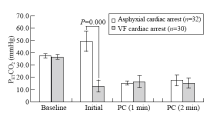
Figure 1.
Partial pressure of end-tidal carbon dioxide (PETCO2) during PC in VF and asphyxial cardiac arrests.
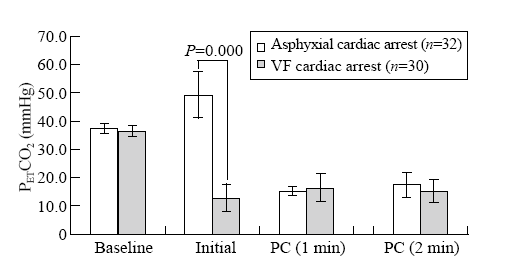
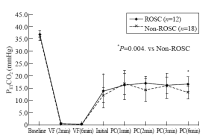
Figure 2.
Partial pressure of end-tidal carbon dioxide (PETCO2) before and after VF cardiac arrest. PC: precordial compression; ROSC: return of spontaneous circulation.
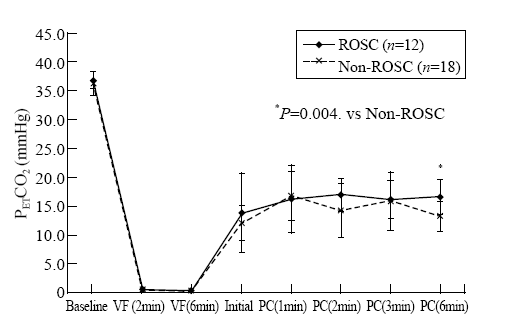
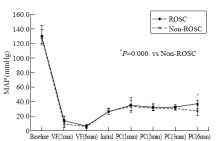
Figure 3.
MAP before and after VF cardiac arrest. PC: precordial compression; ROSC: return of spontaneous circulation.
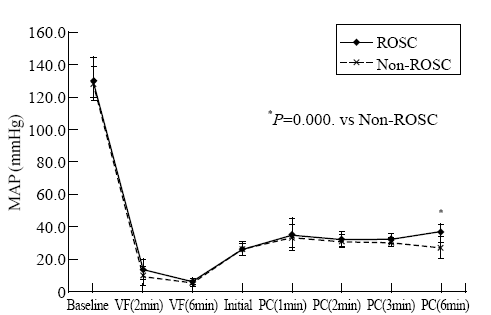
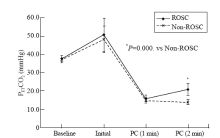
Figure 4.
Partial pressure of end-tidal carbon dioxide (PETCO2) before and after asphyxial cardiac arrest. PC: precordial compression; ROSC: return of spontaneous circulation.
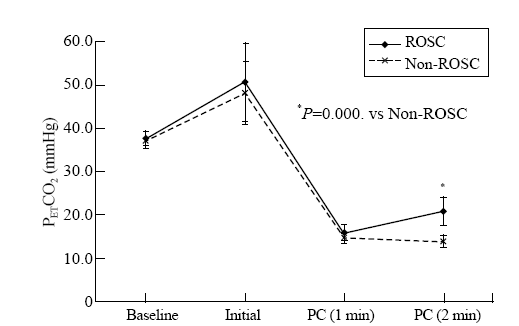
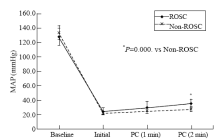
Figure 5.
MAP before and after asphyxial cardiac arrest. PC: precordial compression; ROSC: return of spontaneous circulation.
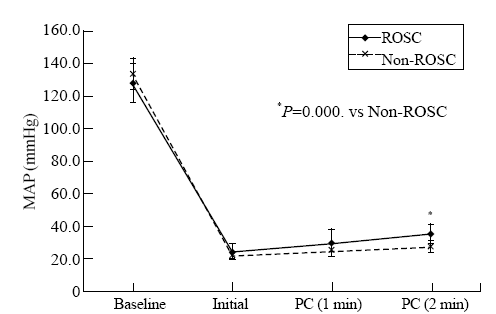
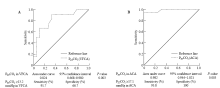
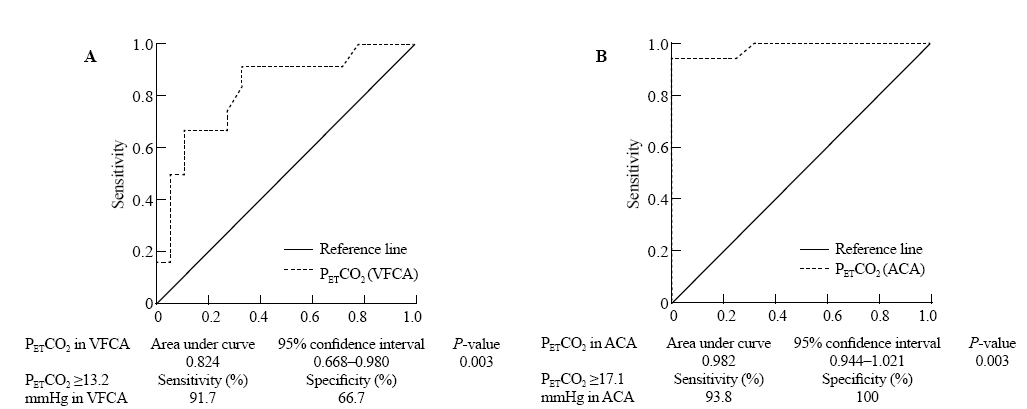
Figure 6.
ROC curves for partial pressure of end-tidal carbon dioxide (PETCO2) in terms of predicting ROSC when measured at 6 minutes after precordial compression for VFCA rats (A) or at 2 minutes after precordial compression for ACA rats (B). The sensitivities and specificities threshold values for predicting ROSC. ROSC: return of spontaneous circulation; VFCA: ventricular fibrillation cardiac arrest; ACA: asphyxial cardiac arrest.
| 1 |
Field JM, Hazinski MF, Sayre MR, Chameides L, Schexnayder SM, Hemphill R, et al. Part 1: executive summary: 2010 American Heart Association Guidelines for Cardiopulmonary Resuscitation and Emergency Cardiovascular Care. Circulation 2010; 122:S640-56.
doi: 10.1161/CIRCULATIONAHA.110.970889 pmid: 20956217 |
| 2 |
Pokorná M, Necas E, Kratochvíl J, Skripský R, Andrlík M, Franek O. A sudden increase in partial pressure end-tidal carbon dioxide (PETCO2) at the moment of return of spontaneous circulation. J Emerg Med 2010; 38:614-621.
doi: 10.1016/j.jemermed.2009.04.064 pmid: 19570645 |
| 3 | Sehra R, Underwood K, Checchia P. End tidal CO2 is a quantitative measure of cardiac arrest. Pacing.Clin Electrophysiol 2003; 26(1 Pt 2):515-517. |
| 4 |
Kolar M, Krizmaric M, Klemen P, Grmec S. Partial pressure of end-tidal carbon dioxide successful predicts cardiopulmonary resuscitation in the field: a prospective observational study. Crit Care 2008; 12:R115.
doi: 10.1186/cc7009 pmid: 18786260 |
| 5 |
Weil MH. Partial pressure of end-tidal carbon dioxide predicts successful cardiopulmonary resuscitation in the field. Crit Care 2008; 12:90.
doi: 10.1186/cc7090 pmid: 19014673 |
| 6 |
Lah K, Križmarić M, Grmec S. The dynamic pattern of end-tidal carbon dioxide during cardiopulmonary resuscitation: difference between asphyxial cardiac arrest and ventricular fibrillation/pulseless ventricular tachycardia cardiac arrest. Crit Care 2011; 15:R13.
pmid: 21223550 |
| 7 |
Grmec S, Lah K, Tusek-Bunc K. Difference in end-tidal CO2 between asphyxia cardiac arrest and ventricular fibrillation/pulseless ventricular tachycardia cardiac arrest in the prehospital setting. Crit Care 2003; 7:R139-144.
doi: 10.1186/cc2369 pmid: 14624688 |
| 8 |
Berg RA, Henry C, Otto CW, Sanders AB, Kern KB, Hilwig RW, et al. Initial end-tidal CO2 is markedly elevated during cardiopulmonary resuscitation after asphyxial cardiac arrest. Pediatr Emerg Care 1996; 12:245-248.
doi: 10.1097/00006565-199608000-00002 pmid: 8858644 |
| 9 |
Luo XR, Zhang HL, Chen GJ, Ding WS, Huang L. Active compression-decompression cardiopulmonary resuscitation (CPR) versus standard CPR for cardiac arrest patients: a meta-analysis. World J Emerg Med 2013; 4:266-272.
pmid: 25215130 |
| 10 |
Trevino RP, Bisera J, Weil MH, Rackow EC, Grundler WG. End-tidal CO2 as a guide to successful cardiopulmonary resuscitation: a preliminary report. Crit Care Med 1985; 13:910-911.
doi: 10.1097/00003246-198511000-00012 pmid: 3931980 |
| 11 |
Von Planta M, von Planta I, Weil MH, Bruno S, Bisera J, Rackow EC. End tidal carbon dioxide as an haemodynamic determinant of cardiopulmonary resuscitation in the rat. Cardiovasc Res 1989; 23:364-368.
doi: 10.1093/cvr/23.4.364 pmid: 2512010 |
| 12 |
Kern KB, Sanders AB, Voorhees WD, Babbs CF, Tacker WA, Ewy GA. Changes in expired end-tidal carbon dioxide during cardiopulmonary resuscitation in dogs: a prognostic guide for resuscitation efforts. J Am Coll Cardiol 1989; 13:1184-1189.
doi: 10.1016/0735-1097(89)90282-9 pmid: 2494245 |
| 13 |
Morimoto Y, Kemmotsu O, Murakami F, Yamamura T, Mayumi T. End-tidal CO2 changes under constant cardiac output during cardiopulmonary resuscitation. Crit Care Med 1993; 21:1572-1576.
doi: 10.1097/00003246-199310000-00028 pmid: 8403969 |
| 14 | Fang X, Tang W, Sun S, Huang L, Huang Z, Weil MH. Mechanism by which activation of delta-opioid receptor reduces the severity of postresuscitation myocardial dysfunction. Crit Care Med 2006; 34:2607-2612. |
| 15 |
Sanders AB, Kern KB, Berg RA. Searching for a predictive rule for terminating cardiopulmonary resuscitation. Acad Emerg Med 2001; 8:654-657.
doi: 10.1111/j.1553-2712.2001.tb00180.x pmid: 11388942 |
| 16 |
Fries M, Weil MH, Chang YT, Castillo C, Tang W. Microcirculation during cardiac arrest and resuscitation. Crit Care Med 2006; 34:S454-457.
doi: 10.1097/01.CCM.0000247717.81480.B2 pmid: 17114977 |
| 17 |
Higgins D, Hayes M, Denman W, Wilkinson DJ. Effectiveness of using end tidal carbon dioxide concentration to monitor cardiopulmonary resuscitation. BMJ 1990; 300:581.
doi: 10.1136/bmj.300.6724.581 pmid: 2108755 |
| 18 |
Morimoto Y, Kemmotsu O, Morimoto Y, Gando S. End-tidal carbon dioxide and resuscitation. Curr Opin Anaesthesiol 1999; 12:173-177.
doi: 10.1097/00001503-199904000-00011 pmid: 17013310 |
| 19 |
Wu JY, Li CS, Liu ZX, Wu CJ, Zhang GC. A comparison of 2 types of chest compressions in a porcine model of cardiac arrest. Am J Emerg Med 2009; 27:823-829.
pmid: 19683111 |
| 20 |
Morley PT. Improved cardiac arrest outcomes: as time goes by? Crit Care 2007; 11:130.
doi: 10.1186/cc5784 pmid: 17498319 |
| 21 |
Shibutani K, Muraoka M, Shirasaki S, Kubal K, Sanchala VT, Gupte P. Do changes in end-tidal PCO2 quantitatively reflect changes in cardiac output? Anesth Analg 1994; 79:829-833.
doi: 10.1213/00000539-199411000-00002 pmid: 7978395 |
| 22 |
White RD, Goodman BW, Svoboda MA. Neurologic recovery following prolonged out-of-hospital cardiac arrest with resuscitation guided by continuous capnography. Mayo Clin Proc 2011; 86:544-548.
doi: 10.4065/mcp.2011.0229 pmid: 21508320 |
| 23 | Gudipati CV, Weil MH, Bisera J, Deshmukh HG, Urban G, Rackow EC, et al. Mean aortic pressure: a monitor of successful CPR. Chest 1986; 89:446S. |
| 24 |
Sanders AB, Atlas M, Ewy GA, Kern KB, Bragg S. Expired CO2 as an index of coronary perfusion pressure. Am J Emerg Med 1985; 3:147-149.
doi: 10.1016/0735-6757(85)90039-7 pmid: 3918548 |
| [1] | Jian-hua Yi, Zhao-cai Zhang, Mei-bian Zhang, Xin He, Hao-ran Lin, Hai-wen Huang, Hai-bin Dai, Yu-wen Huang. Role of epithelial-to-mesenchymal transition in the pulmonary fibrosis induced by paraquat in rats [J]. World Journal of Emergency Medicine, 2021, 12(3): 214-220. |
| [2] | Yi Han, Su-cheng Mu, Jian-li Wang, Wei Wei, Ming Zhu, Shi-lin Du, Min Min, Yun-jie Xu, Zhen-ju Song, Chao-yang Tong. MicroRNA-145 plays a role in mitochondrial dysfunction in alveolar epithelial cells in lipopolysaccharide-induced acute respiratory distress syndrome [J]. World Journal of Emergency Medicine, 2021, 12(1): 54-60. |
| [3] | Xue-jie Dong, Lin Zhang, Yue-lin Yu, Shu-xiao Shi, Xiao-chen Yang, Xiao-qian Zhang, Shuang Tian, Helge Myklebust, Guo-hong Li, Zhi-jie Zheng. The general public’s ability to operate automated external defibrillator: A controlled simulation study [J]. World Journal of Emergency Medicine, 2020, 11(4): 238-245. |
| [4] | Alexei Birkun, Fatima Trunkwala, Adhish Gautam, Miriam Okoroanyanwu, Adesokan Oyewumi. Availability of basic life support courses for the general populations in India, Nigeria and the United Kingdom: An internet-based analysis [J]. World Journal of Emergency Medicine, 2020, 11(3): 133-139. |
| [5] | Jung Wan Kim, Jin Woong Lee, Seung Ryu, Jung Soo Park, InSool Yoo, Yong Chul Cho, Hong Joon Ahn. Changes in peak inspiratory flow rate and peak airway pressure with endotracheal tube size during chest compression [J]. World Journal of Emergency Medicine, 2020, 11(2): 97-101. |
| [6] | Ye-cheng Liu, Yan-meng Qi, Hui Zhang, Joseph Walline, Hua-dong Zhu. A survey of ventilation strategies during cardiopulmonary resuscitation [J]. World Journal of Emergency Medicine, 2019, 10(4): 222-227. |
| [7] | Israel Olatunji Gabriel, Joel O. Aluko. Theoretical knowledge and psychomotor skill acquisition of basic life support training programme among secondary school students [J]. World Journal of Emergency Medicine, 2019, 10(2): 81-87. |
| [8] | Alexei Birkun, Yekaterina Kosova. Social attitude and willingness to attend cardiopulmonary resuscitation training and perform resuscitation in the Crimea [J]. World Journal of Emergency Medicine, 2018, 9(4): 237-248. |
| [9] | Alexei Birkun, Maksim Glotov, Herman Franklin Ndjamen, Esther Alaiye, Temidara Adeleke, Sergey Samarin. Pre-recorded instructional audio vs. dispatchers’ conversational assistance in telephone cardiopulmonary resuscitation: A randomized controlled simulation study [J]. World Journal of Emergency Medicine, 2018, 9(3): 165-171. |
| [10] | Alexei Birkun, Maksim Glotov. Education in cardiopulmonary resuscitation in Russia: A systematic review of the available evidence [J]. World Journal of Emergency Medicine, 2017, 8(4): 245-252. |
| [11] | Ling Zhou, Hui Li, Hong-yan Wei, Chun-lin Hu, Xiao-li Jing, Hong Zhan, Xiao-xing Liao, Xin Li. Study on the development and usage of a cardiopulmonary resuscitation time point recorder [J]. World Journal of Emergency Medicine, 2017, 8(3): 195-199. |
| [12] | Chennappa Kalvatala Krishna, Hakim Irfan Showkat, Meenakshi Taktani, Vikram Khatri. Out of hospital cardiac arrest resuscitation outcome in North India — CARO study [J]. World Journal of Emergency Medicine, 2017, 8(3): 200-205. |
| [13] | Vinej Somaraj, Rekha P Shenoy, Ganesh Shenoy Panchmal, Praveen S Jodalli, Laxminarayan Sonde, Ravichandra Karkal. Knowledge, attitude and anxiety pertaining to basic life support and medical emergencies among dental interns in Mangalore City, India [J]. World Journal of Emergency Medicine, 2017, 8(2): 131-135. |
| [14] | Ji Ung Na, Sang Kuk Han, Pil Cho Choi, Dong Hyuk Shin. Effect of metronome rates on the quality of bag-mask ventilation during metronome-guided 30:2 cardiopulmonary resuscitation: A randomized simulation study [J]. World Journal of Emergency Medicine, 2017, 8(2): 136-140. |
| [15] | Gan-nan Wang, Xu-feng Chen, Li Qiao, Yong Mei, Jin-ru Lv, Xi-hua Huang, Bin Shen, Jin-song Zhang. Comparison of extracorporeal and conventional cardiopulmonary resuscitation: A meta-analysis of 2 260 patients with cardiac arrest [J]. World Journal of Emergency Medicine, 2017, 8(1): 5-11. |
| Viewed | ||||||
|
Full text |
|
|||||
|
Abstract |
|
|||||

