World Journal of Emergency Medicine ›› 2019, Vol. 10 ›› Issue (2): 81-87.doi: 10.5847/wjem.j.1920-8642.2019.02.003
Special Issue: Cardiopulmonary Resuscitation
• Original Articles • Previous Articles Next Articles
Israel Olatunji Gabriel1( ), Joel O. Aluko2
Received:2018-09-06
Accepted:2019-01-10
Online:2019-06-15
Published:2019-06-15
Contact:
Israel Olatunji Gabriel
E-mail:israelchristson@gmail.com
Israel Olatunji Gabriel, Joel O. Aluko. Theoretical knowledge and psychomotor skill acquisition of basic life support training programme among secondary school students[J]. World Journal of Emergency Medicine, 2019, 10(2): 81-87.
Add to citation manager EndNote|Ris|BibTeX
URL: http://wjem.com.cn//EN/10.5847/wjem.j.1920-8642.2019.02.003
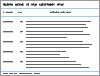
Table 1
Themes of the two-day training programme
| Day | Session theme |
|---|---|
| The first day | |
| Session one | Introduction; cardiac arrest, primary assessment of the unresponsive adult patient, chain of survival in adult CPR, steps in BLS |
| Session two | Using of automated external defibrillators (AED) and one-rescuer and two-rescuer BLS |
| The second day | Practicum using Resusci-Anne manikin |
Table 2
Socio-demographic distribution of the participants (n=210)
| Variables | Frequency | Percent |
|---|---|---|
| Gender | ||
| Female | 84 | 40 |
| Male | 126 | 60 |
| Age (years) | ||
| 14-15 | 135 | 64.3 |
| 16-17 | 51 | 24.3 |
| 18-19 | 24 | 11.4 |
| Weight (kg) | ||
| 30-49 | 151 | 71.9 |
| 50-69 | 56 | 26.7 |
| 70 and above | 3 | 1.4 |
| Tribe | ||
| Hausa | 97 | 46.2 |
| Fulani | 84 | 40.0 |
| Yoruba | 15 | 7.1 |
| Igbo | 9 | 4.3 |
| Others | 5 | 2.4 |
| Class | ||
| Senior secondary class 1 | 97 | 46.2 |
| Senior secondary class 2 | 77 | 36.7 |
| Senior secondary class 3 | 36 | 17.1 |
| Have you previously received training in CPR? | ||
| No | 210 | 100 |
| Yes | 0 | 0 |
Table 3
Distribution of the answers provided regarding the knowledge of BLS at baseline and post-intervention
| Questions about CPR | Baseline (n=210)* | Post intervention (n=210)* | ||||||
|---|---|---|---|---|---|---|---|---|
| Correct answer | Wrong answer | Correct answer | Wrong answer | |||||
| n | % | n | % | n | % | n | % | |
| Upon arrival you find a patient who is unconscious and unresponsive. The rescuer will perform several assessments before initiating treatment/actions. Which is the first critical action the rescuer should perform on this patient once it is determined that the patient is in cardiac arrest? | 12 | 5.7 | 198 | 94.3 | 87 | 41.4 | 123 | 58.6 |
| The 2015 AHA Guidelines for CPR and ECC recommend that to identify cardiac arrest in an unresponsive victim with no breathing (or no normal breathing), a healthcare provider should check a pulse for no more than | 17 | 8.1 | 193 | 91.9 | 77 | 36.7 | 133 | 63.3 |
| Where should the hands be placed to perform chest compression on an adult? | 15 | 7.1 | 195 | 92.9 | 80 | 38.1 | 130 | 61.9 |
| The recommended rate for performing chest compressions for victims of all ages is? | 22 | 10.5 | 188 | 89.5 | 92 | 43.8 | 118 | 56.2 |
| Why is it important to compress to the appropriate depth during CPR? | 28 | 13.3 | 182 | 86.7 | 94 | 44.8 | 116 | 55.2 |
| Complete chest recoil contributes to CPR success by | 29 | 13.8 | 181 | 86.2 | 93 | 44.3 | 117 | 55.7 |
| Which of the following is a characteristic of high-quality CPR in adults? | 23 | 11.0 | 187 | 89.0 | 127 | 60.5 | 83 | 39.5 |
| How long should it take to deliver 1 set of breaths between cycles of compressions? | 19 | 9.0 | 191 | 91.0 | 136 | 64.8 | 74 | 35.2 |
| Gastric inflation is more likely to occur if the rescuer | 18 | 8.6 | 192 | 91.4 | 122 | 58.1 | 88 | 41.9 |
| Ideally, interruptions in chest compressions should be | 27 | 12.9 | 183 | 87.1 | 124 | 59.0 | 86 | 41.0 |
| Where should the paddles/pads of the defibrillator/AED be placed on the patient? | 30 | 14.3 | 180 | 85.7 | 121 | 57.6 | 89 | 42.4 |
| As soon as an AED/defibrillator becomes available, when should the rescuer attach the pads/electrodes and analyse the rhythm: | 17 | 8.1 | 193 | 91.9 | 121 | 57.6 | 89 | 42.4 |
| What is the next immediate action the rescuer should perform after a shock has been delivered: | 16 | 7.6 | 194 | 92.4 | 137 | 65.2 | 73 | 34.8 |
| The depth of chest compressions for an adult victim should be at least | 16 | 7.6 | 194 | 92.4 | 150 | 71.4 | 60 | 28.6 |
| The latest guidelines for CPR recommended BLS sequence of steps are: | 25 | 11.9 | 185 | 88.1 | 140 | 66.7 | 70 | 33.3 |
| The compression-ventilation ratio for 1-rescuer adult CPR is | 20 | 9.5 | 190 | 90.5 | 137 | 65.2 | 73 | 34.8 |
| According to the options below, when should the rescuer reassess the patients pulse and ECG rhythm after initiating CPR? | 13 | 6.2 | 197 | 93.8 | 147 | 70.0 | 63 | 30.0 |
| To reduce rescuer fatigue during team CPR, compressor roles should be switched about every | 17 | 8.1 | 193 | 91.9 | 130 | 61.9 | 80 | 38.1 |
| Once the patients pulse rate is adequate whereby CPR is no longer required, which respiratory rate is considered the most inadequate whereby the rescuer will be required to initiate rescue breaths? | 24 | 11.4 | 186 | 88.6 | 127 | 60.5 | 83 | 39.5 |
| At which rate should the rescuer deliver rescue breaths/ventilations to a patient who is breathing inadequately (too slowly)? | 10 | 4.8 | 200 | 95.2 | 148 | 70.5 | 62 | 29.5 |
Table 4
Distribution of the answers provided regarding the psychomotor skill of BLS at baseline and post-intervention
| Steps for CPR skill performance in adults | Baseline (n=210)* | Post-intervention (n=210)* | ||||||
|---|---|---|---|---|---|---|---|---|
| Correct answer | Wrong answer | Correct answer | Wrong answer | |||||
| n | % | n | % | n | % | n | % | |
| Assessment and activation | ||||||||
| Checks responsiveness | 0 | 0 | 210 | 100.0 | 165 | 78.6 | 45 | 21.4 |
| Shouts for help/sends someone to phone and get an AED | 0 | 0 | 210 | 100.0 | 132 | 62.9 | 78 | 37.1 |
| Checks breathing | 0 | 0 | 210 | 100.0 | 146 | 69.5 | 64 | 30.5 |
| Cycle 1 of CPR (30:2) | ||||||||
| Adult compressions: performs high-quality compressions | 0 | 0 | 210 | 100.0 | 148 | 70.5 | 62 | 29.5 |
| Adult breaths: gives 2 breaths with a barrier device | 0 | 0 | 210 | 100.0 | 151 | 71.9 | 59 | 28.1 |
| Cycle 2 of CPR (repeats steps in cycle 1) | ||||||||
| Gives 30 high-quality compressions | 0 | 0 | 210 | 100.0 | 112 | 53.3 | 98 | 46.7 |
| Gives 2 effective breaths | 0 | 0 | 210 | 100.0 | 117 | 55.7 | 93 | 44.3 |
| AED (follows prompts of AED) | ||||||||
| Powers on AED | 0 | 0 | 210 | 100.0 | 117 | 55.7 | 93 | 44.3 |
| Correctly attaches pads | 0 | 0 | 210 | 100.0 | 110 | 52.4 | 100 | 47.6 |
| Clears for analysis | 0 | 0 | 210 | 100.0 | 118 | 56.2 | 92 | 43.8 |
| Clears to safely deliver a shock | 0 | 0 | 210 | 100.0 | 146 | 69.5 | 64 | 30.5 |
| Presses button to deliver shock | 0 | 0 | 210 | 100.0 | 104 | 49.5 | 106 | 50.5 |
| Student immediately resumes compressions | 0 | 0 | 210 | 100.0 | 146 | 69.5 | 64 | 30.5 |
| 3 of CPR (repeats steps in cycle 1) | ||||||||
| Gives 30 high-quality compressions; gives 2 effective breaths | 0 | 0 | 210 | 100.0 | 157 | 74.8 | 53 | 25.2 |
Table 5
Comparison of the participants’ baseline, post intervention average knowledge and psychomotor skill scores
| Variables | Pre-test M ± (SD) | Post-test M ± (SD) | Mean difference | t | Significance |
|---|---|---|---|---|---|
| Changes in knowledge score | 1.9±1.4 | 11.4±2.4 | 9.48571 | 48.135 | P=0.000 |
| Changes in skill score | 0.0±0.0 | 8.9±1.9 | 8.90000 | 68.967 | P=0.000 |
| 1 | World Health Organization. Global health observatory (GHO) data. vailable form http://www who int/gho/tb/en. 2015. |
| 2 |
Wellens HJ, Lindemans FW, Houben RP, Gorgels AP, Volders PG, ter Bekke RMA, et al. Improving survival after out-of-hospital cardiac arrest requires new tools. Eur Heart J. 2015; 37(19):1499-503.
pmid: 26371116 |
| 3 |
Celermajer DS, Chow CK, Marijon E, Anstey NM, Woo KS. Cardiovascular disease in the developing world: Prevalences, patterns, and the potential of early disease detection. J Am Coll Cardiol. 2012; 60(14):1207-16.
doi: 10.1016/j.jacc.2012.03.074 pmid: 22858388 |
| 4 | Sabir M. Identify knowledge of basic cardiac life support among nursing student. Int J Sci Res Publ. 2017; 7(6):733-8. |
| 5 |
Srivatsa UN, Swaminathan K, Munavarah KSA, Amsterdam E, Shantaraman K. Sudden cardiac death in South India: incidence, risk factors and pathology. Indian Pacing Electrophysiol J. 2016; 16(4):121-5.
pmid: 27924759 |
| 6 |
Roger VL. Epidemiology of heart failure. Circ Res. 2013; 113(6):646-59.
pmid: 23989710 |
| 7 | Benjamin EJ, Virani SS, Callaway CW, Chamberlain AM, Chang AR, Cheng S, et al. Heart disease and stroke statistics—2018 update: a report from the American Heart Association. Circulation. 2018; 137(12):e67-492. |
| 8 | Dal U, Sarpkaya D. Knowledge and psychomotor skills of nursing students in North Cyprus in the area of cardiopulmonary resuscitation. Pakistan J Med Sci. 2013; 29(4):1-6. |
| 9 | Olajumoke TO, Afolayan JM, Raji SA, Adekunle MA. Cardiopulmonary resuscitation - knowledge, attitude & practices in Osun State, Nigeria. J West African Coll Surg. 2012; 2(2):23-32. |
| 10 | Alharbi MM, Horaib YF, Almutairi OM, Alsuaidan BH, Alghoraibi MS, Alhadeedi FH, et al. Exploring the extent of knowledge of CPR skills among school teachers in Riyadh , KSA. J Taibah Univ Med Sci. 2016; 11(5):497-501. |
| 11 |
Adams BD, Benger J. Should we take patients to hospital in cardiac arrest? British Medical Journal. 2014; 349:g5659.
pmid: 25249357 |
| 12 | Go AS, Mozaffarian D, Roger VL, Benjamin EJ, Berry JD, Blaha MJ, et al. Heart disease and stroke statistics—2014 update: a report from the American Heart Association. Circulation. 2013;01-cir. |
| 13 | Mani G, Annadurai K, Danasekaran R. Letter to the Editor: Bystander cardiopulmonary resuscitation in out of hospital cardiac arrest: need of the hour. Afr Health Sci. 2015; 15(1):307-9. |
| 14 | Vural M. Cardiopulmonary resuscitation knowledge among nursing students: a questionnaire study. Anatol J Cardiol. 2017;(8):140-5. |
| 15 |
Sanghavi P, Jena AB, Newhouse JP, Zaslavsky AM. Outcomes of basic versus advanced life support for out-of-hospital medical emergencies. Ann Intern Med. 2015; 163(9):681-90.
pmid: 26457627 |
| 16 | Miranda JJ, Kinra S, Casas JP, Smith GD, Ebrahim S. Non-communicable diseases in low and middle-income countries: context , determinants and health policy. Trop Med Int Heal. 2009; 13(10):1225-34. |
| 17 | World Health Organization. Chapter 1: Burden: mortality, morbidity and risk factors. Glob Status Rep. 2011; 9-31. |
| 18 | Krishna CK, Showkat HI, Taktani M, Khatri V. Out of hospital cardiac arrest resuscitation outcome in North India - CARO study. World J Emerg Med. 2017; 8(3):200-5. |
| 19 | Naqvi S, Siddiqi R, Hussain SA, Batool H, Arshad H. School children training for basic life support. J Coll Physicians Surg Pakistan. 2011; 21(10):611-5. |
| 20 | Hwang S, Do Shin S, Lee K, Song KJ, Ahn KO, Kim YJ, et al. Cardiac arrest in schools: Nationwide incidence, risk, and outcome. Resuscitation. Elsevier; 2017; 110:81-4. |
| 21 | Onyeaso AO, Onyeaso OO. Impact of age and sex on bystander cardiopulmonary resuscitation knowledge. Int J Sci Res Manag. 2017; 5(11):7510-7. |
| 22 | Onyeaso A, Onyeaso C. Cardiopulmonary resuscitation skills in some Nigerian secondary school students. Port Harcourt Med J. 2016; 10(2):60. |
| 23 |
Bhatnagar V, Tandon U, Jinjil K, Dwivedi D, Kiran S, Verma R. Cardiopulmonary resuscitation: Evaluation of knowledge, efficacy, and retention in young doctors joining postgraduation program. Anesth Essays Res. 2017; 11(4):842.
pmid: 29284836 |
| 24 | World Medical Association. World Medical Association Declaration of Helsinki: ethical principles for medical research involving human subjects. JAMA. 2013; 310(20):2191. |
| 25 | Alkandari SA, Alyahya L, Abdulwahab M. Cardiopulmonary resuscitation knowledge and attitude among general dentists in Kuwait. World J Emerg Med. 2017; 8(1):19-24. |
| 26 | Somaraj V, Shenoy RP, Panchmal GS, Jodalli PS, Sonde L, Knowledge, attitude and anxiety pertaining to basic life support and medical emergencies among dental interns in Mangalore City, India. World J Emerg Med. 2017; 8(2):131-5. |
| 27 | Madden C. Undergraduate nursing students’ acquisition and retention of CPR knowledge and skills. Nurse Educ Today. 2006; 26(3):218-27. |
| 28 | Onyeaso AO, Onyeaso OO. Cardiopulmonary resuscitation skills of some undergraduate human kinetics and health education students in a Nigerian University. J Heal Sci. 2017; 7(4):84-90. |
| 29 | Onyeaso A, Onyeaso O. Theoretical knowledge of cardiopulmonary resuscitation among some Nigerian primary and secondary school teachers. Asian J Med Heal. 2017; 6(4):1-10. |
| 30 | Sankar J, Vijayakanthi N, Sankar MJ, Dubey N. Knowledge and skill retention of in-service versus preservice nursing professionals following an informal training program in pediatric cardiopulmonary resuscitation: a repeated-measures quasiexperimental study. Biomed Res Int. 2013; 2013. |
| 31 | Onyeaso AO, Onyeaso OO. Knowledge of cardiopulmonary resuscitation among student teachers in Nigeria. J Heal Sci. 2017; 7(5):91-5. |
| 32 | Meissner TM, Kloppe C, Hanefeld C. Basic life support skills of high school students before and after cardiopulmonary resuscitation training: a longitudinal investigation. Scand J Trauma Resusc Emerg Med. 2012; 20:31. |
| [1] | Alexei Birkun, Fatima Trunkwala, Adhish Gautam, Miriam Okoroanyanwu, Adesokan Oyewumi. Availability of basic life support courses for the general populations in India, Nigeria and the United Kingdom: An internet-based analysis [J]. World Journal of Emergency Medicine, 2020, 11(3): 133-139. |
| [2] | Jung Wan Kim, Jin Woong Lee, Seung Ryu, Jung Soo Park, InSool Yoo, Yong Chul Cho, Hong Joon Ahn. Changes in peak inspiratory flow rate and peak airway pressure with endotracheal tube size during chest compression [J]. World Journal of Emergency Medicine, 2020, 11(2): 97-101. |
| [3] | Ye-cheng Liu, Yan-meng Qi, Hui Zhang, Joseph Walline, Hua-dong Zhu. A survey of ventilation strategies during cardiopulmonary resuscitation [J]. World Journal of Emergency Medicine, 2019, 10(4): 222-227. |
| [4] | Sagar Shah, Steven Tohmasi, Emily Frisch, Amanda Anderson, Roy Almog, Shadi Lahham, Roland Bingisser, John C. Fox. A comparison of simulation versus didactics for teaching ultrasound to Swiss medical students [J]. World Journal of Emergency Medicine, 2019, 10(3): 169-176. |
| [5] | Robert D. Willmore, Damjan Veljanoski, Feray Ozdes, Bethan Stephens, James Mooney, Seamus G. Crumley, Arpan Doshi, Philippa Davies, Shreya Badhrinarayanan, Emily Day, Kristian Tattam, April Wilson, Nathan Crang, Lorna Green, Craig A. Mounsey, Howell Fu, Joseph Williams, Michelle S. D'souza, Dhanya Sebastian, Liam A. Mcgiveron, Matthew G. Percy, James Cohen, Imogen J. John, Alice Lethbridge, Imogen Watkins, Omar Amin, Mubasher A. Qamar, John Gerrard Hanrahan, Emily Cramond-Wong. Do medical students studying in the United Kingdom have an adequate factual knowledge of basic life support? [J]. World Journal of Emergency Medicine, 2019, 10(2): 75-80. |
| [6] | Genevieve Mazza, Carina Mireles Romo, Marlene Torres, Ali Duffens, Annasha Vyas, Katherine Moran, Joshua Livingston, Savannah Gonzales, Shadi Lahham, Inna Shniter, Maxwell Thompson, John Christian Fox. Assessment of clinical dehydration using point of care ultrasound for pediatric patients in rural Panama [J]. World Journal of Emergency Medicine, 2019, 10(1): 46-50. |
| [7] | Alexei Birkun, Yekaterina Kosova. Social attitude and willingness to attend cardiopulmonary resuscitation training and perform resuscitation in the Crimea [J]. World Journal of Emergency Medicine, 2018, 9(4): 237-248. |
| [8] | Alexei Birkun, Maksim Glotov, Herman Franklin Ndjamen, Esther Alaiye, Temidara Adeleke, Sergey Samarin. Pre-recorded instructional audio vs. dispatchers’ conversational assistance in telephone cardiopulmonary resuscitation: A randomized controlled simulation study [J]. World Journal of Emergency Medicine, 2018, 9(3): 165-171. |
| [9] | Kelly Williamson, Jeremy Branzetti, Navneet Cheema, Amer Aldeen. Emergency medicine residencies structure of trainees’ administrative experience: A cross-sectional survey [J]. World Journal of Emergency Medicine, 2018, 9(3): 187-190. |
| [10] | Jennie Buchanan, Daniel Windels, Jeffrey Druck, Kennon Heard. Assessment of toxicology knowledge in the fourth-year medical students: Three years of data [J]. World Journal of Emergency Medicine, 2018, 9(3): 191-194. |
| [11] | Annasha Vyas, Katherine Moran, Joshua Livingston, Savannah Gonzales, Marlene Torres, Ali Duffens, Carina Mireles Romo, Genevieve Mazza, Briana Livingston, Shadi Lahham, John Christian Fox. Feasibility study of minimally trained medical students using the Rural Obstetrical Ultrasound Triage Exam (ROUTE) in rural Panama [J]. World Journal of Emergency Medicine, 2018, 9(3): 216-222. |
| [12] | Shastri Vandana, Singh Shubnum, Kole Tamorish. The relative value of education of emergency physicians in patient outcome: A retrospective analysis at a single center in developing India [J]. World Journal of Emergency Medicine, 2018, 9(2): 130-135. |
| [13] | Sean P. Denny, William B. Minteer, Reece T.H. Fenning, Sahil Aggarwal, Debora H. Lee, Shella K. Raja, Kaavya R. Raman, Allison O. Farfel, Priya A. Patel, MarkLieber, Megan E. Bernstein, Shadi Lahham, John C. Fox. Ultrasound curriculum taught by first-year medical students: A four-year experience in Tanzania [J]. World Journal of Emergency Medicine, 2018, 9(1): 33-40. |
| [14] | Malcolm J. Boyle, Kathryn Eastwood. Drug calculation ability of qualified paramedics: A pilot study [J]. World Journal of Emergency Medicine, 2018, 9(1): 41-45. |
| [15] | Alexei Birkun, Maksim Glotov. Education in cardiopulmonary resuscitation in Russia: A systematic review of the available evidence [J]. World Journal of Emergency Medicine, 2017, 8(4): 245-252. |
| Viewed | ||||||
|
Full text |
|
|||||
|
Abstract |
|
|||||

