World Journal of Emergency Medicine ›› 2018, Vol. 9 ›› Issue (4): 237-248.doi: 10.5847/wjem.j.1920-8642.2018.04.001
• Original Articles • Next Articles
Alexei Birkun1( ), Yekaterina Kosova2
Received:2018-06-09
Accepted:2018-07-16
Online:2018-12-15
Published:2018-12-15
Contact:
Alexei Birkun
E-mail:birkunalexei@gmail.com
Alexei Birkun, Yekaterina Kosova. Social attitude and willingness to attend cardiopulmonary resuscitation training and perform resuscitation in the Crimea[J]. World Journal of Emergency Medicine, 2018, 9(4): 237-248.
Add to citation manager EndNote|Ris|BibTeX
URL: http://wjem.com.cn//EN/10.5847/wjem.j.1920-8642.2018.04.001
Table 1
Respondents’ characteristics and univariate association with previous CPR training
| Characteristics | Total, n (%) | Previous training, n(%) | No previous training, n(%) | Pearson’s Chi-square/ Likelihood ratio | P-value | Phi/ Cramér’s V |
|---|---|---|---|---|---|---|
| Sex | 4.708 | 0.030 | 0.111 | |||
| Male | 174 (45.3) | 103 (59.2) | 71 (40.8) | |||
| Female | 210 (54.7) | 101 (48.1) | 109 (51.9) | |||
| Age, years | 19.522 | 0.003 | 0.225 | |||
| 18-24 | 32 (8.3) | 22 (68.8) | 10 (31.3) | |||
| 25-29 | 34 (8.9) | 19 (55.9) | 15 (44.1) | |||
| 30-39 | 78 (20.3) | 38 (48.7) | 40 (51.3) | |||
| 40-49 | 61 (15.9) | 39 (63.9) | 22 (36.1) | |||
| 50-59 | 67 (17.4) | 40 (59.7) | 27 (40.3) | |||
| 60-69 | 61 (15.9) | 31 (50.8) | 30 (49.2) | |||
| ≥ 70 | 51 (13.3) | 15 (29.4) | 36 (70.6) | |||
| Place of residence | 2.049 | 0.152 | -0.073 | |||
| Urban | 228 (59.4) | 128 (56.1) | 100 (43.9) | |||
| Rural | 156 (40.6) | 76 (48.7) | 80 (51.3) | |||
| Marital status | 13.777 | 0.008 | 0.189 | |||
| Not married | 81 (21.1) | 53 (65.4) | 28 (34.6) | |||
| Married | 229 (59.6) | 121 (52.8) | 108 (47.2) | |||
| Divorced | 34 (8.9) | 17 (50.0) | 17 (50.0) | |||
| Widowed | 39 (10.2) | 12 (30.8) | 27 (69.2) | |||
| No answer | 1 (0.3) | 1 (100.0) | 0 (0.0) | |||
| Education level | 20.902 | 0.001 | 0.228 | |||
| Primary school | 1 (0.3) | 0 (0.0) | 1 (100.0) | |||
| Secondary school | 12 (3.1) | 3 (25.0) | 9 (75.0) | |||
| High school | 55 (14.3) | 25 (45.5) | 30 (54.5) | |||
| College or technical school | 157 (40.9) | 72 (45.9) | 85 (54.1) | |||
| University | 153 (39.8) | 99 (64.7) | 54 (35.3) | |||
| Academic degree | 6 (1.6) | 5 (83.3) | 1 (16.7) | |||
| Occupation | 32.948 | <0.001 | 0.286 | |||
| Employed | 173 (45.1) | 110 (63.6) | 63 (36.4) | |||
| Self-employed | 60 (15.6) | 32 (53.3) | 28 (46.7) | |||
| Student | 24 (6.3) | 18 (75.0) | 6 (25.0) | |||
| Retired | 104 (27.1) | 36 (34.6) | 68 (65.4) | |||
| Unemployed | 20 (5.2) | 8 (40.0) | 12 (60.0) | |||
| Army conscript | 2 (0.5) | 0 (0.0) | 2 (100.0) | |||
| Other | 1 (0.3) | 0 (0.0) | 1 (100.0) | |||
| Medical education | 20.591 | <0.001 | -0.232 | |||
| Yes | 22 (5.7) | 22 (100.0) | 0 (0.0) | |||
| No | 362 (94.3) | 182 (50.3) | 180 (49.7) | |||
| Average monthly income | 19.471 | 0.003 | 0.219 | |||
| <10,000 RUR | 86 (22.4) | 40 (46.5) | 46 (53.5) | |||
| ≥10,000 - <20,000 RUR | 122 (31.8) | 53 (43.4) | 69 (56.6) | |||
| ≥20,000 - <30,000 RUR | 76 (19.8) | 51 (67.1) | 25 (32.9) | |||
| ≥30,000 - <40,000 RUR | 37 (9.6) | 20 (54.1) | 17 (45.9) | |||
| ≥40,000 - <60,000 RUR | 9 (2.3) | 8 (88.9) | 1 (11.1) | |||
| ≥60,000 RUR | 5 (1.3) | 4 (80.0) | 1 (20.0) | |||
| No answer | 49 (12.8) | 28 (57.1) | 21 (42.9) | |||
| Self-perceived CPR knowledge | 94.384 | <0.001 | 0.496 | |||
| Absent | 68 (17.7) | 11 (16.2) | 57 (83.8) | |||
| Poor | 175 (45.6) | 77 (44.0) | 98 (56.0) | |||
| Moderate | 114 (29.7) | 90 (78.9) | 24 (21.1) | |||
| Good | 21 (5.5) | 21 (100.0) | 0 (0.0) | |||
| Very good | 6 (1.6) | 5 (83.3) | 1 (16.7) |
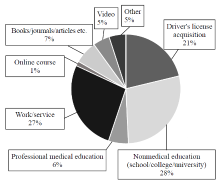
Figure 1.
Distribution of prior CPR training by type.
Table 2
Respondents’ characteristics associated with CPR knowledge in univariate analysis
| Characteristics | Total, n (%) | Correct hand position, n(%) | Incorrect hand position/ no answer, n(%) | Pearson’s Chi-square/ Likelihood ratio/ Fisher’s exact test | P-value | Phi/ Cramér’s V |
|---|---|---|---|---|---|---|
| Previous CPR training | 22.364 | <0.001 | 0.241 | |||
| Yes | 204 (53.1) | 116 (56.9) | 88 (43.1) | |||
| No | 180 (46.9) | 59 (32.8) | 121 (67.2) | |||
| Self-perceived CPR knowledge | 22.796 | <0.001 | 0.244 | |||
| Absent | 68 (17.7) | 16 (23.5) | 52 (76.5) | |||
| Poor | 175 (45.6) | 82 (46.9) | 93 (53.1) | |||
| Moderate | 114 (29.7) | 62 (54.4) | 52 (45.6) | |||
| Good | 21 (5.5) | 14 (66.7) | 7 (33.3) | |||
| Very good | 6 (1.6) | 1 (16.7) | 5 (83.3) | |||
| Age, years | 15.752 | 0.015 | 0.203 | |||
| 18-24 | 32 (8.3) | 17 (53.1) | 15 (46.9) | |||
| 25-29 | 34 (8.9) | 16 (47.1) | 18 (52.9) | |||
| 30-39 | 78 (20.3) | 46 (59.0) | 32 (41.0) | |||
| 40-49 | 61 (15.9) | 31 (50.8) | 30 (49.2) | |||
| 50-59 | 67 (17.4) | 28 (41.8) | 39 (58.2) | |||
| 60-69 | 61 (15.9) | 23 (37.7) | 38 (62.3) | |||
| ≥70 | 51 (13.3) | 14 (27.5) | 37 (72.5) | |||
| Medical education | 4.809 | 0.028 | -0.112 | |||
| Yes | 22 (5.7) | 15 (68.2) | 7 (31.8) | |||
| No | 362 (94.3) | 160 (44.2) | 202 (55.8) | |||
| Average monthly income | 1.420 | 0.965 | 0.061 | |||
| <10,000 RUR | 86 (22.4) | 36 (41.9) | 50 (58.1) | |||
| ≥10,000 - <20,000 RUR | 122 (31.8) | 56 (45.9) | 66 (54.1) | |||
| ≥20,000 - <30,000 RUR | 76 (19.8) | 35 (46.1) | 41 (53.9) | |||
| ≥30,000 - <40,000 RUR | 37 (9.6) | 19 (51.4) | 18 (48.6) | |||
| ≥40,000 - <60,000 RUR | 9 (2.3) | 5 (55.6) | 4 (44.4) | |||
| ≥60,000 RUR | 5 (1.3) | 2 (40.0) | 3 (60.0) | |||
| No answer | 49 (12.8) | 22 (44.9) | 27 (55.1) | |||
| Characteristics | Total, n (%) | Correct compression rate, n (%) | Incorrect compression rate/ no answer, n(%) | Pearson’s Chi-square/ Likelihood ratio/ Fisher’s exact test | P-value | Phi/ Cramér’s V |
| Previous CPR training | — | 0.002 | 0.155 | |||
| Yes | 204 (53.1) | 13 (6.4) | 191 (93.6) | |||
| No | 180 (46.9) | 1 (0.6) | 179 (99.4) | |||
| Self-perceived CPR knowledge | 23.690 | <0.001 | 0.331 | |||
| Absent | 68 (17.7) | 0 (0.0) | 68 (100.0) | |||
| Poor | 175 (45.6) | 3 (1.7) | 172 (98.3) | |||
| Moderate | 114 (29.7) | 5 (4.4) | 109 (95.6) | |||
| Good | 21 (5.5) | 6 (28.6) | 15 (71.4) | |||
| Very good | 6 (1.6) | 0 (0.0) | 6 (100.0) | |||
| Age, years | 1.491 | 0.960 | 0.061 | |||
| 18-24 | 32 (8.3) | 1 (3.1) | 31 (96.9) | |||
| 25-29 | 34 (8.9) | 1 (2.9) | 33 (97.1) | |||
| 30-39 | 78 (20.3) | 2 (2.6) | 76 (97.4) | |||
| 40-49 | 61 (15.9) | 3 (4.9) | 58 (95.1) | |||
| 50-59 | 67 (17.4) | 3 (4.5) | 64 (95.5) | |||
| 60-69 | 61 (15.9) | 3 (4.9) | 58 (95.1) | |||
| ≥ 70 | 51 (13.3) | 1 (2.0) | 50 (98.0) | |||
| Medical education | — | 0.039 | -0.131 | |||
| Yes | 22 (5.7) | 3 (13.6) | 19 (86.4) | |||
| No | 362 (94.3) | 11 (3.0) | 351 (97.0) | |||
| Average monthly income | 14.874 | 0.021 | 0.216 | |||
| <10,000 RUR | 86 (22.4) | 1 (1.2) | 85 (98.8) | |||
| ≥10,000 - <20,000 RUR | 122 (31.8) | 1 (0.8) | 121 (99.2) | |||
| ≥20,000 - <30,000 RUR | 76 (19.8) | 2 (2.6) | 74 (97.4) | |||
| ≥30,000 - <40,000 RUR | 37 (9.6) | 4 (10.8) | 33 (89.2) | |||
| ≥40,000 - <60,000 RUR | 9 (2.3) | 1 (11.1) | 8 (88.9) | |||
| ≥60,000 RUR | 5 (1.3) | 1 (20.0) | 4 (80.0) | |||
| No answer | 49 (12.8) | 4 (8.2) | 45 (91.8) |
Table 3
Respondents’ characteristics associated with willingness to attend CPR training in univariate analysis
| Characteristics | Total, n (%) | Willing to attend CPR training, n(%) | Not willing to attend CPR training/ unsure, n (%) | Pearson’s Chi-square/ Likelihood ratio/ Fisher’s exact test | P-value | Phi/ Cramér’s V |
|---|---|---|---|---|---|---|
| Sex | 8.350 | 0.004 | -0.147 | |||
| Male | 174 (45.3) | 77 (44.3) | 97 (55.7) | |||
| Female | 210 (54.7) | 124 (59.0) | 86 (41.0) | |||
| Age, years | 15.538 | 0.016 | 0.201 | |||
| 18-24 | 32 (8.3) | 22 (68.8) | 10 (31.3) | |||
| 25-29 | 34 (8.9) | 18 (52.9) | 16 (47.1) | |||
| 30-39 | 78 (20.3) | 45 (57.7) | 33 (42.3) | |||
| 40-49 | 61 (15.9) | 38 (62.3) | 23 (37.7) | |||
| 50-59 | 67 (17.4) | 35 (52.2) | 32 (47.8) | |||
| 60-69 | 61 (15.9) | 23 (37.7) | 38 (62.3) | |||
| ≥ 70 | 51 (13.3) | 20 (39.2) | 31 (60.8) | |||
| Marital status | 13.262 | 0.010 | 0.186 | |||
| Not married | 81 (21.1) | 39 (48.1) | 42 (51.9) | |||
| Married | 229 (59.6) | 129 (56.3) | 100 (43.7) | |||
| Divorced | 34 (8.9) | 21 (61.8) | 13 (38.2) | |||
| Widowed | 39 (10.2) | 11 (28.2) | 28 (71.8) | |||
| No answer | 1 (0.3) | 1 (100.0) | 0 (0.0) | |||
| Education level | 11.389 | 0.044 | 0.151 | |||
| Primary school | 1 (0.3) | 0 (0.0) | 1 (100.0) | |||
| Secondary school | 12 (3.1) | 5 (41.7) | 7 (58.3) | |||
| High school | 55 (14.3) | 31 (56.4) | 24 (43.6) | |||
| College or technical school | 157 (40.9) | 84 (53.5) | 73 (46.5) | |||
| University | 153 (39.8) | 81 (52.9) | 72 (47.1) | |||
| Academic degree | 6 (1.6) | 0 (0.0) | 6 (100.0) | |||
| Occupation | 19.096 | 0.004 | 0.219 | |||
| Employed | 173 (45.1) | 98 (56.6) | 75 (43.4) | |||
| Self-employed | 60 (15.6) | 32 (53.3) | 28 (46.7) | |||
| Student | 24 (6.3) | 17 (70.8) | 7 (29.2) | |||
| Retired | 104 (27.1) | 38 (36.5) | 66 (63.5) | |||
| Unemployed | 20 (5.2) | 14 (70.0) | 6 (30.0) | |||
| Army conscript | 2 (0.5) | 1 (50.0) | 1 (50.0) | |||
| Other | 1 (0.3) | 1 (100.0) | 0 (0.0) | |||
| Serious health problems in friends/relatives | 7.724 | 0.021 | 0.142 | |||
| Yes | 130 (33.9) | 78 (60.0) | 52 (40.0) | |||
| No | 224 (58.3) | 113 (50.4) | 111 (49.6) | |||
| Unsure | 30 (7.8) | 10 (33.3) | 20 (66.7) |
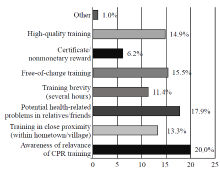
Figure 2.
Motivations for respondents to attend CPR training.
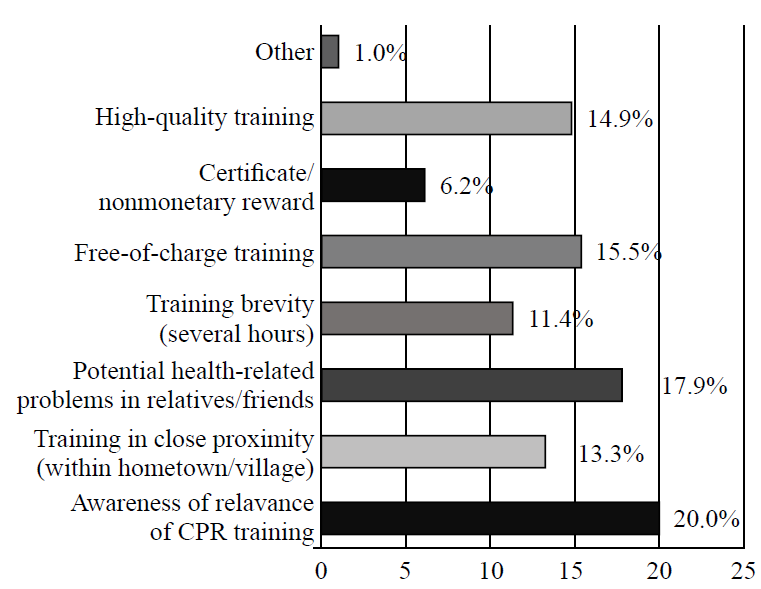
Figure 3.
Percentage distribution of respondents according to their willingness to do CPR in real life.
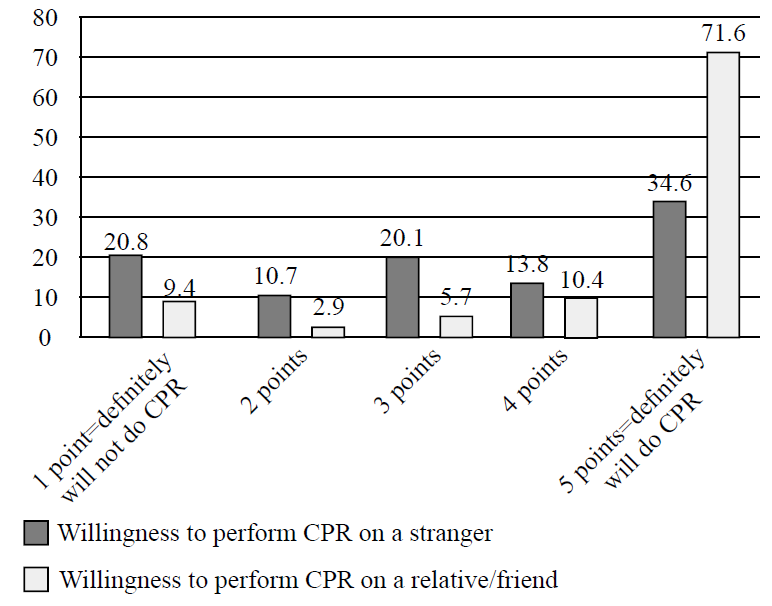
Table 4
Respondents’ characteristics associated with willingness to perform CPR in univariate analysis
| Characteristics | Total, n(%) | Willing to attempt CPR on a stranger, n (%) | Not willing to attempt CPR on a stranger, n (%) | Pearson’s Chi-square/ Likelihood ratio/ Fisher’s exact test | P-value | Phi/ Cramér’s V |
|---|---|---|---|---|---|---|
| Previous CPR training | 6.990 | 0.008 | 0.135 | |||
| Yes | 204 (53.1) | 172 (84.3) | 32 (15.7) | |||
| No | 180 (46.9) | 132 (73.3) | 48 (26.7) | |||
| Willingness to attend CPR training | 9.162 | 0.010 | 0.154 | |||
| Yes | 201 (52.3) | 170 (84.6) | 31 (15.4) | |||
| No | 118 (30.7) | 83 (70.3) | 35 (29.7) | |||
| Unsure | 65 (16.9) | 51 (78.5) | 14 (21.5) | |||
| Self-perceived CPR knowledge | 46.030 | <0.001 | 0.356 | |||
| Absent | 68 (17.7) | 34 (50.0) | 34 (50.0) | |||
| Poor | 175 (45.6) | 141 (80.6) | 34 (19.4) | |||
| Moderate | 114 (29.7) | 103 (90.4) | 11 (9.6) | |||
| Good | 21 (5.5) | 20 (95.2) | 1 (4.8) | |||
| Very good | 6 (1.6) | 6 (100.0) | 0 (0.0) | |||
| Knowledge of hand position for compressions | 6.963 | 0.008 | 0.135 | |||
| Yes | 175 (45.6) | 149 (85.1) | 26 (14.9) | |||
| No | 209 (54.4) | 155 (74.2) | 54 (25.8) | |||
| Serious health problems in friends/relatives | 11.375 | 0.003 | 0.172 | |||
| Yes | 130 (33.9) | 114 (87.7) | 16 (12.3) | |||
| No | 224 (58.3) | 171 (76.3) | 53 (23.7) | |||
| Unsure | 30 (7.8) | 19 (63.3) | 11 (36.7) | |||
| Age, years | 13.361 | 0.038 | 0.187 | |||
| 18-24 | 32 (8.3) | 30 (93.8) | 2 (6.3) | |||
| 25-29 | 34 (8.9) | 30 (88.2) | 4 (11.8) | |||
| 30-39 | 78 (20.3) | 63 (80.8) | 15 (19.2) | |||
| 40-49 | 61 (15.9) | 51 (83.6) | 10 (16.4) | |||
| 50-59 | 67 (17.4) | 45 (67.2) | 22 (32.8) | |||
| 60-69 | 61 (15.9) | 47 (77.0) | 14 (23.0) | |||
| ≥70 | 51 (13.3) | 38 (74.5) | 13 (25.5) | |||
| Characteristics | Total, n(%) | Willing to attempt CPR on a relative/ friend, n (%) | Not willing to attempt CPR on a relative/ friend, n (%) | Pearson’s Chi-square/ Likelihood ratio/ Fisher’s exact test | P-value | Phi/ Cramér’s V |
| Previous CPR training | 6.249 | 0.012 | 0.128 | |||
| Yes | 204 (53.1) | 192 (94.1) | 12 (5.9) | |||
| No | 180 (46.9) | 156 (86.7) | 24 (13.3) | |||
| Willingness to attend CPR training | 0.997 | 0.608 | 0.051 | |||
| Yes | 201 (52.3) | 185 (92.0) | 16 (8.0) | |||
| No | 118 (30.7) | 105 (89.0) | 13 (11.0) | |||
| Unsure | 65 (16.9) | 58 (89.2) | 7 (10.8) | |||
| Self-perceived CPR knowledge | 35.780 | <0.001 | 0.305 | |||
| Absent | 68 (17.7) | 49 (72.1) | 19 (27.9) | |||
| Poor | 175 (45.6) | 162 (92.6) | 13 (7.4) | |||
| Moderate | 114 (29.7) | 110 (96.5) | 4 (3.5) | |||
| Good | 21 (5.5) | 21 (100.0) | 0 (0.0) | |||
| Very good | 6 (1.6) | 6 (100.0) | 0 (0.0) | |||
| Knowledge of hand position for compressions | 13.382 | <0.001 | 0.187 | |||
| Yes | 175 (45.6) | 169 (96.6) | 6 (3.4) | |||
| No | 209 (54.4) | 179 (85.6) | 30 (14.4) | |||
| Serious health problems in friends/relatives | 1.407 | 0.495 | 0.061 | |||
| Yes | 130 (33.9) | 121 (93.1) | 9 (6.9) | |||
| No | 224 (58.3) | 200 (89.3) | 24 (10.7) | |||
| Unsure | 30 (7.8) | 27 (90.0) | 3 (10.0) | |||
| Age, years | 7.012 | 0.320 | 0.134 | |||
| 18-24 | 32 (8.3) | 31 (96.9) | 1 (3.1) | |||
| 25-29 | 34 (8.9) | 32 (94.1) | 2 (5.9) | |||
| 30-39 | 78 (20.3) | 70 (89.7) | 8 (10.3) | |||
| 40-49 | 61 (15.9) | 57 (93.4) | 4 (6.6) | |||
| 50-59 | 67 (17.4) | 58 (86.6) | 9 (13.4) | |||
| 60-69 | 61 (15.9) | 57 (93.4) | 4 (6.6) | |||
| ≥70 | 51 (13.3) | 43 (84.3) | 8 (15.7) |
Table 5
Distribution of responses to the multiple-choice questions querying potential barriers to attempt CPR in real life
| Potential barriers to perform CPR | CPR on a stranger, n (%) | CPR on a relative/friend, n(%) |
|---|---|---|
| Personal physical limitations | 71 (7.5) | 28 (7.3) |
| Reluctance to be in the focus of attention | 33 (3.5) | 6 (1.6) |
| Fear to cause harm to a victim | 240 (25.2) | 137 (35.8) |
| Fear of legal implication | 98 (10.3) | 18 (4.7) |
| Lack of CPR knowledge and skills | 257 (27.0) | 169 (44.1) |
| Fear of catch an infection on a contact with a victim | 92 (9.7) | 8 (2.1) |
| Unpleasant external appearance of a victim | 122 (12.8) | 5 (1.3) |
| Personal problems requiring urgent solution | 23 (2.4) | 3 (0.8) |
| Opposite sex of a victim | 8 (0.8) | 2 (0.5) |
| Other | 8 (0.8) | 7 (1.8) |
| Total | 952 (100.0) | 383 (100.0) |
| [1] |
Coons SJ, Guy MC. Performing bystander CPR for sudden cardiac arrest: behavioral intentions among the general adult population in Arizona. Resuscitation. 2009; 80(3):334-40.
doi: 10.1016/j.resuscitation.2008.11.024 pmid: 19157675 |
| [2] | Ong ME, Shin SD, De Souza NN, Tanaka H, Nishiuchi T, Song KJ, et al. Outcomes for out-of-hospital cardiac arrests across 7 countries in Asia: The Pan Asian Resuscitation Outcomes Study (PAROS). Resuscitation. 2015; 96:100-8. |
| [3] |
Gräsner JT, Lefering R, Koster RW, Masterson S, Böttiger BW, Herlitz J, et al. Corrigendum to "EuReCa ONE-27 Nations, ONE Europe, ONE Registry A prospective one month analysis of out-of-hospital cardiac arrest outcomes in 27 countries in Europe" [Resuscitation 105 (2016) 188-195]. Resuscitation. 2016; 109:145-6.
doi: 10.1016/j.resuscitation.2016.10.001 pmid: 27750053 |
| [4] |
Chen M, Wang Y, Li X, Hou L, Wang Y, Liu J, et al. Public knowledge and attitudes towards bystander cardiopulmonary resuscitation in China. Biomed Res Int. 2017; 2017:3250485.
doi: 10.1155/2017/3250485 pmid: 28367441 |
| [5] |
Berdowski J, Berg RA, Tijssen JG, Koster RW. Global incidences of out-of-hospital cardiac arrest and survival rates: Systematic review of 67 prospective studies. Resuscitation. 2010; 81(11):1479-87.
doi: 10.1016/j.resuscitation.2010.08.006 pmid: 20828914 |
| [6] | Federal State Statistics Service (Russian Federation). Death rates by main chapters of causes [Internet]. Moscow, Federal State Statistics Service. Available from: www.gks.ru/free_doc/new_site/population/demo/demo24.xls. Russian. |
| [7] | State Statistics Service of Ukraine. Demographic and social statistics. Population (1990-2017) [Internet]. Kiev, State Statistics Service of Ukraine. Available from: http://www.ukrstat.gov.ua/operativ/operativ2007/ds/nas_rik/nas_u/nas_rik_u.html. Ukrainian. |
| [8] | Birkun AA, Glotov MA. Epidemiological features of out-of-hospital cardiac arrest: evidence from particular administrative centre in Russian Federation. Anesteziol Reanimatol. 2017; 62(2):113-7. Russian. |
| [9] |
Larsen MP, Eisenberg MS, Cummins RO, Hallstrom AP. Predicting survival from out-of-hospital cardiac arrest: a graphic model. Ann Emerg Med. 1993; 22(11):1652-8.
doi: 10.1016/s0196-0644(05)81302-2 pmid: 8214853 |
| [10] |
Perkins GD, Handley AJ, Koster RW, Castrén M, Smyth MA, Olasveengen T, et al. European Resuscitation Council Guidelines for Resuscitation 2015: Section 2. Adult basic life support and automated external defibrillation. Resuscitation. 2015; 95:81-99.
doi: 10.1016/j.resuscitation.2015.07.015 pmid: 26477420 |
| [11] |
Axelsson AB, Herlitz J, Holmberg S, Thorén AB. A nationwide survey of CPR training in Sweden: foreign born and unemployed are not reached by training programmes. Resuscitation. 2006; 70(1):90-7.
doi: 10.1016/j.resuscitation.2005.11.009 pmid: 16757090 |
| [12] |
Kuramoto N, Morimoto T, Kubota Y, Maeda Y, Seki S, Takada K, et al. Public perception of and willingness to perform bystander CPR in Japan. Resuscitation. 2008; 79(3):475-81.
doi: 10.1016/j.resuscitation.2008.07.005 pmid: 18805615 |
| [13] |
Lee MJ, Hwang SO, Cha KC, Cho GC, Yang HJ, Rho TH. Influence of nationwide policy on citizens' awareness and willingness to perform bystander cardiopulmonary resuscitation. Resuscitation. 2013; 84(7):889-94.
doi: 10.1016/j.resuscitation.2013.01.009 pmid: 23328406 |
| [14] |
Greif R, Lockey AS, Conaghan P, Lippert A, De Vries W, Monsieurs KG, et al. European Resuscitation Council Guidelines for Resuscitation 2015: Section 10. Education and implementation of resuscitation. Resuscitation. 2015; 95:288-301.
doi: 10.1016/j.resuscitation.2015.07.032 pmid: 26477418 |
| [15] | Directorate of the Federal State Statistics Service of the Republic of Crimea and Sevastopol. Official statistics. Republic of Crimea. Population [Internet]. Federal State Statistics Service. Available from: http://crimea.gks.ru/wps/wcm/connect/rosstat_ts/crimea/ru/statistics/stat_Crimea/population. Russian. |
| [16] | Directorate of the Federal State Statistics Service of the Republic of Crimea and Sevastopol. Official statistics. Republic of Crimea. Population [Internet]. Federal State Statistics Service. Available from: http://crimea.gks.ru/wps/wcm/connect/rosstat_ts/crimea/ru/statistics/stat_Seva/population. Russian. |
| [17] | Cochran WG. 3rd edition. Sampling Techniques. New York: John Wiley and Sons. 1977: 190-205. |
| [18] | Cohen J. Statistical Power Analysis for the Behavioral Science. New York: Erlbaim; 1988. |
| [19] |
Urban J, Thode H, Stapleton E, Singer AJ. Current knowledge of and willingness to perform hands-only CPR in laypersons. Resuscitation. 2013; 84(11):1574-8.
doi: 10.1016/j.resuscitation.2013.04.014 pmid: 23619739 |
| [20] |
Özbilgin Ş, Akan M, Hancı V, Aygün C, Kuvaki B. Evaluation of public awareness, knowledge and attitudes about cardiopulmonary resuscitation: report of İzmir. Turk J Anaesthesiol Reanim. 2015; 43(6):396-405.
doi: 10.5152/TJAR.2015.61587 pmid: 27366536 |
| [21] |
Jennings S, Hara TO, Cavanagh B, Bennett K. A national survey of prevalence of cardiopulmonary resuscitation training and knowledge of the emergency number in Ireland. Resuscitation. 2009; 80(9):1039-42.
pmid: 19586705 |
| [22] |
Rasmus A, Czekajlo MS. A national survey of the Polish population's cardiopulmonary resuscitation knowledge. Eur J Emerg Med. 2000; 7(1):39-43.
doi: 10.1097/00063110-200003000-00008 pmid: 10839378 |
| [23] |
Rajapakse R, Noč M, Kersnik J. Public knowledge of cardiopulmonary resuscitation in Republic of Slovenia. Wien Klin Wochenschr. 2010; 122(23-24):667-72.
pmid: 21132393 |
| [24] |
Jelinek GA, Gennat H, Celenza T, O'Brien D, Jacobs I, Lynch D. Community attitudes towards performing cardiopulmonary resuscitation in Western Australia. Resuscitation. 2001; 51(3):239-46.
doi: 10.1016/s0300-9572(01)00411-7 pmid: 11738773 |
| [25] |
Cheung BM, Ho C, Kou KO, Kuong EE, Lai KW, Leow PL, et al. Knowledge of cardiopulmonary resuscitation among the public in Hong Kong: telephone questionnaire survey. Xianggang Yi Xue Za Zhi. 2003; 9(5):323-8.
pmid: 14530525 |
| [26] |
Son JW, Ryoo HW, Moon S, Kim JY, Ahn JY, Park JB, et al. Association between public cardiopulmonary resuscitation education and the willingness to perform bystander cardiopulmonary resuscitation: a metropolitan citywide survey. Clin Exp Emerg Med. 2017; 4(2):80-7.
doi: 10.15441/ceem.16.160 pmid: 28717777 |
| [27] |
Johnston TC, Clark MJ, Dingle GA, FitzGerald G. Factors influencing Queenslanders' willingness to perform bystander cardiopulmonary resuscitation. Resuscitation. 2003; 56(1):67-75.
pmid: 12505741 |
| [28] |
Vaillancourt C, Stiell IG. Cardiac arrest care and emergency medical services in Canada. Can J Cardiol. 2004; 20(11):1081-90.
pmid: 15457303 |
| [29] | Lysenko KI, Dezhurniy LI, Baturin DI. Issues of first aid and resuscitation training in non-physicians. Anesteziol Reanimatol 2011; 5:76-8. Russian. |
| [30] | Volianskyi O. Ways to develop pre-hospital aid training in Ukraine. Likars'ka sprava. 2017; 5-6:175-9. Ukrainian. |
| [31] |
Birkun A, Glotov M. Education in cardiopulmonary resuscitation in Russia: A systematic review of the available evidence. World J Emerg Med. 2017; 8(4):245-52.
doi: 10.5847/wjem.j.1920-8642.2017.04.001 pmid: 29123601 |
| [1] | Janett Kreutziger, Philip Puchner, Stefan Schmid, Wolfgang Mayer, Harald Prossliner, Wolfgang Lederer. Accuracy of training blood volume quantification using a visual estimation tool [J]. World Journal of Emergency Medicine, 2021, 12(3): 174-178. |
| [2] | Xue-jie Dong, Lin Zhang, Yue-lin Yu, Shu-xiao Shi, Xiao-chen Yang, Xiao-qian Zhang, Shuang Tian, Helge Myklebust, Guo-hong Li, Zhi-jie Zheng. The general public’s ability to operate automated external defibrillator: A controlled simulation study [J]. World Journal of Emergency Medicine, 2020, 11(4): 238-245. |
| [3] | Alexei Birkun, Fatima Trunkwala, Adhish Gautam, Miriam Okoroanyanwu, Adesokan Oyewumi. Availability of basic life support courses for the general populations in India, Nigeria and the United Kingdom: An internet-based analysis [J]. World Journal of Emergency Medicine, 2020, 11(3): 133-139. |
| [4] | Jung Wan Kim, Jin Woong Lee, Seung Ryu, Jung Soo Park, InSool Yoo, Yong Chul Cho, Hong Joon Ahn. Changes in peak inspiratory flow rate and peak airway pressure with endotracheal tube size during chest compression [J]. World Journal of Emergency Medicine, 2020, 11(2): 97-101. |
| [5] | Ye-cheng Liu, Yan-meng Qi, Hui Zhang, Joseph Walline, Hua-dong Zhu. A survey of ventilation strategies during cardiopulmonary resuscitation [J]. World Journal of Emergency Medicine, 2019, 10(4): 222-227. |
| [6] | Wirachin Hoonpongsimanont, Preet Kaur Sahota, Yanjun Chen, Maria Nguyen, Christine Louis, Jonathan Pena, Andrew Wong, Maxwell Jen. Emergency department patient experience: Same location, same provider, different scores by different survey methods [J]. World Journal of Emergency Medicine, 2019, 10(3): 138-144. |
| [7] | Alexander S. Kwon, Shadi Lahham, John C. Fox. Can an 8th grade student learn point of care ultrasound? [J]. World Journal of Emergency Medicine, 2019, 10(2): 109-113. |
| [8] | Israel Olatunji Gabriel, Joel O. Aluko. Theoretical knowledge and psychomotor skill acquisition of basic life support training programme among secondary school students [J]. World Journal of Emergency Medicine, 2019, 10(2): 81-87. |
| [9] | Michael D.T. Yue, David W. Spivey, Daniel B. Gingold, Douglas G. Sward. The effect of wilderness and medical training on injury and altitude preparedness among backcountry hikers in Rocky Mountain National Park [J]. World Journal of Emergency Medicine, 2018, 9(3): 172-177. |
| [10] | Alexei Birkun, Maksim Glotov, Herman Franklin Ndjamen, Esther Alaiye, Temidara Adeleke, Sergey Samarin. Pre-recorded instructional audio vs. dispatchers’ conversational assistance in telephone cardiopulmonary resuscitation: A randomized controlled simulation study [J]. World Journal of Emergency Medicine, 2018, 9(3): 165-171. |
| [11] | Ahmad Aalam, Mark Zocchi, Khalid Alyami, Abdullah Shalabi, Abdullah Bakhsh, Asaad Alsufyani, Abdulrahman Sabbagh, Mohammed Alshahrani, Jesse M. Pines. Perceptions of emergency medicine residents on the quality of residency training in the United States and Saudi Arabia [J]. World Journal of Emergency Medicine, 2018, 9(1): 5-13. |
| [12] | Alexei Birkun, Maksim Glotov. Education in cardiopulmonary resuscitation in Russia: A systematic review of the available evidence [J]. World Journal of Emergency Medicine, 2017, 8(4): 245-252. |
| [13] | Muhammad Akhter Hamid, Sohaib Siddiqui, Jabeen Fayyaz, Ayesha Chandna, Aliya Ariz, Joe Butchey, Elancheliyan Ambalavanar, Niraj Mistry, Aftab Muhammad Azad, Junaid A. Bhatti, Dennis Scolnik. Paediatric-appropriate facilities in emergency departments of community hospitals in Ontario: A cross-sectional study [J]. World Journal of Emergency Medicine, 2017, 8(4): 264-268. |
| [14] | Ling Zhou, Hui Li, Hong-yan Wei, Chun-lin Hu, Xiao-li Jing, Hong Zhan, Xiao-xing Liao, Xin Li. Study on the development and usage of a cardiopulmonary resuscitation time point recorder [J]. World Journal of Emergency Medicine, 2017, 8(3): 195-199. |
| [15] | Chennappa Kalvatala Krishna, Hakim Irfan Showkat, Meenakshi Taktani, Vikram Khatri. Out of hospital cardiac arrest resuscitation outcome in North India — CARO study [J]. World Journal of Emergency Medicine, 2017, 8(3): 200-205. |
| Viewed | ||||||
|
Full text |
|
|||||
|
Abstract |
|
|||||

