World Journal of Emergency Medicine ›› 2018, Vol. 9 ›› Issue (3): 203-210.doi: 10.5847/wjem.j.1920-8642.2018.03.007
• Original Articles • Previous Articles Next Articles
Suresh Kumar Arumugam1, Insolvisagan Mudali1, Gustav Strandvik1, Ayman El-Menyar2,3( ), Ammar Al-Hassani1, Hassan Al-Thani1
Received:2017-08-09
Accepted:2018-01-10
Online:2018-09-15
Published:2018-09-15
Contact:
Ayman El-Menyar
E-mail:aymanco65@yahoo.com
Suresh Kumar Arumugam, Insolvisagan Mudali, Gustav Strandvik, Ayman El-Menyar, Ammar Al-Hassani, Hassan Al-Thani. Risk factors for ventilator-associated pneumonia in trauma patients: A descriptive analysis[J]. World Journal of Emergency Medicine, 2018, 9(3): 203-210.
Add to citation manager EndNote|Ris|BibTeX
URL: http://wjem.com.cn//EN/10.5847/wjem.j.1920-8642.2018.03.007
Table 1
Demographic, clinical characteristics and outcomes of all intubated trauma patients by site of intubation
| Variables | All patients (n=332) | PHI (n=124) | TRI (n=208) | P value |
|---|---|---|---|---|
| Age (years) | 30.7±14.8 | 31±12.7 | 30.5±16.0 | 0.80 |
| Males, n (%) | 307 (92.5) | 114 (91.9) | 193 (92.8) | 0.77 |
| Mechanism of injury, n (%) | ||||
| Traffic-related | 213 (64.4) | 89 (71.8) | 124 (59.9) | 0.26 for all |
| Fall from height | 76 (22.7) | 22 (17.7) | 53 (25.6) | |
| Gunshot/Assault/Stab | 18 (5.4) | 4 (3.2) | 14 (6.8) | |
| Fall of heavy object | 6 (1.8) | 2 (1.6) | 4 (1.9) | |
| Self-inflicted | 5 (1.5) | 1 (0.8) | 4 (1.9) | |
| ATV/sports | 7 (2.1) | 2 (1.6) | 5 (2.4) | |
| Others | 7 (2.1) | 4 (3.2) | 3 (1.4) | |
| Vital signs at ED | ||||
| Systolic blood pressure (mmHg) | 123.8±28.9 | 121.8±29.9 | 125.0±28.4 | 0.34 |
| Diastolic blood pressure (mmHg) | 75.9±19.8 | 78.0±22.8 | 74.7±17.8 | 0.18 |
| Respiratory rate (beats/minute) | 17.3±7.8 | 10.6±7.5 | 21.3±4.6 | 0.001 |
| Oxygen saturation (%) | 96.9±6.3 | 97.4±6.8 | 96.6±6.0 | 0.25 |
| Glasgow coma score | 7.4±5.1 | 3.6±2.6 | 9.6±4.9 | 0.001 |
| Injury severity score | 21.0±9.4 | 22.3±9.3 | 20.2±9.3 | 0.05 |
| Polytrauma (ISS≥16), n (%) | 252 (76.1) | 99 (79.8) | 153 (73.9) | 0.22 |
| Head injury, n (%) | 245 (74.0) | 100 (81.3) | 145 (69.7) | 0.02 |
| Chest injury, n (%) | 172 (52.0) | 73 (59.3) | 99 (47.6) | 0.04 |
| Head AIS | 3.6±0.9 | 3.7±0.9 | 3.6±0.9 | 0.25 |
| Chest AIS | 2.9±0.6 | 2.8±0.5 | 2.9±0.6 | 0.16 |
| Alcohol positive, n (%) | 39 (11.9) | 13 (10.7) | 26 (12.6) | 0.59 |
| Blood alcohol level | 43.7±18 | 39.4±16.6 | 45.8±18.5 | 0.29 |
| Ventilator-associated pneumonia, n(%) | 57 (17.2) | 23 (18.5) | 34 (16.3) | 0.60 |
| Ventilatory days (days) | 3 (1-163) | 5 (1-163) | 3 (1-56) | 0.09 |
| ICU length of stay (days) | 7 (1-155) | 9.5 (1-155) | 6 (1-150) | 0.004 |
| Hospital length of stay (days) | 19 (1-254) | 23 (1-199) | 18 (2-254) | 0.09 |
| Mortality, n (%) | 25 (7-5) | 12 (9.7) | 13 (6.3) | 0.25 |
Table 2
Demographic, clinical characteristics and outcomes of trauma patients developed ventilator-associated pneumonia
| Variables | All VAP cases (n=57) | VAP in PHI cases (n=23) | VAP in TRI cases (n=34) | P value |
|---|---|---|---|---|
| Age (years) | 36.2±14.7 | 34.6±10.6 | 37.3±17.0 | 0.50 |
| Males, n (%) | 52 (91.2) | 21 (91.3) | 31 (91.2) | 0.98 |
| SBP (mmHg) | 126.4±27.8 | 128.5±30.0 | 125.0±26.7 | 0.65 |
| DBP (mmHg) | 78.2±21.2 | 78.1±22.8 | 78.2±20.4 | 0.99 |
| Respiratory rate (beats/minute) | 15.6±8.5 | 7.6±6.6 | 20.8±4.8 | 0.001 |
| Oxygen saturation (%) | 95.3±7.2 | 96.2±8.6 | 94.6±6.0 | 0.43 |
| GCS | 3 (3-15) | 3 (3-3) | 6.5 (3-15) | 0.001 |
| ISS | 25.1±9.5 | 23.9±8.6 | 25.8±10.1 | 0.45 |
| Polytrauma (ISS≥16), n (%) | 51 (89.5) | 20 (87.0) | 31 (91.2) | 0.61 |
| Head injury, n (%) | 51 (91.1) | 21 (95.5) | 30 (88.2) | 0.35 |
| Chest injury, n (%) | 36 (64.3) | 13 (59.1) | 23 (67.6) | 0.51 |
| Head AIS | 3.9±0.9 | 3.9±0.8 | 4.0±0.9 | 0.85 |
| Chest AIS | 2.9±0.6 | 2.8±0.4 | 3.0±0.7 | 0.45 |
| Alcohol positive, n (%) | 8 (15.1) | 2 (9.5) | 6 (18.8) | 0.35 |
| Blood alcohol level | 40.6±15.2 | 41.6±20.4 | 40.2±15.5 | 0.92 |
| Days to development VAP (days) | 4 (2-31) | 4 (2-30) | 5 (2-31) | 0.08 |
| Early-onset VAP (≤4 days), n (%) | 31 (54.4) | 15 (65.2) | 16 (47.1) | 0.71 for all |
| Late-onset VAP (>4 days), n (%) | 26 (45.6) | 8 (34.8) | 18 (52.9) | |
| WBC (on the day of VAP) | 11.1±4.6 | 12.7±6.3 | 9.9±2.8 | 0.03 |
| Ventilatory days (days) | 9.5 (1-163) | 9 (1-163) | 10 (2-56) | 0.66 |
| ICU length of stay (days) | 16 (3-155) | 16 (5-155) | 15 (3-150) | 0.95 |
| Hospital length of stay (days) | 33 (5-186) | 38 (13-186) | 29 (5-114) | 0.07 |
| Mortality, n (%) | 2 (3.5) | 0 (0.0) | 2 (5.9) | 0.23 |
Table 3
Comparison of demographics, clinical presentation and outcomes in patients with and without VAP
| Variables | No VAP (n=275) | VAP (n=57) | Pvalue |
|---|---|---|---|
| Age (mean±SD) (years) | 29.5±14.5 | 35.6±14.7 | 0.002 |
| Males, n (%) | 255 (92.7) | 52 (91.2) | 0.69 |
| SBP (mmHg) | 123.3±29.2 | 126.4±27.9 | 0.46 |
| DBP (mmHg) | 75.5±19.6 | 78.2±21.2 | 0.37 |
| Respiratory rate (beats/minute) | 17.6±7.6 | 15.6±8.5 | 0.08 |
| Oxygen saturation (%) | 97.2±6.1 | 95.3±7.2 | 0.06 |
| GCS | 7.7±5.2 | 5.6±4.1 | 0.007 |
| ISS | 20±9 | 25.1±9.5 | 0.001 |
| Polytrauma (ISS≥16), n (%) | 201 (73.4) | 51 (89.5) | 0.009 |
| Head injury, n (%) | 194 (70.5) | 51 (91.1) | 0.001 |
| Chest injury, n (%) | 136 (49.5) | 36 (64.3) | 0.04 |
| Head AIS | 3.5±0.9 | 3.9±0.9 | 0.003 |
| Chest AIS | 2.8±0.6 | 2.9±0.6 | 0.57 |
| Alcohol positive, n(%) | 31 (11.3) | 8 (15.1) | 0.43 |
| Blood alcohol level | 44.5±18.8 | 40.6±15.2 | 0.58 |
| Ventilatory days (days) | 3 (1-36) | 9.5 (1-163) | 0.001 |
| ICU length of stay (days) | 6 (1-47) | 16 (3-155) | 0.001 |
| Hospital length of stay (days) | 17 (1-254) | 33 (5-186) | 0.001 |
| Mortality, n (%) | 23 (8.4) | 2 (3.5) | 0.20 |
Table 4
Microbiological characteristics of patients developed ventilator-associated pneumonia by the site of intubation, n (%)
| Variables | All VAP cases (n=57) | VAP in PHI (n=23) | VAP in TRI (n=34) |
|---|---|---|---|
| Klebsiella pneumoniae | 18 (36.1) | 5 (21.7) | 13 (38.2) |
| Hemophilus influenza | 17 (29.8) | 7 (30.4) | 10 (29.4) |
| Staphylococcus aureus | 16 (28.1) | 8 (34.8) | 8 (23.5) |
| Streptococcal pneumoniae | 9 (15.8) | 3 (13.0) | 6 (17.6) |
| Enterobacter cloacae | 7 (12.3) | 2 (8.7) | 5 (14.7) |
| Pseudomonas aureriginosa | 7 (12.3) | 2 (8.7) | 5 (14.7) |
| Acenatobacter banumanii | 4 (7.0) | 1 (4.3) | 3 (8.8) |
| Moraxella catterhallis | 3 (5.3) | 1 (4.3) | 2 (5.9) |
| Klebsiella oxytoca | 2 (3.5) | 1 (4.3) | 1 (2.9) |
| Klebsiella ozonae | 3 (5.3) | 3 (13.0) | 0 (0.0) |
| Streptococcal group C | 1 (1.8) | 1 (4.3) | 0 (0.0) |
| Proteus vulgaris | 1 (1.8) | 0 (0.0) | 1 (2.9) |
| Serratia margascens | 1 (1.8) | 1 (4.3) | 0 (0.0) |
| Escheritia coli | 1 (1.8) | 0 (0.0) | 1 (2.9) |
| Burkholdia cepacia | 1 (1.8) | 1 (4.3) | 0 (0.0) |
Table 5
Sputum culture in patients with early and late onset of VAP by intubation location, n (%)
| Micro-organisms | Field intubation | ED intubation | ||
|---|---|---|---|---|
| Early VAP (≤ 4 days) (n=15) | Late VAP (> 4 days) (n=8) | Early VAP (≤ 4 days) (n=16) | Late VAP (> 4 days) (n=18) | |
| Staphylococcus aureus | 5 (33.3) | 3 (37.5) | 5 (31.3) | 3 (16.7) |
| Streptococcal group C | 0 (0.0) | 1 (12.5) | 0 (0.0) | 0 (0.0) |
| Klebsiella pneumoniae | 3 (20.0) | 2 (25.0) | 6 (37.5) | 7 (38.9) |
| Streptococcal pneumoniae | 3 (20.0) | 0 (0.0) | 4 (25.0) | 2 (11.1) |
| Hemophilus influenza | 7 (46.7) | 0 (0.0) | 7 (43.8) | 3 (16.7) |
| Moraxella catterhallis | 1 (6.7) | 0 (0.0) | 2 (12.5) | 0 (0.0) |
| Pseudomonas aureriginosa | 2 (13.3) | 0 (0.0) | 0 (0.0) | 5 (27.8) |
| Klebsiella oxytoca | 1 (6.3) | 1 (12.5) | 0 (0.0) | 1 (5.6) |
| Proteus vulgaris | 0 (0.0) | 0 (0.0) | 0 (0.0) | 1 (5.6) |
| Serratia margascens | 0 (0.0) | 1 (12.5) | 0 (0.0) | 0 (0.0) |
| Klebsiella ozonae | 2 (13.3) | 1 (12.5) | 0 (0.0) | 0 (0.0) |
| Enterobacter cloacae | 2 (13.3) | 0 (0.0) | 1 (6.3) | 4 (22.2) |
| Acenatobacter banumanii | 1 (6.7) | 0 (0.0) | 1 (6.3) | 2 (11.1) |
| Escheritia coli | 0 (0.0) | 0 (0.0) | 0 (0.0) | 1 (5.6) |
| Burkholdia cepacia | 1 (6.7) | 0 (0.0) | 0 (0.0) | 0 (0.0) |
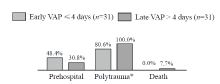
Figure 1.
Comparison of early versus late VAP (P<0.05).
Table 6
Predictors of VAP in trauma patients
| Variables | Odd ratio | 95% Confidence Interval | P value |
|---|---|---|---|
| Age | 0.99 | 0.95-1.03 | 0.77 |
| SBP trauma room | 1.02 | 1.00-1.04 | 0.01 |
| GCS trauma room | 0.78 | 0.76-0.90 | 0.001 |
| Injury severity score | 1.03 | 0.97-1.09 | 0.27 |
| Ventilatory days | 1.22 | 1.12-1.34 | 0.001 |
| Chest AIS | 1.11 | 0.47-2.61 | 0.79 |
| Prehospital intubation | 0.17 | 0.05-0.56 | 0.003 |
Table 7
Regression analysis models for prehospital intubation (PHI) to predict the risk of VAP
| Model | Variables | Odd ratio | 95% Confidence Interval | Pvalue |
|---|---|---|---|---|
| Crude | PHI | 1.16 | 0.65-2.08 | 0.60 |
| 1 | PHI, age | 1.19 | 0.66-2.16 | 0.55 |
| 2 | PHI, age, SBP | 1.17 | 0.64-2.15 | 0.59 |
| 3 | PHI, age, SBP, ISS | 1.05 | 0.56-1.95 | 0.87 |
| 4 | PHI, age, SBP, ISS, GCS | 0.61 | 0.28-1.28 | 0.19 |
| 5 | PHI, age, SBP, ISS, GCS, ventilatory days | 0.42 | 0.18-1.02 | 0.05 |
| 6 | PHI, age, SBP, ISS, GCS, ventilatory days, chest AIS | 0.17 | 0.05-0.56 | 0.003 |
| [1] |
Kalanuria AA, Ziai W, Mirski M. Ventilator-associated pneumonia in the ICU. Crit Care. 2014; 18:208.
doi: 10.1186/cc13775 pmid: 25029020 |
| [2] |
Tablan OC, Anderson LJ, Besser R, Bridges C, Hajjeh R, Tablan OC, et al. Guidelines for preventing health-care--associated pneumonia, 2003: recommendations of CDC and the Healthcare Infection Control Practices Advisory Committee. MMWR Recomm Rep. 2004; 53(RR-3):1-36.
pmid: 15048056 |
| [3] |
Dudeck MA, Weiner LM, Allen-Bridson K, Malpiedi PJ, Peterson KD, Pollock DA, et al. National Healthcare Safety Network (NHSN) report, data summary for 2012, Device-associated module. Am J Infect Control. 2013; 41(12):1148-66.
doi: 10.1016/j.ajic.2013.09.002 pmid: 24274911 |
| [4] |
Mangram AJ, Sohn J, Zhou N, Hollingworth AK, Ali-Osman FR, Sucher JF, et al. Trauma-associated pneumonia: time to redefine ventilator-associated pneumonia in trauma patients. Am J Surg. 2015; 210:1056-61; discussion 1061-2.
doi: 10.1016/j.amjsurg.2015.06.029 pmid: 26477792 |
| [5] | Magnotti LJ, Croce MA, Fabian TC. Is ventilator-associated pneumonia in trauma patients an epiphenomenon or a cause of death? Sur Infect (Larchmt). 2004; 5:237-42. |
| [6] |
Rello J, Ollendorf DA, Oster G, Vera-Llonch M, Bellm L, Redman R, et al. Epidemiology and outcomes of ventilator-associated pneumonia in a large US database. Chest. 2002; 122(6):2115-21.
doi: 10.1378/chest.122.6.2115 pmid: 12475855 |
| [7] |
Wallace WC, Cinat M, Gornick WB, Lekawa ME, Wilson SE. Nosocomial infections in the surgical intensive care unit: a difference between trauma and surgical patients. Am Surg. 1999; 65:987-90.
pmid: 10515549 |
| [8] |
Cook DJ, Walter SD, Cook RJ, Griffith LE, Guyatt GH, Leasa D, et al. Incidence of and risk factors for ventilator-associated pneumonia in critically ill patients. Ann Intern Med. 1998; 129(6):433-40.
doi: 10.7326/0003-4819-129-6-199809150-00002 pmid: 9735080 |
| [9] |
Eckert MJ, Davis RL 2nd, Reed KA, Santaniello JM, Poulakidas S, Esposito TJ, et al. Urgent airways after trauma: who gets pneumonia? J Trauma. 2004; 57(4):750-5.
doi: 10.1097/01.ta.0000147499.73570.12 pmid: 15514528 |
| [10] |
Eckert MJ, Davis KA, Reed RL 2nd, Esposito TJ, Santaniello JM, Poulakidas S, et al. Ventilator-associated pneumonia, like real estate: location really matters. J Trauma. 2006; 60(1):104-10; discussion 110.
doi: 10.1097/01.ta.0000197376.98296.7c pmid: 16456443 |
| [11] |
Jovanovic B, Milan Z, Markovic-Denic L, Djuric O, Radinovic K, Doklestic K, et al. Risk factors for ventilator-associated pneumonia in patients with severe traumatic brain injury in a Serbian trauma centre. Int J Infect Dis. 2015; 38:46-51.
doi: 10.1016/j.ijid.2015.07.005 pmid: 26166697 |
| [12] |
Zarzaur BL, Bell TM, Croce MA, Fabian TC. Geographic variation in susceptibility to ventilator-associated pneumonia after traumatic injury. J Trauma Acute Care Surg. 2013; 75(2):234-40.
doi: 10.1097/TA.0b013e3182924c18 pmid: 23823609 |
| [13] |
Croce MA, Fabian TC, Tolley EA. A formula for prediction of post-traumatic pneumonia based on early anatomic and physiologic parameters. J Trauma. 2003; 54:724-30.
doi: 10.1097/01.TA.0000054643.54218.C5 pmid: 12707535 |
| [14] | Karch SB, Lewis T, Young S, Hales D, Ho CH. Field intubation of trauma patients: complications, indications and outcomes. Am J Emerg Med. 1996; 4(7):617-9. |
| [15] |
Evans HL, Zonies DH, Warner KJ, Bulger EM, Sharar SR, Maier RV, et al. Timing of intubation and ventilator-associated pneumonia following injury. Arch Surg. 2010; 145(11):1041-6.
doi: 10.1001/archsurg.2010.239 pmid: 21079091 |
| [16] |
Mohr NM, Harland KK, Skeete D, Pearson K, Choi K. Duration of prehospital intubation is not a risk factor for development of early ventilator-associated pneumonia. J Crit Care. 2014; 29(4):539-44.
doi: 10.1016/j.jcrc.2014.03.030 pmid: 24793661 |
| [17] |
American Thoracic Society, Infectious Diseases Society of America. Guidelines for the management of adults with hospital-acquired, ventilator-associated, and healthcare-associated pneumonia. Am J Respir Crit Care Med. 2005; 171(4):388-416.
pmid: 15699079 |
| [18] |
Chastre J, Fagon JY. Ventilator-associated pneumonia. Am J Respir Crit Care Med. 2002; 165(7):867-903.
doi: 10.1164/ajrccm.165.7.2105078 pmid: 11934711 |
| [19] |
Cook DJ, Kollef MH. Risk factors for ICU acquired pneumonia. JAMA. 1998; 279(20):1605-6.
doi: 10.1001/jama.279.20.1605 pmid: 9613899 |
| [20] | Evans HL, Warner K, Bulger EM, Sharar SR, Maier RV, Cuschieri J. Pre-hospital intubation factors and pneumonia in trauma patients. Surg Infect (Larchmt). 2011; 12(5):339-44. |
| [21] |
Gianakis A, McNett M, Belle J, Moran C, Grimm D. Risk factors for ventilator-associated pneumonia: among trauma patients with and without brain injury. J Trauma Nurs. 2015; 22(3):125-31.
doi: 10.1097/JTN.0000000000000121 pmid: 25961478 |
| [22] |
Chen LP, Chen JH, Chen Y, Wu C, Yang XH. Efficacy and safety of glucocorticoids in the treatment of community-acquired pneumonia: A meta-analysis of randomized controlled trials. World J Emerg Med. 2015; 6(3):172-8.
doi: 10.5847/wjem.j.1920-8642.2015.03.002 pmid: 26401176 |
| [23] |
Michelet P, Couret D, Brégeon F, Perrin G, D'Journo XB, Pequignot V, et al. Early onset pneumonia in severe chest trauma: a risk factor analysis. J Trauma. 2010; 68(2):395-400.
doi: 10.1097/TA.0b013e3181a601cb pmid: 20154552 |
| [24] | Centers for Disease Control and Prevention. Ventillator-associated Pneumonia (VAP) Events 2017. Available at: https://www.cdc.gov/nhsn/pdfs/pscmanual/10-vae_final.pdf Accessed March 4, 2017. |
| [25] |
Antonelli M, Moro ML, Capelli O, De Blasi RA, D'Errico RR, Conti G, et al. Risk factors for early onset pneumonia in trauma patients. Chest. 1994; 105(1):224-8.
doi: 10.1378/chest.105.1.224 pmid: 8275735 |
| [26] |
Magret M, Amaya-Villar R, Garnacho J, Lisboa T, Díaz E, Dewaele J, et al. Ventilator-associated pneumonia in trauma patients is associated with lower mortality: results from EU-VAP study. J Trauma. 2010; 69(4):849-54.
pmid: 20938271 |
| [27] |
Melsen WG, Rovers MM, Bonten MJ. Ventilator-associated pneumonia and mortality: a systematic review of observational studies. Crit Care Med. 2009; 37(10):2709-18.
doi: 10.1097/ccm.0b013e3181ab8655 pmid: 19885994 |
| [1] | Gui-long Feng, Miao-miao Zheng, Shi-hong Yao, Yin-qi Li, Shao-jun Zhang, Wei-jing Wen, Kai Fan, Jia-li Zhang, Xiao Zhang. Risk factors and predictive model of adrenocortical insufficiency in patients with traumatic brain injury [J]. World Journal of Emergency Medicine, 2021, 12(3): 179-184. |
| [2] | Zi-wei Ke, Yue Jiang, Ya-ping Bao, Ye-qin Yang, Xiao-mei Zong, Min Liu, Xiang-yun Guan, Zhong-qiu Lu. Intensivists’ response to hyperoxemia in mechanical ventilation patients: The status quo and related factors [J]. World Journal of Emergency Medicine, 2021, 12(3): 202-206. |
| [3] | Yong Liang, Hong Zeng, Yu-geng Liu, Ai-min Xu, Wen-hong Liu. Prevalence of post-traumatic stress disorder after earthquakes among the elderly in China: A meta-analysis [J]. World Journal of Emergency Medicine, 2021, 12(2): 137-142. |
| [4] | Hai-jiang Zhou, Tian-fei Lan, Shu-bin Guo. Outcome prediction value of National Early Warning Score in septic patients with community-acquired pneumonia in emergency department: A single-center retrospective cohort study [J]. World Journal of Emergency Medicine, 2020, 11(4): 206-215. |
| [5] | Samantha Shwe, Lauren Witchey, Shadi Lahham, Ethan Kunstadt, Inna Shniter, John C. Fox. Retrospective analysis of eFAST ultrasounds performed on trauma activations at an academic level-1 trauma center [J]. World Journal of Emergency Medicine, 2020, 11(1): 12-17. |
| [6] | Linda C. Chokotho, Wakisa Mulwafu, Mulinda Nyirenda, Foster J. Mbomuwa, Hemant G. Pandit, Grace Le, Christopher Lavy. Establishment of trauma registry at Queen Elizabeth Central Hospital (QECH), Blantyre, Malawi and mapping of high risk geographic areas for trauma [J]. World Journal of Emergency Medicine, 2019, 10(1): 33-41. |
| [7] | Hojat Sheikh Motahar Vahedi, Hadi Hajebi, Elnaz Vahidi, Amir Nejati, Morteza Saeedi. Comparison between intravenous morphine versus fentanyl in acute pain relief in drug abusers with acute limb traumatic injury [J]. World Journal of Emergency Medicine, 2019, 10(1): 27-32. |
| [8] | Bianca M. Wahlen, Ayman El-Menyar, Mohammad Asim, Hassan Al-Thani. Rapid sequence induction (RSI) in trauma patients: Insights from healthcare providers [J]. World Journal of Emergency Medicine, 2019, 10(1): 19-26. |
| [9] | Brian G. Cornelius, Elizabeth Webb, Angela Cornelius, Kenneth W.G. Smith, Srdan Ristic, Jay Jain, Urska Cvek, Marjan Trutschl. Effect of sedative agent selection on morbidity, mortality and length of stay in patients with increase in intracranial pressure [J]. World Journal of Emergency Medicine, 2018, 9(4): 256-261. |
| [10] | Ahmed El Muntasar, Ethan Toner, Oddai A. Alkhazaaleh, Danaradja Arumugam, Nikhil Shah, Shahab Hajibandeh, Shahin Hajibandeh. Effect of angioembolisation versus surgical packing on mortality in traumatic pelvic haemorrhage: A systematic review and meta-analysis [J]. World Journal of Emergency Medicine, 2018, 9(2): 85-92. |
| [11] | Yong-xia Gao, Yan-bo Song, Ze-juan Gu, Jin-song Zhang, Xu-feng Chen, Hao Sun, Zhen Lu. Video versus direct laryngoscopy on successful first-pass endotracheal intubation in ICU patients [J]. World Journal of Emergency Medicine, 2018, 9(2): 99-104. |
| [12] | Saeed Mahmood, Omaima Mahmood, Ayman El-Menyar, Mohammad Asim, Hassan Al-Thani. Predisposing factors, clinical assessment, management and outcomes of agitation in the trauma intensive care unit [J]. World Journal of Emergency Medicine, 2018, 9(2): 105-112. |
| [13] | Hui Xie, Zhi-gang Zhou, Wei Jin, Cheng-bin Yuan, Jiang Du, Jian Lu, Rui-lan Wang. Ventilator management for acute respiratory distress syndrome associated with avian influenza A (H7N9) virus infection: A case series [J]. World Journal of Emergency Medicine, 2018, 9(2): 118-124. |
| [14] | Kasim Turgut, Mehmet Ediz Sarihan, Cemil Colak, Taner Güven, Ali Gür, Sükrü Gürbüz. Falls from height: A retrospective analysis [J]. World Journal of Emergency Medicine, 2018, 9(1): 46-50. |
| [15] | Shahin Shadnia, Nasim Zaman, Hossein Hassanian-Moghaddam, Hamed Shafaroodi, Mina Padandar, Mohammad Hasan Rezaeizadeh. Prognostic value of cortisol and thyroid function tests in poisoned patients admitted to toxicology ICU [J]. World Journal of Emergency Medicine, 2018, 9(1): 51-55. |
| Viewed | ||||||
|
Full text |
|
|||||
|
Abstract |
|
|||||

