World Journal of Emergency Medicine ›› 2022, Vol. 13 ›› Issue (4): 259-265.doi: 10.5847/wjem.j.1920-8642.2022.060
• Original Articles • Next Articles
Chun Zhao1, Mei-yun Xin2, Jing Li3, Jin-fang Zhao1, Yu-juan Wang1, Wei Wang1, Qian Gao4, Jie Chen4, Qi-wei Wang1, You-peng Jin1,4( )
)
Received:2021-11-19
Accepted:2022-02-27
Online:2022-06-23
Published:2022-07-01
Contact:
You-peng Jin
E-mail:jinyp79@sina.cn
Chun Zhao, Mei-yun Xin, Jing Li, Jin-fang Zhao, Yu-juan Wang, Wei Wang, Qian Gao, Jie Chen, Qi-wei Wang, You-peng Jin. Comparing the precision of the pSOFA and SIRS scores in predicting sepsis-related deaths among hospitalized children: a multi-center retrospective cohort study[J]. World Journal of Emergency Medicine, 2022, 13(4): 259-265.
Add to citation manager EndNote|Ris|BibTeX
URL: http://wjem.com.cn/EN/10.5847/wjem.j.1920-8642.2022.060

Figure 1.
Flowchart of selection of patients with infection.
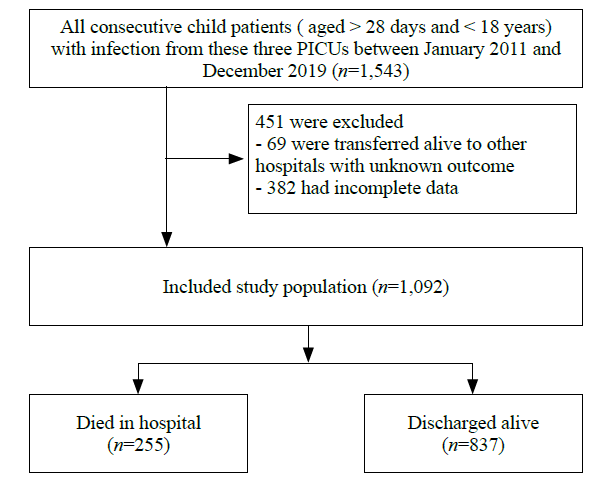
Table 1.
Demographic and clinical characteristics of survivors and non-survivors with infectious disease
| Characteristics | All (n=1,092) | Survivors (n=837) | Non-survivors (n=255) | P-value |
|---|---|---|---|---|
| Age, months | 7.0 (2.9-19.2) | 7.0 (2.9-19.0) | 6.0 (2.8-24.0) | 0.100 |
| Male | 669 (61.3) | 156 (61.2) | 513 (61.3) | 1.000 |
| Type of admission | 0.450 | |||
| Medical condition | 953 (87.2) | 734 (87.7) | 219 (85.9) | |
| Surgical condition | 139 (12.8) | 103 (12.3) | 36 (14.1) | - |
| Admission type | ||||
| Respiratory failure | 403 (36.9) | 339 (40.5) | 64 (25.1) | <0.001 |
| Neurologic compromise | 175 (16.0) | 147 (17.6) | 28 (11.0) | 0.010 |
| Cardiovascular compromise | 168 (15.4) | 92 (11.0) | 76 (29.8) | <0.001 |
| Hematologic derangement | 113 (10.3) | 86 (10.3) | 27 (10.6) | 0.890 |
| Metabolic derangement | 88 (8.1) | 78 (9.3) | 10 (3.9) | 0.010 |
| Trauma | 107 (9.8) | 75 (9.0) | 32 (12.5) | 0.090 |
| Other | 38 (3.5) | 20 (2.4) | 18 (7.1) | <0.001 |
| Infection source | ||||
| Bloodstream | 147 (13.5) | 102 (12.2) | 45 (17.6) | 0.030 |
| Respiratory tract | 625 (57.2) | 502 (60.0) | 123 (48.2) | 0.001 |
| Cerebral | 132 (12.1) | 108 (12.9) | 24 (9.4) | 0.130 |
| Genitourinary tract | 9 (0.8) | 9 (1.1) | 0 (0) | 0.100 |
| Digestive tract | 117 (10.7) | 75 (9.0) | 42 (16.5) | 0.001 |
| Other | 62 (5.7) | 41 (4.9) | 21 (8.2) | 0.044 |
| SIRS criteria score (n=1,092) | 2 (1-3) | 2 (1-3) | 2 (1-3) | 0.018 |
| 24 h-pSOFA (n=898) | 4.0 (2.0-6.0) | 3.0 (2.0-5.0) | 6.0 (4.0-9.0) | <0.001 |
| Treatments | ||||
| Mechanical ventilation | 825 (75.5) | 585 (69.9) | 240 (94.1) | <0.001 |
| Continuous blood purification | 144 (13.2) | 93 (11.1) | 51 (20.0) | <0.001 |
| Outcomes | ||||
| Ventilator days, d | 2.7 (0-7.7) | 4 (0-9) | 6 (1-12) | <0.001 |
| PICU LOS, d | 8 (4-15) | 14 (8-24) | 10 (3-16) | <0.001 |

Figure 2.
In-hospital mortality rate based on the SIRS criteria and the maximal pSOFA score.
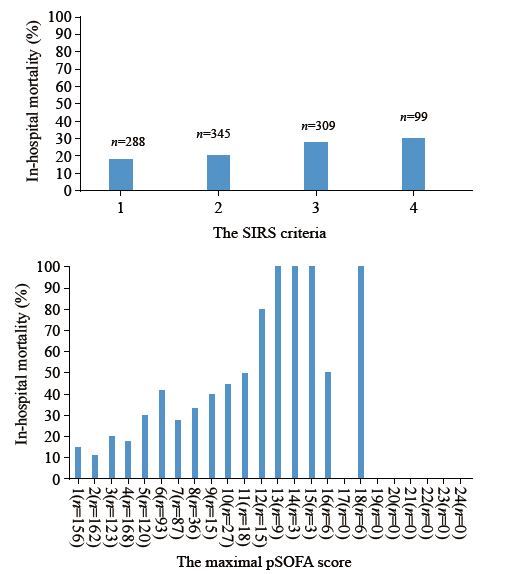
Table 2.
Multivariable logistic regression to analyze the risk factors of in-hospital mortality
| Variables | B | S.E. | Wald | P-value | OR (95% CI) |
|---|---|---|---|---|---|
| Infection source | -0.301 | 0.055 | 55.701 | <0.001 | |
| Respiratory tract | -0.561 | 0.785 | 0.510 | 0.475 | 0.571 (0.123-2.660) |
| Bloodstream | -2.853 | 0.979 | 8.500 | 0.004 | 0.058 (0.008-0.393) |
| Hepatobiliary system | -0.970 | 1.012 | 0.918 | 0.338 | 0.379 (0.052-2.757) |
| SIRS | -0.149 | 0.099 | 2.284 | 0.131 | 0.861 (0.709-1.045) |
| 24 h-pSOFA | 0.241 | 0.030 | 64.029 | <0.001 | 1.273 (1.200-1.350) |
| MV | 1.732 | 0.331 | 27.329 | <0.001 | 5.653 (2.953-10.822) |
| CBP | -0.176 | 0.245 | 0.581 | 0.472 | 0.839 (0.519-1.354) |
Table 3.
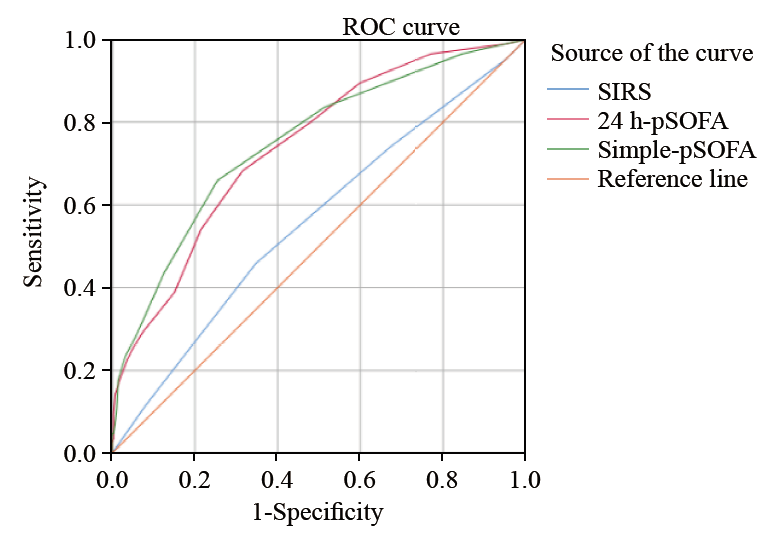
The predictive value of SIRS, pSOFA and simple-pSOFA for in-hospital mortality of infected children
| Predictor | AUC | 95% CI | S.E. | P-value | |
|---|---|---|---|---|---|
| SIRS | 0.559 | 0.519-0.600 | 0.021 | 0.004 | |
| 24 h-pSOFA | 0.740 | 0.706-0.774 | 0.017 | <0.001 | |
| Simple-pSOFA | 0.751 | 0.716-0.786 | 0.019 | <0.001 | |
| Predictor | Definition | In-hospital mortality | |||
| Sensitivity (%) | Specificity (%) | Negative predictive value (%) | Positive predictive value (%) | ||
| SIRS | ≥ 2 criteria (pediatric) | 74.1 | 32.6 | 80.5 | 25.1 |
| ≥ 3 criteria (pediatric) | 45.9 | 65.2 | 76.3 | 22.8 | |
| 24 h-pSOFA | ≥ 2 | 97.6 | 21.1 | 95.5 | 27.6 |
| ≥ 4 | 79.2 | 52.7 | 89.1 | 33.4 | |
| ≥ 5 | 68.2 | 69.2 | 87.4 | 39.5 | |
| Simple-pSOFA | ≥ 2 | 83.5 | 48.7 | 90.7 | 33.2 |
| ≥ 3 | 65.9 | 74.6 | 87.8 | 44.1 | |
Table 4.
Simple-pediatric sequential organ failure assessment score
| Variables | Scorea | |||||
|---|---|---|---|---|---|---|
| 0 | 1 | 2 | 3 | 4 | ||
| Coagulationb | ||||||
| Platelet count,×109 /L | ≥150 | 100-149 | 50-99 | 20-49 | <20 | |
| Cardiovascular | ||||||
| MAP (mmHg) by age group | Vasoactive infusion (μg/[kg·min])c | |||||
| <1 month | ≥46 | <46 | Dopamine hydrochloride ≤5 or dobutamine hydrochloride (any) | Dopamine hydrochloride >5 or epinephrine ≤0.1 or norepinephrine bitartrate ≤0.1 | Dopamine hydrochloride >15 or epinephrine >0.1 or norepinephrine bitartrate >0.1 | |
| 1-11 months | ≥55 | <55 | ||||
| 12-23 months | ≥60 | <60 | ||||
| 24-59 months | ≥62 | <62 | ||||
| 60-143 months | ≥65 | <65 | ||||
| 144-216 months | ≥67 | <67 | ||||
| >216 months | ≥70 | <70 | ||||
| Neurologic | ||||||
| Glasgow Coma Scored | 15 | 13-14 | 10-12 | 6-9 | <6 | |
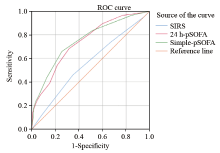
Figure 3.
AUROC curve of SIRS, 24 h-pSOFA and simple-pSOFA for in-hospital mortality in patients with suspected infection.
| 1 |
Hartman ME, Linde-Zwirble WT, Angus DC, Watson RS. Trends in the epidemiology of pediatric severe sepsis. Pediatr Crit Care Med. 2013; 14(7): 686-93.
doi: 10.1097/PCC.0b013e3182917fad |
| 2 | Balamuth F, Weiss SL, Neuman MI, Scott H, Brady PW, Paul R, et al. Pediatric severe sepsis in US children’s hospitals. Pediatr Crit Care Med. 2014; 15(9): 798-805. |
| 3 |
Liu L, Johnson HL, Cousens S, Perin J, Scott S, Lawn JE, et al. Global, regional, and national causes of child mortality: an updated systematic analysis for 2010 with time trends since 2000. Lancet. 2012; 379(9832): 2151-61.
doi: 10.1016/S0140-6736(12)60560-1 pmid: 22579125 |
| 4 |
Schlapbach LJ, Straney L, Alexander J, MacLaren G, Festa M, Schibler A, et al. Mortality related to invasive infections, Sepsis, and septic shock in critically ill children in Australia and New Zealand, 2002-13: a multicentre retrospective cohort study. Lancet Infect Dis. 2015; 15(1): 46-54.
doi: 10.1016/S1473-3099(14)71003-5 pmid: 25471555 |
| 5 |
Weiss SL, Balamuth F, Hensley J, Fitzgerald JC, Bush J, Nadkarni VM, et al. The epidemiology of hospital death following pediatric severe sepsis: when, why, and how children with sepsis die. Pediatr Crit Care Med. 2017; 18(9): 823-30.
doi: 10.1097/PCC.0000000000001222 |
| 6 |
Kissoon N, Carcillo JA, Espinosa V, Argent A, Devictor D, Madden M, et al. World federation of pediatric intensive care and critical care societies: global sepsis initiative. Pediatr Crit Care Med. 2011; 12(5): 494-503.
doi: 10.1097/PCC.0b013e318207096c |
| 7 |
Boeddha NP, Schlapbach LJ, Driessen GJ, Herberg JA, Rivero-Calle I, Cebey-López M, et al. Mortality and morbidity in community-acquired sepsis in European pediatric intensive care units: a prospective cohort study from the European Childhood Life-threatening Infectious Disease Study (EUCLIDS). Crit Care. 2018; 22(1): 143.
doi: 10.1186/s13054-018-2052-7 |
| 8 |
Weiss SL, Fitzgerald JC, Pappachan J, Wheeler D, Jaramillo-Bustamante JC, Salloo A, et al. Global epidemiology of pediatric severe sepsis: the sepsis prevalence, outcomes, and therapies study. Am J Respir Crit Care Med. 2015; 191(10): 1147-57.
doi: 10.1164/rccm.201412-2323OC |
| 9 | Goldstein B, Giroir B, Randolph A, International Consensus Conference on Pediatric Sepsis. International pediatric sepsis consensus conference:definitions for sepsis and organ dysfunction in pediatrics. Pediatr Crit Care Med.ed. 2005; 6(1): 2-8. |
| 10 |
Dellinger RP, Levy MM, Rhodes A, Annane D, Gerlach H, Opal SM, et al. Surviving sepsis campaign: international guidelines for management of severe sepsis and septic shock: 2012. Intensive Care Med. 2013; 39(2):165-228.
doi: 10.1007/s00134-012-2769-8 pmid: 23361625 |
| 11 |
Kaukonen KM, Bailey M, Pilcher D, Cooper DJ, Bellomo R. Systemic inflammatory response syndrome criteria in defining severe sepsis. N Engl J Med. 2015; 372(17): 1629-38.
doi: 10.1056/NEJMoa1415236 |
| 12 | Raith EP, Udy AA, Bailey M, McGloughlin S, MacIsaac C, Bellomo R, et al. Prognostic accuracy of the SOFA score, SIRS criteria,and qSOFA score for in-hospital mortality among adults with suspected infection admitted to the intensive care unit. JAMA. 2017; 317(3): 290-300. |
| 13 |
Singer M, Deutschman CS, Seymour CW, Shankar-Hari M, Annane D, Bauer M, et al. The third international consensus definitions for sepsis and septic shock (Sepsis-3). JAMA. 2016; 315(8): 801-10.
doi: 10.1001/jama.2016.0287 |
| 14 |
Matics TJ, Sanchez-Pinto LN. Adaptation and validation of a pediatric sequential organ failure assessment score and evaluation of the Sepsis-3 definitions in critically ill children. JAMA Pediatr. 2017; 171(10): e172352.
doi: 10.1001/jamapediatrics.2017.2352 |
| 15 |
Schlapbach LJ, Straney L, Bellomo R, MacLaren G, Pilcher D. Prognostic accuracy of age-adapted SOFA, SIRS, PELOD-2, and qSOFA for in-hospital mortality among children with suspected infection admitted to the intensive care unit. Intensive Care Med. 2018; 44(2): 179-88.
doi: 10.1007/s00134-017-5021-8 pmid: 29256116 |
| 16 | Shime N, Kawasaki T, Nakagawa S. Proposal of a new pediatric sequential organ failure assessment score for possible validation. Pediatr Crit Care Med. 2017; 18(1): 98-9. |
| 17 |
Kawasaki T, Shime N, Straney L, Bellomo R, MacLaren G, Pilcher D, et al. Paediatric sequential organ failure assessment score (pSOFA): a plea for the world-wide collaboration for consensus. Intensive Care Med. 2018; 44(6): 995-7.
doi: 10.1007/s00134-018-5188-7 pmid: 29704146 |
| 18 |
Seymour CW, Liu VX, Iwashyna TJ, Brunkhorst FM, Rea TD, Scherag A, et al. Assessment of clinical criteria for sepsis: for the third international consensus definitions for sepsis and septic shock (Sepsis-3). JAMA. 2016; 315(8): 762-74.
doi: 10.1001/jama.2016.0288 |
| 19 |
Hanley JA, McNeil BJ. The meaning and use of the area under a receiver operating characteristic (ROC) curve. Radiology. 1982; 143(1): 29-36.
doi: 10.1148/radiology.143.1.7063747 pmid: 7063747 |
| 20 |
Vincent JL, Mira JP, Antonelli M. Sepsis: older and newer concepts. Lancet Respir Med. 2016; 4(3): 237-40.
doi: 10.1016/S2213-2600(15)00522-6 |
| 21 |
Vincent JL, Opal SM, Marshall JC, Tracey KJ. Sepsis definitions: time for change. Lancet. 2013; 381(9868): 774-5.
doi: 10.1016/S0140-6736(12)61815-7 |
| 22 |
Scott HF, Deakyne SJ, Woods JM, Bajaj L. The prevalence and diagnostic utility of systemic inflammatory response syndrome vital signs in a pediatric emergency department. Acad Emerg Med. 2015; 22(4): 381-9.
doi: 10.1111/acem.12610 |
| 23 |
Agyeman PKA, Schlapbach LJ, Giannoni E, Stocker M, Posfay-Barbe KM, Heininger U, et al. Epidemiology of blood culture-proven bacterial sepsis in children in Switzerland: a population-based cohort study. Lancet Child Adolesc Health. 2017; 1(2): 124-33.
doi: 10.1016/S2352-4642(17)30010-X |
| 24 |
Vincent JL, Moreno R, Takala J, Willatts S, Bruining H, et al. The SOFA (Sepsis-related Organ Failure Assessment) score to describe organ dysfunction/failure. On behalf of the Working Group on Sepsis-Related Problems of the European Society of Intensive Care Medicine. Intensive Care Med. 1996; 22(7): 707-10.
doi: 10.1007/BF01709751 |
| [1] | Hai Hu, Jing-yuan Jiang, Ni Yao. Comparison of different versions of the quick sequential organ failure assessment for predicting in-hospital mortality of sepsis patients: A retrospective observational study [J]. World Journal of Emergency Medicine, 2022, 13(2): 114-119. |
| [2] | Yu-qing Cui, Xian-fei Ding, Huo-yan Liang, Dong Wang, Xiao-juan Zhang, Li-feng Li, Quan-cheng Kan, Le-xin Wang, Tong-wen Sun. Efficacy and safety of low-dose corticosteroids for acute respiratory distress syndrome: A systematic review and meta-analysis [J]. World Journal of Emergency Medicine, 2021, 12(3): 207-213. |
| [3] | Wen Gao, Yu-ping Zhang, Jing-fen Jin. Poor outcomes of delirium in the intensive care units are amplified by increasing age: A retrospective cohort study [J]. World Journal of Emergency Medicine, 2021, 12(2): 117-123. |
| [4] | Hao-tian Chen, Jian-feng Xu, Xiao-xia Huang, Ni-ya Zhou, Yong-kui Wang, Yue Mao. Blood eosinophils and mortality in patients with acute respiratory distress syndrome: A propensity score matching analysis [J]. World Journal of Emergency Medicine, 2021, 12(2): 131-136. |
| [5] | Wei Guo, Lin-yu Ran, Ji-hong Zhu, Qing-gang Ge, Zhe Du, Fei-long Wang, Wei-bo Gao, Tian-bing Wang. Identifying critically ill patients at risk of death from coronavirus disease [J]. World Journal of Emergency Medicine, 2021, 12(1): 18-23. |
| [6] | Li-wei Duan, Jin-long Qu, Jian Wan, Yong-hua Xu, Yi Shan, Li-xue Wu, Jin-hao Zheng, Wei-wei Jiang, Qi-tong Chen, Yan Zhu, Jian Zhou, Wen-bo Yu, Lei Pei, Xi Song, Wen-fang Li, Zhao-fen Lin. Effects of viral infection and microbial diversity on patients with sepsis: A retrospective study based on metagenomic next-generation sequencing [J]. World Journal of Emergency Medicine, 2021, 12(1): 29-35. |
| [7] | Muhammad Akhter Hamid, Ruqiya Afroz, Uqba Nawaz Ahmed, Aneela Bawani, Dilnasheen Khan, Rabia Shahab, Asim Salim. The importance of visualization of appendix on abdominal ultrasound for the diagnosis of appendicitis in children: A quality assessment review [J]. World Journal of Emergency Medicine, 2020, 11(3): 140-144. |
| [8] | Rui-xue Sun, Priscilla Song, Joseph Walline, He Wang, Ying-chun Xu, Hua-dong Zhu, Xue-zhong Yu, Jun Xu. Morbidity and mortality risk factors in emergency department patients with Acinetobacter baumannii bacteremia [J]. World Journal of Emergency Medicine, 2020, 11(3): 164-168. |
| [9] | Shao-hua Liu, Huo-yan Liang, Hong-yi Li, Xian-fei Ding, Tong-wen Sun, Jing Wang. Effect of low high-density lipoprotein levels on mortality of septic patients: A systematic review and meta-analysis of cohort studies [J]. World Journal of Emergency Medicine, 2020, 11(2): 109-116. |
| [10] | Yi-wen Fan, Shao-wei Jiang, Jia-meng Chen, Hui-qi Wang, Dan Liu, Shu-ming Pan, Cheng-jin Gao. A pulmonary source of infection in patients with sepsis-associated acute kidney injury leads to a worse outcome and poor recovery of kidney function [J]. World Journal of Emergency Medicine, 2020, 11(1): 18-26. |
| [11] | Wei He, Yue-yang You, Kai Sun, Chen Xie, Yue Ming, Li-na Yu, Feng-jiang Zhang, Min Yan. Admission delay is associated with worse surgical outcomes for elderly hip fracture patients: A retrospective observational study [J]. World Journal of Emergency Medicine, 2020, 11(1): 27-32. |
| [12] | Chang Pan, Xiao-ran Huang, Jiao-jiao Pang, Kai Cheng, Feng Xu, Yu-guo Chen. Trends in mortality of emergency departments patients in China [J]. World Journal of Emergency Medicine, 2019, 10(3): 152-155. |
| [13] | Genevieve Mazza, Carina Mireles Romo, Marlene Torres, Ali Duffens, Annasha Vyas, Katherine Moran, Joshua Livingston, Savannah Gonzales, Shadi Lahham, Inna Shniter, Maxwell Thompson, John Christian Fox. Assessment of clinical dehydration using point of care ultrasound for pediatric patients in rural Panama [J]. World Journal of Emergency Medicine, 2019, 10(1): 46-50. |
| [14] | Yuzeng Shen, Yee Chien Tay, Edward Wee Kwan Teo, Nan Liu, Shao Wei Lam, Marcus Eng Hock Ong. Association between the elderly frequent attender to the emergency department and 30-day mortality: A retrospective study over 10 years [J]. World Journal of Emergency Medicine, 2018, 9(1): 20-25. |
| [15] | Kasim Turgut, Mehmet Ediz Sarihan, Cemil Colak, Taner Güven, Ali Gür, Sükrü Gürbüz. Falls from height: A retrospective analysis [J]. World Journal of Emergency Medicine, 2018, 9(1): 46-50. |
| Viewed | ||||||
|
Full text |
|
|||||
|
Abstract |
|
|||||

