World Journal of Emergency Medicine ›› 2017, Vol. 8 ›› Issue (2): 106-109.doi: 10.5847/wjem.j.1920-8642.2017.02.004
• Original Articles • Previous Articles Next Articles
Youichi Yanagawa( ), Kouhei Ishikawa, Kei Jitsuiki, Toshihiko Yoshizawa, Yasumasa Oode, Kazuhiko Omori, Hiromichi Ohsaka
Received:2016-02-20
Accepted:2016-08-03
Online:2017-06-15
Published:2017-06-15
Contact:
Youichi Yanagawa
E-mail:yyanaga@juntendo.ac.jp
Youichi Yanagawa, Kouhei Ishikawa, Kei Jitsuiki, Toshihiko Yoshizawa, Yasumasa Oode, Kazuhiko Omori, Hiromichi Ohsaka. Fibrinogen degradation product levels on arrival for trauma patients requiring a transfusion even without head injury[J]. World Journal of Emergency Medicine, 2017, 8(2): 106-109.
Add to citation manager EndNote|Ris|BibTeX
URL: http://wjem.com.cn//EN/10.5847/wjem.j.1920-8642.2017.02.004
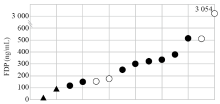
Figure 1.
A scattergram of the FDP values among the mortality cases. Among the blunt trauma mortality cases (head injury, white circle; without head injury, back circle), the minimum FDP value was 104 ng/mL (with the exception of the penetrating wound cases [triangle]).
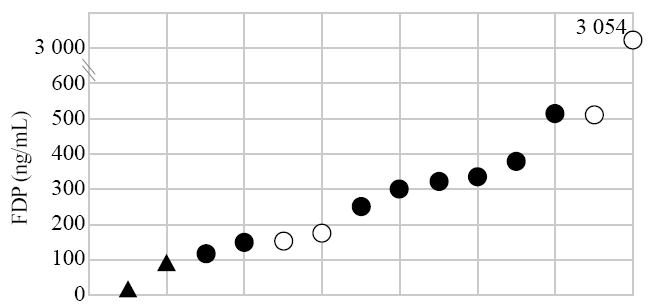
Table 1
The demographic and clinical characteristics according to the FDP level in all patients including those with head injuries
| Variables | FDP>100 (n=57) | FDP≤100 (n=44) | P value |
|---|---|---|---|
| Age (years) | 66.8±2.7 | 58.3±3.0 | <0.05 |
| Sex (M/F) | 30/27 | 31/13 | 0.10 |
| Systolic blood pressure (mmHg) | 103.5±5.5 | 118.2±6.9 | n.s. |
| Heart rate (beats/minute) | 83.4±3.5 | 85.3±3.9 | n.s. |
| Glasgow Coma Scale | 11.7±0.5 | 11.6±0.6 | n.s. |
| Type of injury, n (%) | <0.01 | ||
| Blunt | 57 (100) | 38 (86.4) | |
| Penetrating | 0 | 6 (13.6) | |
| Mechanism of injury, n (%) | |||
| Traffic accident | 44 (77.2) | 25 (56.9) | |
| Fall | 13 (22.8) | 9 (20.4) | |
| Others | 0 | 10 (22.7) | |
| Injury Severity Score | 19.7±1.4 | 13.3±1.7 | <0.01 |
| Open fracture, n (%) | 6 (10.5) | 12 (27.2) | <0.05 |
| Ratio of cerebral lesions, n (%) | 10 (17.5) | 3 (6.8) | n.s. |
| Hemoglobin (g/dL) | 10.9±0.2 | 11.1±0.3 | n.s. |
| Creatinine phosphokinesis (IU/L) | 561.5±65.0 | 645.2±208.9 | n.s. |
| Prothrombin time (%) | 78.2±3.4 | 89.0±3.7 | <0.05 |
| FDP (μg/mL) | 330.3±52.7 | 37.2±4.2 | <0.0001 |
| Transfusion (U) | 13.0±1.4 | 8.1±1.3 | <0.05 |
| Mortality rate, n (%) | 12 (21.0) | 2 (4.5) | <0.05 |
Table 2
The demographic and clinical characteristics according to the FDP level in patients without head injuries
| Variables | FDP>100 (n=47) | FDP≤100 (n=41) | P value |
|---|---|---|---|
| Age (years) | 68.0±2.5 | 58.5±3.0 | 0.01 |
| Sex (M/F) | 26/21 | 30/11 | 0.08 |
| Systolic blood pressure (mmHg) | 105.7±5.7 | 119.3±7.2 | n.s. |
| Heart rate (beats/minute) | 86.7±3.5 | 84.9±4.0 | n.s. |
| Glasgow Coma Scale | 12.2±0.6 | 11.8±0.6 | n.s. |
| Type of injury, n (%) | <0.01 | ||
| Blunt | 47 (100) | 35 (85.4) | |
| Penetrating | 0 | 6 (14.6) | |
| Mechanism of injury, n (%) | |||
| Traffic accident | 38 (80.9) | 22 (53.8) | |
| Fall | 9 (19.1) | 9 (21.9) | |
| Others | 0 | 10 (24.3) | |
| Injury Severity Score | 19.3±1.7 | 13.0±1.8 | 0.01 |
| Open fracture, n (%) | 5 (10.6) | 12 (29.2) | <0.05 |
| Hemoglobin (g/dL) | 11.4±0.3 | 11.3±0.3 | n.s. |
| Creatinine phosphokinesis (IU/L) | 579.3±69.9 | 675.0±224.1 | n.s. |
| Prothrombin time (%) | 78.2±3.6 | 91.0±3.1 | 0.01 |
| FDP (μg/mL) | 347.7±63.5 | 34.9±4.3 | <0.0001 |
| Transfusion (U) | 13.6±1.7 | 7.5±1.1 | <0.01 |
| Mortality rate, n (%) | 10 (21.2) | 2 (4.8) | <0.05 |
| 1 |
Suehiro E, Koizumi H, Fujiyama Y, Yoneda H, Suzuki M. Predictors of deterioration indicating a requirement for surgery in mild to moderate traumatic brain injury. Clin Neurol Neurosurg. 2014; 127:97-100.
doi: 10.1016/j.clineuro.2014.10.007 pmid: 25459251 |
| 2 |
Selladurai BM, Vickneswaran M, Duraisamy S, Atan M. Coagulopathy in acute head injury—a study of its role as a prognostic indicator. Br J Neurosurg. 1997; 11(5):398-404.
doi: 10.1080/02688699745880 pmid: 9474270 |
| 3 |
Saggar V, Mittal RS, Vyas MC. Hemostatic abnormalities in patients with closed head injuries and their role in predicting early mortality. J Neurotrauma. 2009; 26(10):1665-8.
doi: 10.1089/neu.2008.0799 pmid: 19697972 |
| 4 | Zhang LD, Liu HB, Li YN, Ma HM, Liu YB, Wang MY. Correlation analysis between plasma D-dimer levels and orthopedic trauma severity. Chin Med J (Engl). 2012; 125(17):3133-6. |
| 5 |
Suehiro E, Koizumi H, Fujiyama Y, Yoneda H, Suzuki M. Predictors of deterioration indicating a requirement for surgery in mild to moderate traumatic brain injury. Clin Neurol Neurosurg. 2014; 127:97-100.
doi: 10.1016/j.clineuro.2014.10.007 pmid: 25459251 |
| 6 |
Hagiwara S, Oshima K, Aoki M, Murata M, Ishihara K, Kaneko M, et al. Usefulness of fibrin degradation products and d-dimer levels as biomarkers that reflect the severity of trauma. J Trauma Acute Care Surg. 2013; 74(5):1275-8.
doi: 10.1097/TA.0b013e31828cc967 pmid: 23609278 |
| 7 |
Raza I, Davenport R, Rourke C, Platton S, Manson J, Spoors C, et al. The incidence and magnitude of fibrinolytic activation in trauma patients. J Thromb Haemost. 2013; 11(2):307-14.
doi: 10.1111/jth.12078 |
| 8 |
Turtay MG, Kirimliolu V, Ceylan C. Coagulopathy in multiple traumas. Ulus Travma Acil Cerrahi Derg. 2010; 16(3):198-202.
pmid: 20517742 |
| 9 |
Carlin AM, Tyburski JG, Wilson RF, Steffes C. Factors affecting the outcome of patients with splenic trauma. Am Surg. 2002; 68(3):232-9.
pmid: 11893100 |
| 10 |
Tornetta P 3rd, Mostafavi H, Riina J, Turen C, Reimer B, Levine R, et al. Morbidity and mortality in elderly trauma patients. J Trauma. 1999; 46(4):702-6.
pmid: 10217237 |
| 11 |
Mostafa G, Gunter OL, Norton HJ, McElhiney BM, Bailey DF, Jacobs DG. Age, blood transfusion, and survival after trauma. Am Surg. 2004; 70(4):357-63.
pmid: 15098792 |
| 12 |
Malone DL, Dunne J, Tracy JK, Putnam AT, Scalea TM, Napolitano LM. Blood transfusion, independent of shock severity, is associated with worse outcome in trauma. J Trauma. 2003; 54(5):898-905; discussion 905-7.
doi: 10.1097/01.TA.0000060261.10597.5C pmid: 12777902 |
| 13 |
Robinson WP 3rd, Ahn J, Stiffler A, Rutherford EJ, Hurd H, Zarzaur BL, et al. Blood transfusion is an independent predictor of increased mortality in nonoperatively managed blunt hepatic and splenic injuries. J Trauma. 2005; 58(3):437-44; discussion 444-5.
doi: 10.1097/01.ta.0000153935.18997.14 pmid: 15761334 |
| 14 | Inoue K, Hifumi T, Kiriu N, Kanemura T, Okada I, Inoue J, et al. Acute coagulopathy after multiple blunt injuries in a case of hemophilia A-consideration for pathophysiology of coagulopathy. Am J Emerg Med. 2017; 35(1):194.e1-194.e3. |
| 15 |
Johansson PI, Sørensen AM, Perner A, Welling KL, Wanscher M, Larsen CF, et al. Disseminated intravascular coagulation or acute coagulopathy of trauma shock early after trauma? An observational study. Crit Care. 2011; 15(6):R272.
pmid: 22087841 |
| 16 | Hayakawa M, Gando S, Ieko M, Honma Y, Homma T, Yanagida Y, et al. Massive amounts of tissue factor induce fibrinogenolysis without tissue hypoperfusion in rats. Shock. 2013; 39(6):514-9. |
| 17 |
Cade J, Regoeczi E, Hirsh J, Buchanan M. The effect of experimental hematoma on serum levels of fibrinogen-related antigen. Blood. 1976; 47(5):855-9.
pmid: 1260138 |
| 18 |
Omori K, Ishikawa K, Obinata M, Mishima K, Fukusato S, Ohsaka H, et al. Significance of the vacuum phenomenon in patients with trauma evaluated by whole-body computed tomography. Am J Emerg Med. 2015; 33(2):282-5.
pmid: 25530190 |
| 19 |
Obinata M, Omori K, Ishikawa K, Osaka H, Oode Y, Yanagawa Y. Significance of pneumorrhachis detected by single-pass whole-body computed tomography in patients with trauma. J Emerg Trauma Shock. 2015; 8(2):120-1.
doi: 10.4103/0974-2700.155524 pmid: 25949046 |
| 20 |
Soen S, Fujiwara S, Takayanagi R, Sato M, Tsujimoto M, Yamamoto T, et al. Japan Fracture Observational Study (JFOS): patient characteristics and interim data on the use of daily teriparatide in Japanese patients with osteoporosis. Curr Med Res Opin. 2015; 31(9):1771-9.
doi: 10.1185/03007995.2015.1074063 pmid: 26189932 |
| 21 |
Arai H, Ouchi Y, Toba K, Endo T, Shimokado K, Tsubota K, et al. Japan as the front-runner of super-aged societies: Perspectives from medicine and medical care in Japan. Geriatr Gerontol Int. 2015; 15(6):673-87.
doi: 10.1111/ggi.12450 pmid: 25656311 |
| [1] | Yu-qing Cui, Xian-fei Ding, Huo-yan Liang, Dong Wang, Xiao-juan Zhang, Li-feng Li, Quan-cheng Kan, Le-xin Wang, Tong-wen Sun. Efficacy and safety of low-dose corticosteroids for acute respiratory distress syndrome: A systematic review and meta-analysis [J]. World Journal of Emergency Medicine, 2021, 12(3): 207-213. |
| [2] | Wen Gao, Yu-ping Zhang, Jing-fen Jin. Poor outcomes of delirium in the intensive care units are amplified by increasing age: A retrospective cohort study [J]. World Journal of Emergency Medicine, 2021, 12(2): 117-123. |
| [3] | Hao-tian Chen, Jian-feng Xu, Xiao-xia Huang, Ni-ya Zhou, Yong-kui Wang, Yue Mao. Blood eosinophils and mortality in patients with acute respiratory distress syndrome: A propensity score matching analysis [J]. World Journal of Emergency Medicine, 2021, 12(2): 131-136. |
| [4] | Wei Guo, Lin-yu Ran, Ji-hong Zhu, Qing-gang Ge, Zhe Du, Fei-long Wang, Wei-bo Gao, Tian-bing Wang. Identifying critically ill patients at risk of death from coronavirus disease [J]. World Journal of Emergency Medicine, 2021, 12(1): 18-23. |
| [5] | Rui-xue Sun, Priscilla Song, Joseph Walline, He Wang, Ying-chun Xu, Hua-dong Zhu, Xue-zhong Yu, Jun Xu. Morbidity and mortality risk factors in emergency department patients with Acinetobacter baumannii bacteremia [J]. World Journal of Emergency Medicine, 2020, 11(3): 164-168. |
| [6] | Shao-hua Liu, Huo-yan Liang, Hong-yi Li, Xian-fei Ding, Tong-wen Sun, Jing Wang. Effect of low high-density lipoprotein levels on mortality of septic patients: A systematic review and meta-analysis of cohort studies [J]. World Journal of Emergency Medicine, 2020, 11(2): 109-116. |
| [7] | Wei He, Yue-yang You, Kai Sun, Chen Xie, Yue Ming, Li-na Yu, Feng-jiang Zhang, Min Yan. Admission delay is associated with worse surgical outcomes for elderly hip fracture patients: A retrospective observational study [J]. World Journal of Emergency Medicine, 2020, 11(1): 27-32. |
| [8] | Chang Pan, Xiao-ran Huang, Jiao-jiao Pang, Kai Cheng, Feng Xu, Yu-guo Chen. Trends in mortality of emergency departments patients in China [J]. World Journal of Emergency Medicine, 2019, 10(3): 152-155. |
| [9] | Yuzeng Shen, Yee Chien Tay, Edward Wee Kwan Teo, Nan Liu, Shao Wei Lam, Marcus Eng Hock Ong. Association between the elderly frequent attender to the emergency department and 30-day mortality: A retrospective study over 10 years [J]. World Journal of Emergency Medicine, 2018, 9(1): 20-25. |
| [10] | Kasim Turgut, Mehmet Ediz Sarihan, Cemil Colak, Taner Güven, Ali Gür, Sükrü Gürbüz. Falls from height: A retrospective analysis [J]. World Journal of Emergency Medicine, 2018, 9(1): 46-50. |
| [11] | Nik Hisamuddin Rahman, Ruslan Rainis, Syed Hatim Noor, Sharifah Mastura Syed Mohamad. The Buffering analysis to identify common geographical factors within the vicinity of severe injury related to motor vehicle crash in Malaysia [J]. World Journal of Emergency Medicine, 2016, 7(4): 278-284. |
| [12] | Cui-ping Zhu, Xiao-hui Wu, Yu-ting Liang, Wen-cheng Ma, Lu Ren. The mortality of patients in a pediatric emergency department at a tertiary medical center in China: An observational study [J]. World Journal of Emergency Medicine, 2015, 6(3): 212-216. |
| [13] | Ruo Wu, Shi-yun Lin, Hui-min Zhao. Albuterol in the treatment of acute respiratory distress syndrome: A meta-analysis of randomized controlled trials [J]. World Journal of Emergency Medicine, 2015, 6(3): 165-171. |
| [14] | Bret A. Nicks, Kevin M. Campos, William P. Bozeman. Association of low non-invasive near-infrared spectroscopic measurements during initial trauma resuscitation with future development of multiple organ dysfunction [J]. World Journal of Emergency Medicine, 2015, 6(2): 105-110. |
| [15] | Bedia Gülen, Ertan Sonmez, Serpil Yaylaci, Mustafa Serinken, Cenker Eken, Ali Dur, Figen Tunali Turkdogan, Özgür Söğüt. Effect of harmless acute pancreatitis score, red cell distribution width and neutrophil/lymphocyte ratio on the mortality of patients with nontraumatic acute pancreatitis at the emergency department [J]. World Journal of Emergency Medicine, 2015, 6(1): 29-33. |
| Viewed | ||||||
|
Full text |
|
|||||
|
Abstract |
|
|||||

